

This article was automatically translated from the original Turkish version.
Official Name: | GBU-43/B Massive Ordnance Air Blast | ||||||||
|---|---|---|---|---|---|---|---|---|---|
Abbreviation: | MOAB | ||||||||
Other Name: | Mother of All Bombs | ||||||||
Type: | GPS-guided conventional air bomb | ||||||||
Origin: | United States of America | ||||||||
Developer: | United States Air Force Research Laboratory | ||||||||
Manufacturer: | Dynetics | ||||||||
Year of Development: | 2002 | ||||||||
First Test: | March 2003 | ||||||||
First Operational Use: | 13 April 2017 | ||||||||
First Used Location: | Achin, Nangarhar, Afghanistan | ||||||||
Total Weight: | Approximately 9,800 kg | ||||||||
Length: | Approximately 9.17 m | ||||||||
Explosive Filling: | Approximately 8,500 kg | ||||||||
Explosion Type: | Air burst, high pressure wave | ||||||||
Unit Cost: | Approximately 16 million US dollars (estimated as reported in 2017) | ||||||||
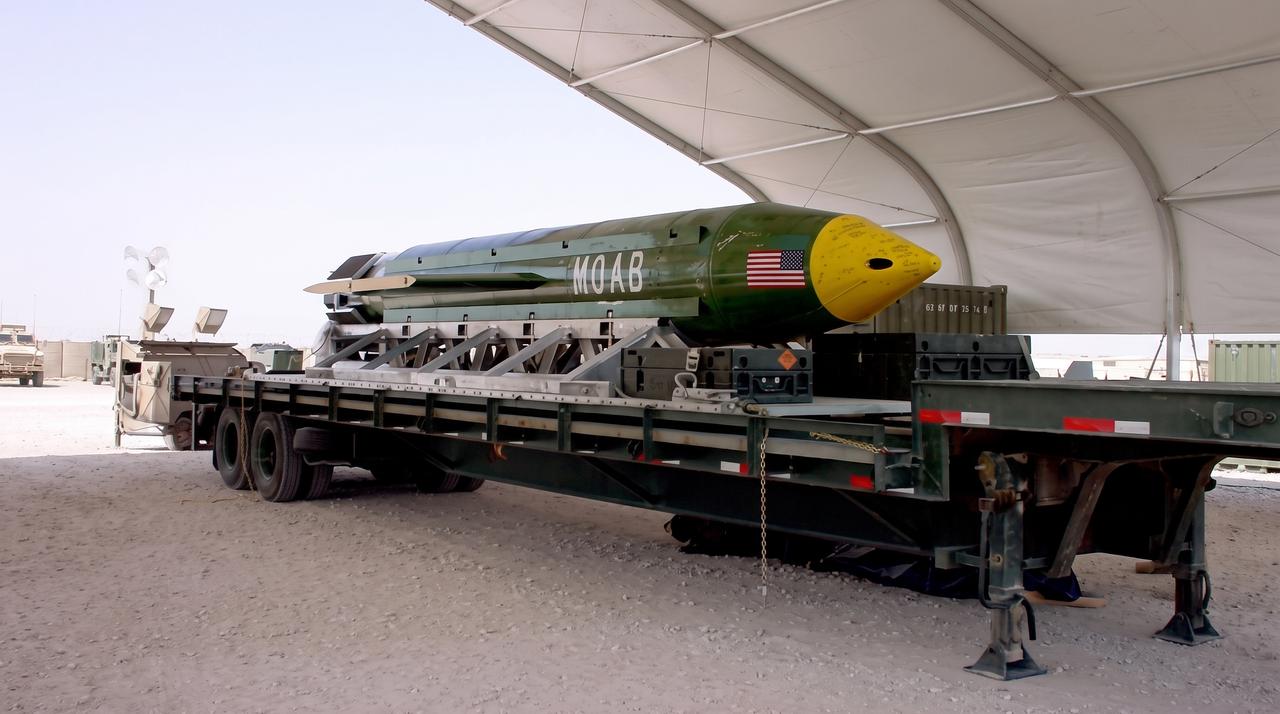
GBU-43/B Massive Ordnance Air Blast (MOAB), is a conventional air bomb developed by the United States, designed to create destructive effects over large areas using a high explosive charge and a satellite guidance system. Known in the public as the “Mother of All Bombs,” this munition is one of the largest non-nuclear bombs in the U.S. arsenal, weighing approximately 9.8 tons and measuring over 9 meters in length. First tested in 2003, the GBU-43/B was used operationally for the first time on 13 April 2017 in Afghanistan against a network of tunnels and caves controlled by ISIS. It returned to international attention in October 2026 amid reports that the United States might use this bomb in potential military operations targeting Iran’s nuclear facilities and energy infrastructure.
The GBU-43/B MOAB was designed in 2002 as part of the United States Air Force’s efforts to develop conventional munitions with high destructive power. The goal was to create a more advanced weapon system capable of replacing the BLU-82 Daisy Cutter, a bomb used since the Vietnam War to generate blast effects over wide areas.
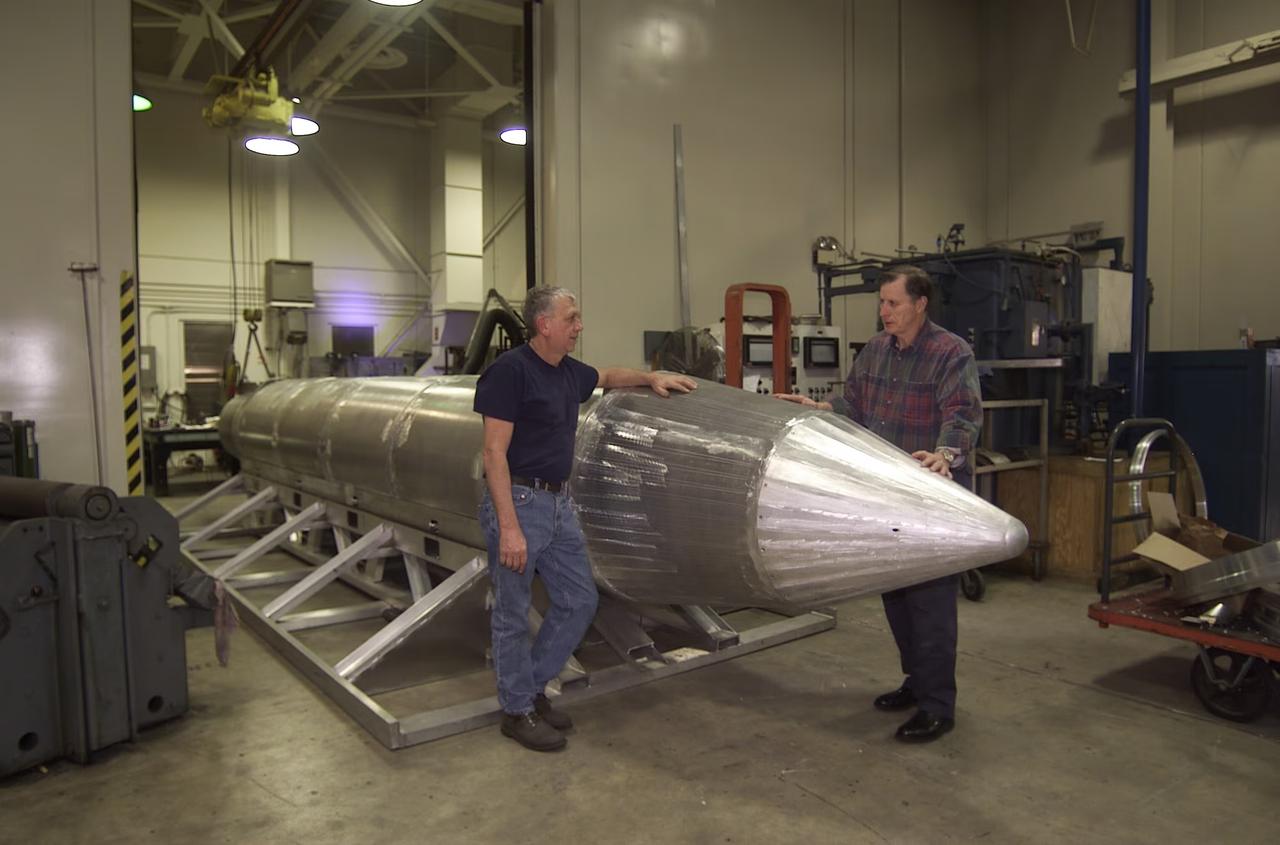
Al Weimorts, who designed the GBU-43/B (left), and lead model maker Joseph Fellenz (right) examine the prototype before painting and testing (DVIDS)
Developed by the U.S.-based aerospace and defense company Dynetics, the bomb was specifically engineered to generate powerful pressure waves across large surface areas, neutralize military assets in open terrain, and destroy cave and tunnel entrances.
The development of the GBU-43/B coincided with the U.S. military’s preparations for its 2003 invasion of Iraq. At the time, U.S. Secretary of Defense Donald Rumsfeld stated that the weapon’s destructive power could exert psychological pressure on the Iraqi regime.
The first tests of the bomb were conducted in March 2003 at Eglin Air Force Base in Florida. Reports indicated that the mushroom cloud produced by the explosion was visible from a distance of approximately 32 kilometers.
Although the GBU-43/B was deployed to the Middle East in 2003, it was not used during the Iraq War. Its first operational use occurred in Afghanistan in 2017.
Due to its large size and substantial explosive payload, the GBU-43/B MOAB is classified as one of the most powerful conventional air munitions in the U.S. inventory.
The bomb’s casing is made of relatively thin aluminum material to allow the blast wave generated by the explosion to propagate over a wide area. The design aims to maximize the transfer of explosive energy to the surrounding environment.
The munition is equipped with a GPS-guided guidance system that enables precise targeting. Due to its large dimensions, the MOAB cannot be carried by most conventional or strategic bombers; instead, it is deployed from military transport aircraft such as the MC-130.
The GBU-43/B MOAB is designed as a high-explosive munition that generates a powerful blast wave over a wide area. Upon detonation, the released energy can cause severe damage to structures, military vehicles, personnel, and targets in open terrain.
The bomb is designed to detonate just above the ground, allowing the resulting blast wave to spread across a broad surface area.
It has been noted that the MOAB exhibits high destructive effects in open terrain and near-surface structures. However, the extent of its impact zone varies depending on terrain characteristics, surrounding obstacles, target location, and the depth of underground facilities.
The blast effect of the MOAB is estimated to cause serious damage within a radius of approximately one kilometer, but this does not imply a uniform destruction zone where all structures suffer equal damage.
The bomb’s primary function is not to penetrate thick concrete layers or deeply buried fortified facilities, but to generate high-pressure and explosive effects over a wide area. For this reason, the GBU-43/B is classified as a different category of munition from bunker-busting bombs designed to destroy deep and hardened underground military installations.
The GBU-43/B MOAB was used for the first time on 13 April 2017 during a military operation in Achin district of Nangarhar province in eastern Afghanistan. The U.S. military targeted a network of caves and tunnels in a region near the Pakistani border, which had been used by ISIS’s Afghan branch. The approximately 9.8-ton bomb was dropped from an MC-130 military transport aircraft. The U.S. Department of Defense stated that the strike aimed to neutralize the group’s underground shelters, tunnel networks, and defensive positions.
Then-U.S. President Donald Trump described the operation as successful. Afghan officials reported that 94 members of the organization were killed and no civilian casualties occurred. However, some local reports from the region suggested civilian casualties and extensive damage to homes. These claims have not been independently verified. The Afghanistan operation marked the first time the GBU-43/B was used in combat, approximately 14 years after its development.
The GBU-43/B MOAB and the GBU-57 Massive Ordnance Penetrator (MOP) are two distinct conventional bombs developed by the United States with high destructive capabilities. While both munitions are large in size, they differ significantly in target type and detonation mechanism.
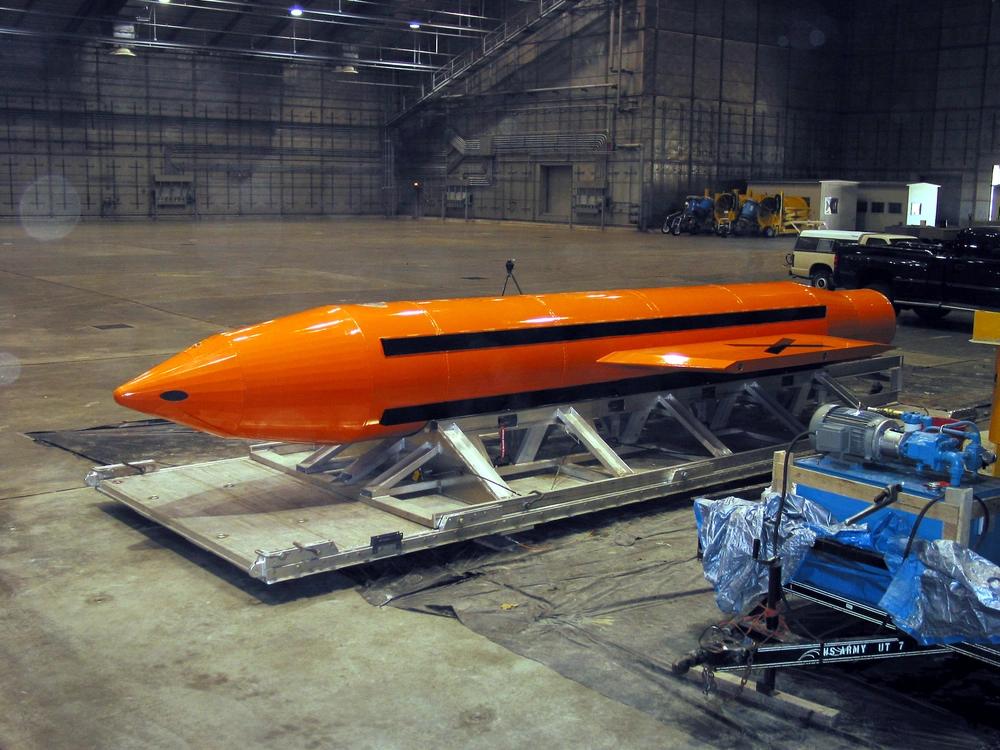
A MOAB (DVIDS)
The GBU-43/B MOAB was developed to generate powerful blast waves over large surface areas. It is specifically designed to be effective against military targets in open terrain, cave entrances, and surface-near structures.
The GBU-57 MOP, by contrast, was developed to target deep underground facilities and hardened bunkers. Weighing approximately 13.6 tons, the munition features a high-strength steel casing that enables it to penetrate thick concrete layers and rock formations before detonating underground.
The GBU-57 is reported to have a penetration capability of up to 61 meters. However, its actual penetration depth varies depending on the geological properties and structural resilience of the target. While the MOAB stands out for its wide-area blast effect, the GBU-57 is distinguished by its ability to destroy deep and protected targets.
In October 2026, the GBU-43/B MOAB re-entered the international spotlight amid reports that the United States might use it in potential new military operations against Iran. On 15 October 2026, news outlets including CNN reported that the Pentagon was considering the use of the GBU-43/B bomb in possible strikes on Iran’s energy infrastructure and nuclear facilities.
The reports indicated that if U.S. President Donald Trump decided to restart military operations, the MOAB could be among the options considered for attacks on Iran’s strategic sites. On 16 October 2026, President Trump told Newsmax television that the bomb under consideration against Iran was not a nuclear weapon.
Trump stated that U.S. forces could target an underground facility reportedly built in the Pickaxe Mountain region and mentioned the possibility of its destruction. He also noted that the potential operation would not involve U.S. ground forces.
The development and production of the GBU-43/B MOAB were carried out as part of the United States’ early 2000s programs to develop high-destructive conventional weapons. In 2017, reports indicated that the unit cost of the bomb was approximately $16 million. That same year, it was reported that the U.S. military had produced 20 MOABs and spent around $314 million under the program.
These figures reflect data from 2017 reports and do not indicate the exact number of munitions in the U.S. inventory or current production costs as of 2026. Although the MOAB is one of the largest non-nuclear air bombs in the U.S. arsenal, it is not the heaviest conventional munition. The GBU-57 MOP, weighing approximately 13.6 tons, exceeds the MOAB in total weight.
The GBU-43/B MOAB has been included in military assessments not only for its high explosive capacity but also for its psychological and strategic effects. During its development, analysts assessed that large-scale explosions could serve as a deterrent against adversaries and function as a psychological pressure tool in military operations.
Originally introduced in 2003 as a potential tool to deter the Iraqi regime, the bomb became one of the symbols of U.S. conventional military power after its first operational use in Afghanistan in 2017. The 2026 claims regarding its possible use against Iran have once again brought into focus the MOAB’s military effectiveness, the potential impact of massive explosions on civilian infrastructure, and the regional security risks it entails.
Al Jazeera. “What is the ‘Mother of All Bombs’ US could use in Iran?” Accessed October 17, 2026.https://www.aljazeera.com/news/2026/10/15/what-is-the-mother-of-all-bombs-us-could-use-in-iran
Anadolu Agency. “GBU-43/B MOAB infografiği.” Accessed October 17, 2026.https://www.aa.com.tr/en/info/infographic/54495
Anadolu Ajansı. "Trump'tan İran'ın nükleer tesislerine 'tüm bombaların anası' ile saldırılabileceği sinyali." Accessed October 17, 2026.https://www.aa.com.tr/tr/dunya/trumptan-iranin-nukleer-tesislerine-tum-bombalarin-anasi-ile-saldirilabilecegi-sinyali/4090673
BBC News. “Mother of all bombs: How powerful is US mega-weapon?” Accessed October 17, 2026.https://www.bbc.com/news/world-asia-39596333
CNN. “US considering 'Mother of All Bombs' in Iran.” Accessed October 17, 2026.https://edition.cnn.com/2026/10/15/politics/us-considering-mother-of-all-bombs-iran
Collins, Shannon. “MOAB Creators.” Photograph record. DVIDS, February 21, 2018. Accessed October 17, 2026.https://www.dvidshub.net/image/4155164/moab-creators
Collins, Shannon. “MOAB2.” Photograph record. DVIDS, February 21, 2018. Accessed October 17, 2026.
Reuters. “US military weighs use of 'Mother of All Bombs' in potential future strikes on Iran, CNN says.” Accessed October 17, 2026.https://www.reuters.com/world/us-military-weighs-use-mother-all-bombs-potential-future-strikes-iran-cnn-says-2026-10-15/
TIME. “The U.S. Just Dropped the ‘Mother of All Bombs’ in Afghanistan. But What Is That?” Accessed October 17, 2026.https://time.com/4739302/mother-of-all-bombs-afghanistan-what-is-that/
U.S. Department of Defense. “GBU-43/B MOAB Photograph.” Accessed October 17, 2026.https://www.war.gov/Multimedia/Photos/igphoto/2001732840/
United States Air Force. “The ‘Mother of All Bombs’.” Photograph. Accessed October 17, 2026.https://www.af.mil/News/Photos/igphoto/2000645110/
United States Department of Defense. “A Massive Ordnance Air Blast (MOAB) Weapon Is Prepared for Testing at the Eglin Air Force Armament Center.” Photograph record. DVIDS, July 27, 2025. Accessed October 17, 2026.https://www.dvidshub.net/image/9211518/massive-ordnance-air-blast-moab-weapon-prepared-testing-eglin-air-force-armament-center
Voice of America. “Explainer: MOAB Bomb.” Accessed October 17, 2026.https://www.voanews.com/a/explainer-moab-bomb/3810284.html

Official Name: | GBU-43/B Massive Ordnance Air Blast | ||||||||
|---|---|---|---|---|---|---|---|---|---|
Abbreviation: | MOAB | ||||||||
Other Name: | Mother of All Bombs | ||||||||
Type: | GPS-guided conventional air bomb | ||||||||
Origin: | United States of America | ||||||||
Developer: | United States Air Force Research Laboratory | ||||||||
Manufacturer: | Dynetics | ||||||||
Year of Development: | 2002 | ||||||||
First Test: | March 2003 | ||||||||
First Operational Use: | 13 April 2017 | ||||||||
First Used Location: | Achin, Nangarhar, Afghanistan | ||||||||
Total Weight: | Approximately 9,800 kg | ||||||||
Length: | Approximately 9.17 m | ||||||||
Explosive Filling: | Approximately 8,500 kg | ||||||||
Explosion Type: | Air burst, high pressure wave | ||||||||
Unit Cost: | Approximately 16 million US dollars (estimated as reported in 2017) | ||||||||
No Discussion Added Yet
Start discussion for "Dynetics GBU-43/B MOAB" article
Development of the GBU-43/B MOAB
Technical Specifications of the GBU-43/B MOAB
Explosive Power and Destructive Effects of the MOAB
Use of the GBU-43/B MOAB in Afghanistan
Differences Between the GBU-43/B MOAB and the GBU-57
U.S. Claims of Using the MOAB Against Iran
Production Cost and Status in the U.S. Inventory
Military and Strategic Significance of the MOAB