

This article was automatically translated from the original Turkish version.

An earthquake is the shaking of the Earth’s surface caused by the breaking of tectonic plates forming the crust and the subsequent release of energy in the form of waves. The definition is extremely clear, rational, and scientific.
When we trace the etymology of the word, we find a seamless Turkish summary of this shaking: the word “deprem” evolved from Old Turkish “tepremek,” meaning “to shake, to move.” This verb derives from “tepiz,” meaning “flexible, motion-inducing,” whose root extends back to the Turkish verb “tepmek,” meaning “to kick.”【1】 Thus, our ancestors knew that the ground beneath their feet was not fixed, but a living, trembling, restless entity.
Yet they did not know that beneath meters of soil, tectonic plates fracture, and compressed energy erupts along fault lines as waves reaching the surface.
Throughout history, humanity has not merely been a creature struggling for physical survival; it has also been a seeker of meaning, striving to make sense of the universe and align itself with nature’s immense power. Where science now performs this function, myths once did the same. They imposed order amid chaos and rendered the unknown comprehensible.
The sudden collapse of the ground beneath one’s feet, the terrifying rumble rising from below—these were among the greatest crises humans faced. Every society responded to this crisis with its own geography, lifestyle, and sacred worldview, interpreting this violent trembling through its own narrative.
For the Turks, the process unfolded precisely this way. To explain the uncontrollable power of the earth and to tame their fears, they constructed their own mythological cosmos.
For ancient people, it was hardly plausible that the Earth could simply rest in infinite space on its own. Since we walk upon it, build homes on it, and cultivate crops, something must be holding this vast world steady from below. Indeed, in many cultures, this cosmic supporter took the form of a turtle, a colossal elephant, or a fish at the bottom of the oceans.【2】 In the vast geography of the Turks, the most important actor bearing this heavy burden was the faithful laborer of the earth: the ox.
According to traditional Turkish belief, the world rests upon the horns of an ox. This ox, when stung by a fly, suffers neck pain, grows weary, or simply shakes itself. At that very moment, the Earth trembles, and stones are thrown from their places.【3】
These narratives have been kept alive in the collective memory of our people for centuries. If you speak to the right person at the right time, you will find them right beside you in their purest form. The real challenge lies in capturing this memory before it fades, committing it to writing, and conveying it to those who do not know it.
Indeed, academic Ejdan Sadrazam acted precisely out of this concern for oral culture. He visited the door of Hıfsiye Alkan (1918–2018), a 100-year-old woman living in the village of Karye-i Bladanisa, nestled in the mountains of Cyprus, whose history dates back to the 1571 settlement. Hıfsiye Nine had never attended school; she learned to read and write through her own efforts and had never stepped beyond her small mountain village in her entire life. From her, Sadrazam successfully collected this ancient myth.【4】
When Ejdan Sadrazam asked her in 2015, “What happens when a person dies?,” Hıfsiye Nine replied:
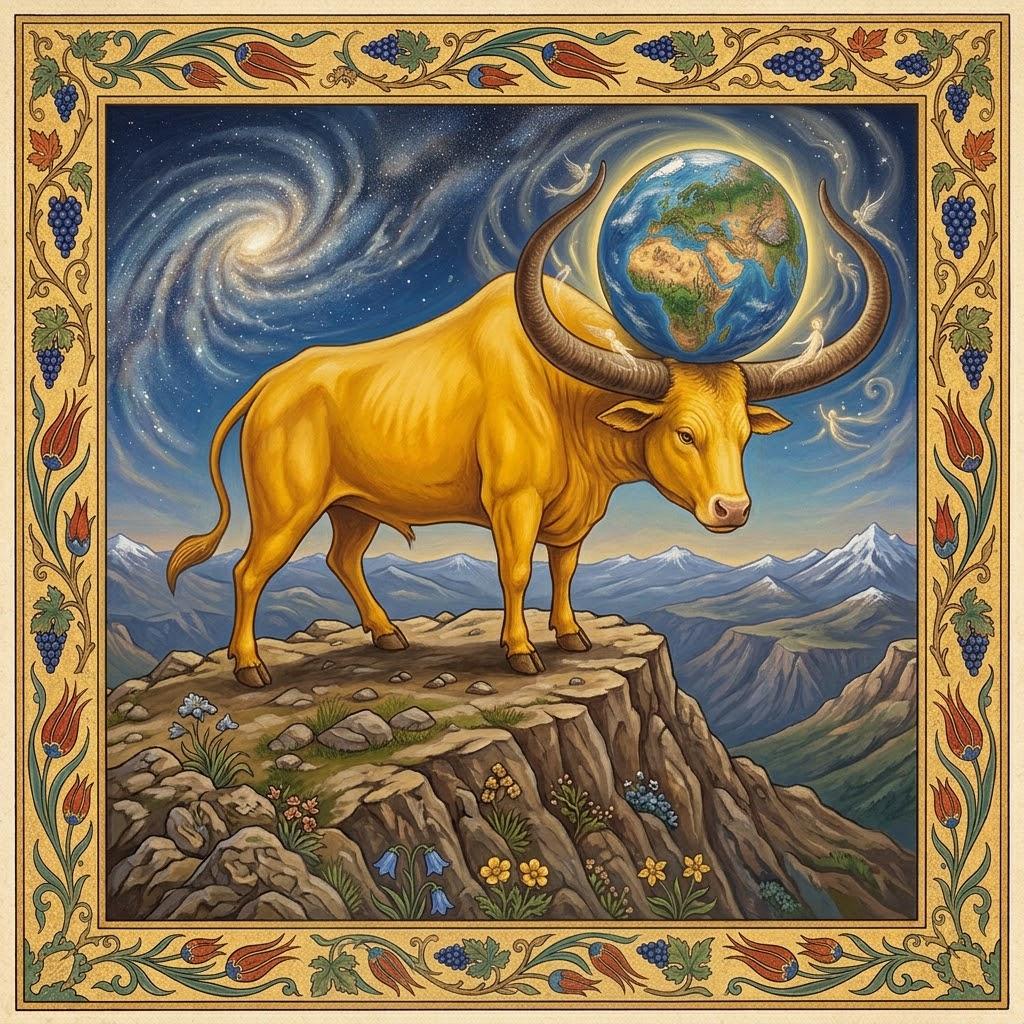
Sarı Öküz (Yapay Zekâ ile Oluşturulmuştur)
“On a mountain peak stands the Yellow Ox,
Carrying the world between his two horns.
He holds the souls of the dead within his horns.
When a person dies, their soul becomes a gurdcuk, exiting through the mouth,
Then its wings emerge from the gurdcuk.
It flies away...
And enters within the Yellow Ox’s horns.
The Yellow Ox grows furious if souls fail to enter his horns!
He shakes his tail and tosses them away.
When the Yellow Ox stirs, the earth trembles, and an earthquake occurs…”【5】
The narrative does not end there; it also links the end of the world—the Day of Judgment—to those same horns. When the horns become so heavy with the souls of the dead that the ox can no longer bear them, they will burst, and the world will be shattered. Thus, every movement of the Yellow Ox is a minor earthquake, a warning, a resonance of the approaching final cataclysm.
This ox, symbolized by the color yellow—the color of the earth and the center—is a captivating mythic construct created by humans to tame their helplessness and fear before nature’s immense power.【6】
Did Turkish mythological thought explain the underworld and earthquakes solely through the stirring of an ox?
Of course not.
When we consider the vast geography, diverse climates, and varied lifestyles of the Turkic peoples, we cannot expect them to rely on a single symbol.
Especially among Turkic communities closely connected to water and fish, another colossal cosmic supporter enters the scene: the Fish.
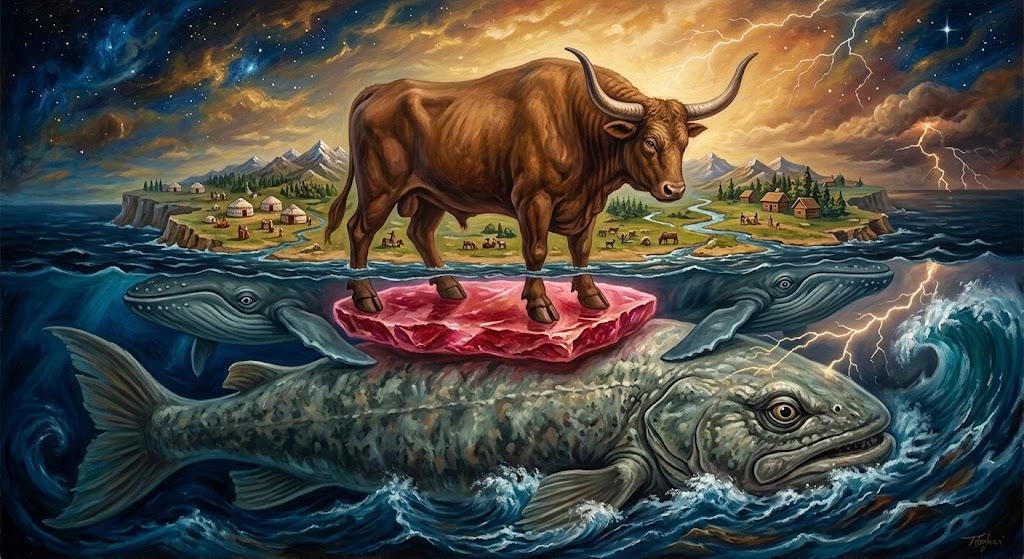
Dünyayı Dengede Tutan Güçler (Yapay Zekâ ile Oluşturulmuştur)
In folk imagination, the earth is not a single-layered structure. In ancient narratives, the world rests on the horns of an ox, who stands upon a red ruby stone, which in turn rests on the back of a colossal fish.【7】
In this cosmic chain stretching from the Crimean Tatars to the Turkic peoples of southern Siberia, the immense fish beneath us—sometimes named Kiro Balak or Behmût—causes lightning to strike, floods to erupt, and tremors to begin whenever it blinks its eyes or turns its body.
The same holds true not only in the steppes but also in the deep epic universe of Siberia. In the famous Altai epic, the Maaday Kara, the Earth is said to be carried by two giant whales living in a nine-gulfed black sea.【8】
Recall the magnificent scene from the epic: the whale cries helplessly, declaring that movement beneath the earth has been forbidden by fate. “If I stir, the earth will tremble, and floods will break loose!” it says.【9】
Do you see the deep logic here?
Whether it is the shaking of an ox’s horns or the turning of a colossal fish beneath the seas—for our ancestors, an earthquake was nothing more than a momentary restlessness or displacement of the immense living beings that upheld the Earth’s balance. This was a seamless way to tame nature’s immense power and give it form through familiar entities.
As you may have noticed, in the oldest layers of Turkish mythology, earthquakes are mostly described as “causeless” or explained solely by nature’s internal dynamics. The Yellow Ox is stung by a fly, suffers neck pain, or the colossal fish beneath the earth turns its back—and an earthquake occurs. At this stage, there is no moral questioning such as, “I must have sinned, and that is why the earth shook.” Nature is a vast being governed by its own rules.
But as time passed and societies transitioned to settled life and adopted celestial religions, particularly Islam, these mythic frameworks began to transform.
The “ox merely stirring in place” of mythology gradually evolved in folk poetry and legends into a mechanism of reward and punishment—a natural phenomenon responding to human actions. Humanity was no longer merely a passive victim of earthquakes; it became an actor whose morality, justice, and conduct triggered or averted the tremors.
In our ashik literature, we can trace this transformation seamlessly. Pir Sultan Abdal, when he wrote,
“He placed the entire world upon the ox,
The foundation of the earth since time immemorial,”【10】
transferred this ancient mythic carrier into poetry. Sivasli Âşık Ruhsati expanded the concept further: according to him, the Yellow Ox beneath the earth is 114,000 years old, its skin thicker than mountains, yet it cannot withstand even the smallest fly (bugle) on its forehead. As the fly flies away, the ox shakes itself and destroys the world!【11】
In the poetic exchanges between Âşık Şenlik and Âşık Bayram, the myth becomes entirely interwoven with Islamic motifs. The ox’s name is now Lehusa; it has 40,000 eyes, and the angel Mikail, who first subdued it from its wild state, now calms it! References are made to the Surah Al-Baqarah, to Hz. Musa and his people, and to divine texts.【12】
And finally, the age changes…
The master voice of republican-era folk poetry, Âşık Veysel, emerges on the scene. Veysel encapsulates the great rupture in the collective consciousness in just one quatrain:
“Let the Yellow Ox roam free,
Let everyone close their eyes and wander.
Let a factory be built in every corner,
Awaken from this negligence, O citizen.”【13】
Veysel’s outcry represents the mythic mind confronting the rational world. The Yellow Ox is no longer the mysterious subterranean carrier of the earth; it has become a symbol of a mythic worldview. Yet the human mind cannot so easily erase thousands of years of sediment. The myth changes its surface layer, but when the need arises, it retreats into the deeper strata of collective memory.
Even when we hear the dark rumble rising from beneath the earth and our minds turn to science, our souls still wonder when the ancient Yellow Ox will shake itself once more.
This myth remains true whether we know it or not.
Akman, Eyüp. "Türk Mitolojisi ve Halk Şiirinde 'Sarı/Kızıl Öküz' İnancı." *Türkiyat Mecmuası* 22, no. 1 (2012): 1-16. Accessed October 5, 2026.https://dergipark.org.tr/en/download/article-file/173056
Nişanyan Sözlük. "depre[mek]." Accessed October 5, 2026.https://www.nisanyansozluk.com/kelime/depre%C5%9F-
Sadrazam, Ejdan. "Bir Kıbrıs Türk Miti Üzerine Antropolojik Çözümleme: Sarı Öküz." *Millî Folklor* 34, Volume 17, no. 135 (2022): 18–32. Accessed October 5, 2026.https://dergipark.org.tr/en/download/article-file/1756657
Çelik, Adil. "Mitolojiden Efsaneye Deprem Anlatıları: Kahramanmaraş Örneği." *Millî Folklor* 37, no. 148 (2025): 53-64. Accessed October 5, 2026.https://dergipark.org.tr/en/download/article-file/3997173
[1]
Nişanyan Sözlük. "depre[mek]" Erişim Tarihi: 5 Ekim 2026. https://www.nisanyansozluk.com/kelime/depre%C5%9F-
[2]
Eyüp Akman, "Türk Mitolojisi ve Halk Şiirinde 'Sarı/Kızıl Öküz' İnancı," *Türkiyat Mecmuası* 22, no. 1 (2012): 3. Accessed October 5, 2026. Adil Çelik, "Mitolojiden Efsaneye Deprem Anlatıları: Kahramanmaraş Örneği," *Millî Folklor* 37, Volume 19, no. 148 (2025): 57. Accessed October 5, 2026.
[3]
Akman, "Sarı/Kızıl Öküz İnancı," 1-2.
[4]
Ejdan Sadrazam, "Bir Kıbrıs Türk Miti Üzerine Antropolojik Çözümleme: Sarı Öküz," Millî Folklor 34, c. 17, no. 135 (2022): 21-22. Erişim Tarihi: 5 Ekim 2026. https://dergipark.org.tr/en/download/article-file/1756657
[5]
Sadrazam, "Bir Kıbrıs Türk Miti Üzerine Antropolojik Çözümleme: Sarı Öküz," 22.
[6]
Akman, "Sarı/Kızıl Öküz İnancı," 4, 14; Sadrazam, ""Bir Kıbrıs Türk Miti Üzerine Antropolojik Çözümleme: Sarı Öküz," 22-23
[7]
Akman, "Sarı/Kızıl Öküz İnancı," 2
[8]
Akman, "Sarı/Kızıl Öküz İnancı," 3.
[9]
Akman, "Sarı/Kızıl Öküz İnancı," 3.
[10]
Akman, "Sarı/Kızıl Öküz İnancı," 8.
[11]
Akman, "Sarı/Kızıl Öküz İnancı," 8.
[12]
Akman, "Sarı/Kızıl Öküz İnancı," 9-10.
[13]
Akman, "Sarı/Kızıl Öküz İnancı," 14.
The Ox
From Meaninglessness to a World of Reward and Punishment