

This article was automatically translated from the original Turkish version.
+1 More
Eastern Spruce (Picea orientalis)
Team(s) | Pinales | ||||||||
|---|---|---|---|---|---|---|---|---|---|
Family | Pinaceae | ||||||||
Habitat | Humid regions Mountainous regions Continental climates | ||||||||
Order | 20–50 m | ||||||||
Importance | Landscaping Paper production Furniture Lumber | ||||||||
Genus | Picea | ||||||||
Class | Pinopsida | ||||||||
Section | Pinophyta | ||||||||
Realm | Plantae | ||||||||
Oriental Spruce (Picea orientalis) is the common name for evergreen needle-leaved trees belonging to the genus Picea within the family Pinaceae. This genus, widely distributed across the Northern Hemisphere, plays a significant role in natural forest ecosystems. In Türkiye, the principal native spruce species is the Oriental spruce, a tree of considerable importance in both forest ecology and economic value.

Oriental Spruce
The Oriental spruce belongs to the class Coniferae of the gymnosperms (Gymnospermae) and is a member of the family Pinaceae. The genus Picea consists morphologically of needle-leaved, cone-bearing, evergreen trees.
The Oriental spruce is a major coniferous tree species naturally occurring in the Caucasus and the eastern Black Sea region of Türkiye. In Türkiye it is primarily distributed in the Eastern Black Sea Region, where it thrives in mountainous areas characterized by humid and cool climatic conditions. Although occasionally found at elevations near sea level, it predominantly forms extensive and continuous forest communities at higher altitudes. High humidity, abundant rainfall, and cool temperatures provide the most favorable environment for its healthy development.
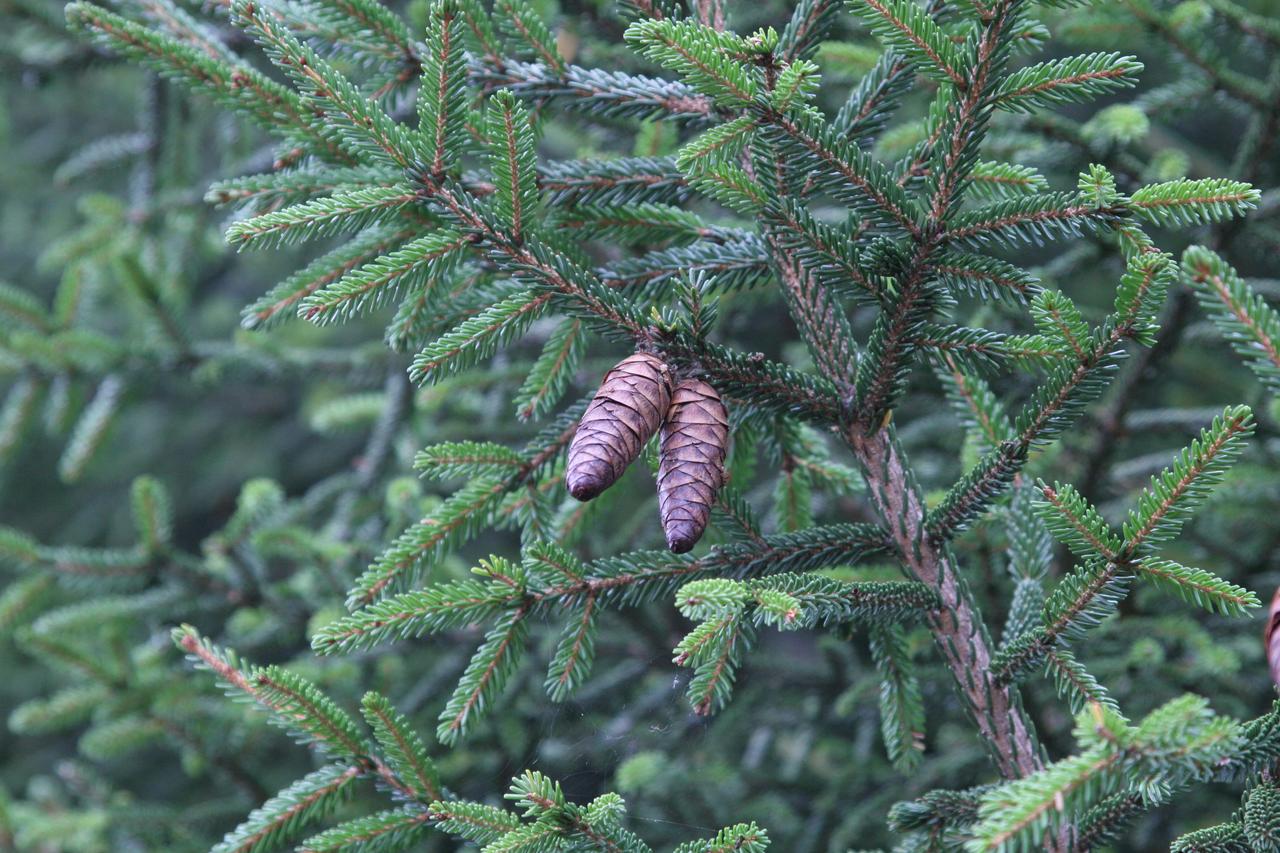
Under optimal growing conditions, the Oriental spruce attains considerable height with a straight, cylindrical trunk. The trunk is thick and robust, reaching wide diameters in well-developed individuals. The crown has a narrow, pointed, pyramidal shape. Branches typically develop horizontally or with a slight drooping habit.
Needles are short, stiff, and dark green. They are attached singly to shoots and leave small bumps on the shoot surface after shedding. Cones are generally pendulous, cylindrical or oval in shape, and green or reddish when young, turning brown upon maturity. Seeds are winged and dispersed by wind.
The Oriental spruce prefers moist and cool climatic conditions. It exhibits optimal growth in deep, humus-rich, well-aerated soils with adequate moisture. Sandy-loamy and nutrient-rich soils are particularly suitable. The root system is predominantly shallow, making the species vulnerable to strong winds and prolonged drought conditions.
Its shade tolerance during the juvenile stage enables it to establish successfully even in dense stands. Within its natural range, it is generally resistant to winter frosts; however, late frosts in some years can damage young shoots. In neglected or overly dense forests, damage from snow breakage and windthrow may occur.
The wood of the Oriental spruce is light, straight-grained, and easy to work, making it widely used in various industries. It is an important raw material for pulp and paper production as well as for construction lumber, plywood, veneer, furniture, paneling, packaging materials, crates, boxes, baskets, matches, and pencil manufacturing. Its resin also holds economic value.
Due to its regular pyramidal form and evergreen appearance, it is also commonly selected as an ornamental plant in parks and gardens. It is frequently used in landscape applications in regions with cool and humid climates.
Spruce species can be propagated by seed, as well as through cuttings and grafting. Excessive pruning is avoided during the seedling stage; only competing shoots are removed to ensure the proper development of the main trunk. Maintaining soil moisture is sufficient, and excessive irrigation is generally unnecessary. Occasionally, pests such as aphids, bark beetles, and spider mites, as well as fungal diseases like needle cast and black spot, may cause damage.
The Oriental spruce is recognized as one of Türkiye’s most important forest tree species due to its ecological role in natural forest formation and its economic contribution as a source of timber and industrial raw material.
Atatürk Orman Çiftliği. "Ladin." *Bitkisel Üretimler.* Accessed February 9, 2026. https://www.aoc.gov.tr/Portal/BitkiselUretimler/ladin-/71
Ölmez, Zafer, Zafer Yerli, and Fatih Temel. “Doğu Ladini (Picea orientalis) Kozalak ve Tohum Özelliklerindeki Coğrafi Farklılıklar.” Turkish Journal of Biodiversity 2, no. 1 (2019): 6–12. Accessed February 9, 2026. https://doi.org/10.38059/biodiversity.523478
Üçüncü, Kemal, Aytaç Aydın, Samet Demirel, and Sebahattin Tiryaki. “An Investigation on the Moisture Adsorption of Eastern Spruce (Picea orientalis (L.) Link.).” Kastamonu University Journal of Forestry Faculty 19, no. 3 (2019): 272–283. Accessed February 9, 2026. https://doi.org/10.17475/kastorman.662451


Eastern Spruce (Picea orientalis)
Team(s) | Pinales | ||||||||
|---|---|---|---|---|---|---|---|---|---|
Family | Pinaceae | ||||||||
Habitat | Humid regions Mountainous regions Continental climates | ||||||||
Order | 20–50 m | ||||||||
Importance | Landscaping Paper production Furniture Lumber | ||||||||
Genus | Picea | ||||||||
Class | Pinopsida | ||||||||
Section | Pinophyta | ||||||||
Realm | Plantae | ||||||||
No Discussion Added Yet
Start discussion for "Eastern Spruce (Picea orientalis)" article
Taxonomic Position
Geographic Distribution
Morphological Characteristics
Ecological Characteristics and Growth Requirements
Economic and Landscape Value
Production and Maintenance