


This article was automatically translated from the original Turkish version.
Gas Turbine Combustion Chamber
Definition(s) | Swirl angle: an important parameter that affects the distribution of the air-fuel mixture and combustion efficiency in the combustion chamber of gas turbines. | ||||||||
|---|---|---|---|---|---|---|---|---|---|
Combustion Chamber Zones | Dilution Zone Intermediate Zone Primary Zone | ||||||||
Temperature Distribution According to Angles | optimizing mixing but potentially creating flow instability risks. turbulence reaches its maximum level turbulent kinetic energy spreads to wider regions of the combustion chamber. At a 60 degree angle increasing NOx emissions. At a 45 degree angle a narrow and high-temperature core may form At a 30 degree swirl angle | ||||||||
In gas turbines, the swirl angle is a critical parameter that directly affects the distribution of the air-fuel mixture in the combustion chamber and the combustion efficiency. Swirls enhance flame stability by imparting a swirling motion to the air flow, homogenize the mixture, and improve combustion efficiency. The magnitude of the angle plays a decisive role in determining flame shape, temperature distribution, combustion rate, and emission levels. A well-chosen swirl angle can provide a more efficient combustion process while simultaneously offering low emissions and reliable work performance. However, inappropriate angle selections can lead to problems such as flame blowout, uneven combustion, and localized overheating like road. Therefore, the design of swirls in gas turbines must be carefully optimized.
The interior of the combustion chamber consists of three regions: the primary region zone, the intermediate zone, and the dilution zone. The primary zone’s function is to stabilize the flame and provide sufficient duration temperature and turbulence to ensure complete combustion of the incoming air-fuel mixture. The purpose of the intermediate zone is to reduce the temperature of the combustion products and complete the combustion process. Additional air enters this region to control the high temperatures generated in the primary zone, where unburned fuel is combusted with excess air. The dilution zone’s purpose is to further cool the hot gases produced in the combustion chamber to reduce the inlet temperature turbine.

Zones of the combustion chamber and air distribution
The air flow pattern in the primary zone has significant importance implications for flame stability. Although different air flow patterns are employed toLINK[1]) together, all share the common feature of generating vortices that recirculate a portion of the hot combustion products back into the incoming air and fuel stream. One of the most effective methods to promote air recirculation in the primary zone is to place swirlers around the fuel injector to generate vortices. Swirls impart rotational motion to the air flow, enabling better air-fuel mixing, higher turbulence, and consequently more efficient combustion.

Designed swirlers
In a representative design process, Ansys Discovery was used to easily analyze the vortices generated by the swirlers and make necessary design modifications.

CFD analysis performed with Ansys Discovery
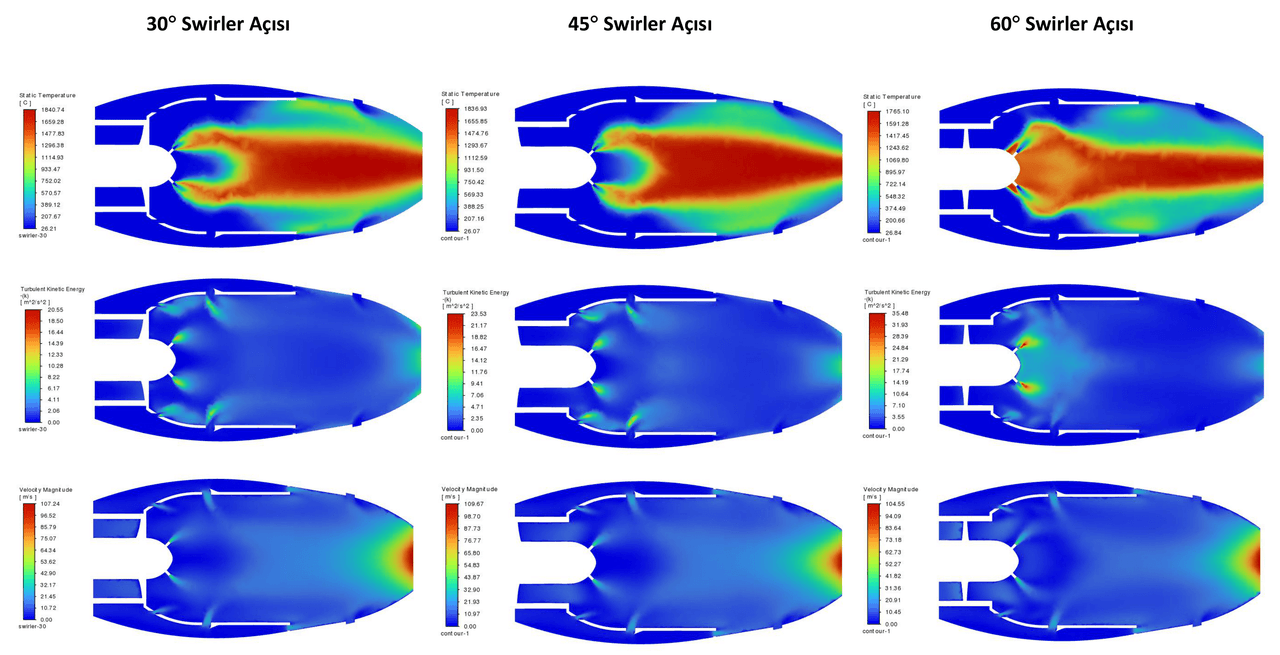
In the referenced study, non-premixed combustion analyses were conducted for various swirl angles. The SST k-ε turbulence model was employed to simulate turbulent flow, and this model resolves turbulence with sufficient accuracy both near the wall and in the free region. Additionally, the combustion process was solved using the non-premixed combustion model, in which the fuel (CH₄) and oxidizer (O₂) are supplied separately and mix within the flow field before reacting. The resulting data are presented in the figure below.

Analysis results obtained
At a 30° swirl angle, the relatively weak vortex causes the air-fuel mixture to concentrate centrally, resulting in a narrower and hotter core region. This situation can lead to localized overheating and elevated NOₓ emissions. At 45°, increased rotational motion causes the temperature to spread more widely along the combustion chamber, yet a distinct hot core remains at the center. At 60° swirl angle, the strongest rotational flow ensures that temperature mixture becomes more homogeneous, with peak temperatures lower than those observed at the two lower angles, resulting in a more balanced thermal distribution and potentially reduced NOₓ emissions.
At a low swirl angle (30°), turbulence is concentrated primarily in the inlet region and rapidly diminishes within the combustion chamber, leading to insufficient mixing reason. At 45°, turbulent kinetic energy increases and spreads more extensively from the inlet region into broader parts of the combustion chamber, significantly improving mixing. At 60°, TKE values rise markedly and are distributed more uniformly across nearly the entire combustion chamber. This strong turbulence ensures effective fast and homogeneous air-fuel mixing, but also presents a potential source of flow instabilities within the system.
Davidović, N. S., N. M. Kolarević, M. B. Stanković, and M. V. Miloš. “Research of Expendable Turbojet Tubular Combustion Chamber.” *Advances in Mechanical Engineering* 14, no. 5 (2022).
Ibrahim, I., Enagi, K. A., Al-Attab, A., and Z. A. Zainal. “Combustion Chamber Design and Performance for Micro Gas Turbine Application.” *Fuel Processing Technology* 166 (2017): 258–68. https://doi.org/10.1016/j.fuproc.2017.05.037.
Lefebvre, Arthur H., and Dilip R. Ballal. *Gas Turbine Combustion: Alternative Fuels and Emissions.* 3rd ed. Boca Raton, FL: CRC Press, 2010. https://doi.org/10.1201/9781420086058.
Rolls-Royce plc. *Jet Engines.* 5th ed. Derby, England: Rolls-Royce plc, 1996. https://www.valentiniweb.com/piermo/meccanica/mat/Rolls%20Royce%20-%20The%20Jet%20Engine.pdf.


Gas Turbine Combustion Chamber
Definition(s) | Swirl angle: an important parameter that affects the distribution of the air-fuel mixture and combustion efficiency in the combustion chamber of gas turbines. | ||||||||
|---|---|---|---|---|---|---|---|---|---|
Combustion Chamber Zones | Dilution Zone Intermediate Zone Primary Zone | ||||||||
Temperature Distribution According to Angles | optimizing mixing but potentially creating flow instability risks. turbulence reaches its maximum level turbulent kinetic energy spreads to wider regions of the combustion chamber. At a 60 degree angle increasing NOx emissions. At a 45 degree angle a narrow and high-temperature core may form At a 30 degree swirl angle | ||||||||
No Discussion Added Yet
Start discussion for "Effect of Swirl Angle on Combustion Performance in Gas Turbines" article
Combustion Chamber Zones
Swirls
Non-Premixed Combustion Analysis and Results
Temperature Distribution
Turbulent Kinetic Energy (TKE)