


This article was automatically translated from the original Turkish version.
+1 More
Location | Nevşehir Street Aksaray / Türkiye Aksaray Center | ||||||||
|---|---|---|---|---|---|---|---|---|---|
Construction Date(s) | 1221–1236 | ||||||||
Commissioned by | I. Gıyaseddin Keyhüsrev (Sultan of the Seljuk Empire of Anatolia) | ||||||||
Architectural Period | Seljuk Period of Anatolia | ||||||||
Height(s) | 30.6 metres | ||||||||
Number of Steps | 92 | ||||||||
Curvature Ratio | 3° 11' 18.08'' (on the minaret shaft) | ||||||||
Other Slopes | From ground level: 2° 28' 14.16'' Table inclination: 44' 48.59'' | ||||||||
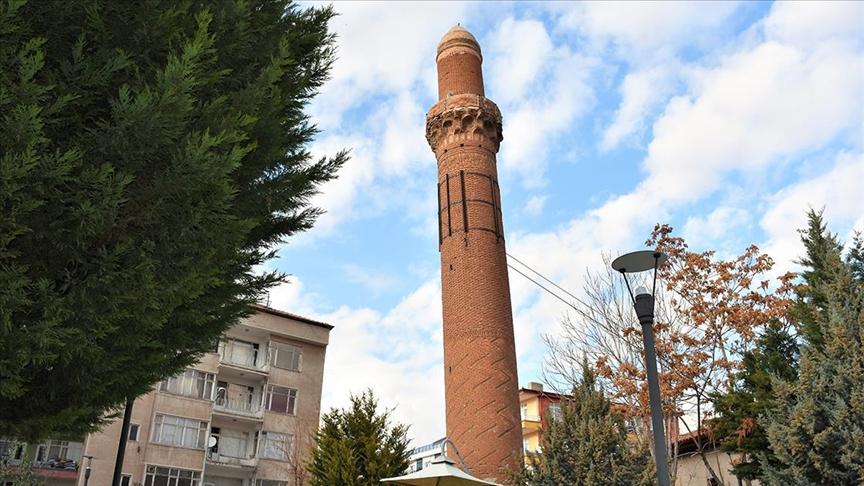
Eğri Minare is located in the city center of Aksaray province in Türkiye’s Central Anatolia Region, along Nevşehir Street. The structure is commonly known as Eğri Minare due to its tilt and as Kızıl Minare because it is constructed from red brick. Eğri Minare is one of the significant architectural heritage sites surviving from the Seljuk period.

Eğri Minare (Aksaray Provincial Directorate of Culture and Tourism)
Built in the 13th century, Eğri Minare was constructed during the reign of Sultan I. Gıyaseddin Keyhüsrev of the Anatolian Seljuks. At that time, Aksaray was one of the important centers of the Anatolian Seljuk State. The minaret represents a significant example of Seljuk architecture from its period.
The minaret is constructed of red bricks bonded with Horasan mortar. It has a cylindrical body resting on a square base. The body is divided into two sections by a fine horizontal line. The lower section is decorated with zigzag motifs, while the upper section features blue and green ceramic mosaics. The minaret includes a balcony, and its total height is 30.6 meters. Inside, there are a total of 92 steps.
Eğri Minare derives its name from its structural tilt. Three distinct tilts have been measured:
It is widely accepted that the tilt was intentionally introduced during construction by the master builder. Another theory suggests that the tilt may have resulted from ground settlement due to the historical position of the nearby Uluırmak River. However, investigations have determined that the minaret rests on solid ground and shows no signs of subsidence or soil-related damage.

Eğri Minare (Anadolu Agency)
Aksaray İl Directorate of Culture and Tourism. "Eğri Minare." *Ministry of Culture and Tourism of the Republic of Turkey.* Accessed June 15, 2025. https://aksaray.ktb.gov.tr/TR-232485/egri-minare.html
Karadavut, Zekeriya. “Aksaray’daki Tarihi Eğri Minare’deki ‘Eğrilik Araştırması’ Tamamlandı.” *Anadolu Ajansı*. Accessed June 15, 2025. https://www.aa.com.tr/tr/gundem/aksaraydaki-tarihi-egri-minaredeki-egrilik-arastirmasi-tamamlandi/2773502
Koçak, Adem. “Tarihi Eğri Minare Restore Edilecek.” Anadolu Ajansı. Accessed June 15, 2025. https://www.aa.com.tr/tr/kultur-sanat/tarihi-egri-minare-restore-edilecek/791359
Türkiye Kültür Portalı. "Eğri Minare – Aksaray." T.C. Kültür ve Turizm Bakanlığı. Accessed June 15, 2025. https://www.kulturportali.gov.tr/turkiye/aksaray/gezilecekyer/egri-minare-kizil-minare

Location | Nevşehir Street Aksaray / Türkiye Aksaray Center | ||||||||
|---|---|---|---|---|---|---|---|---|---|
Construction Date(s) | 1221–1236 | ||||||||
Commissioned by | I. Gıyaseddin Keyhüsrev (Sultan of the Seljuk Empire of Anatolia) | ||||||||
Architectural Period | Seljuk Period of Anatolia | ||||||||
Height(s) | 30.6 metres | ||||||||
Number of Steps | 92 | ||||||||
Curvature Ratio | 3° 11' 18.08'' (on the minaret shaft) | ||||||||
Other Slopes | From ground level: 2° 28' 14.16'' Table inclination: 44' 48.59'' | ||||||||
History and Construction
Architectural Features
State of Tilt