


This article was automatically translated from the original Turkish version.
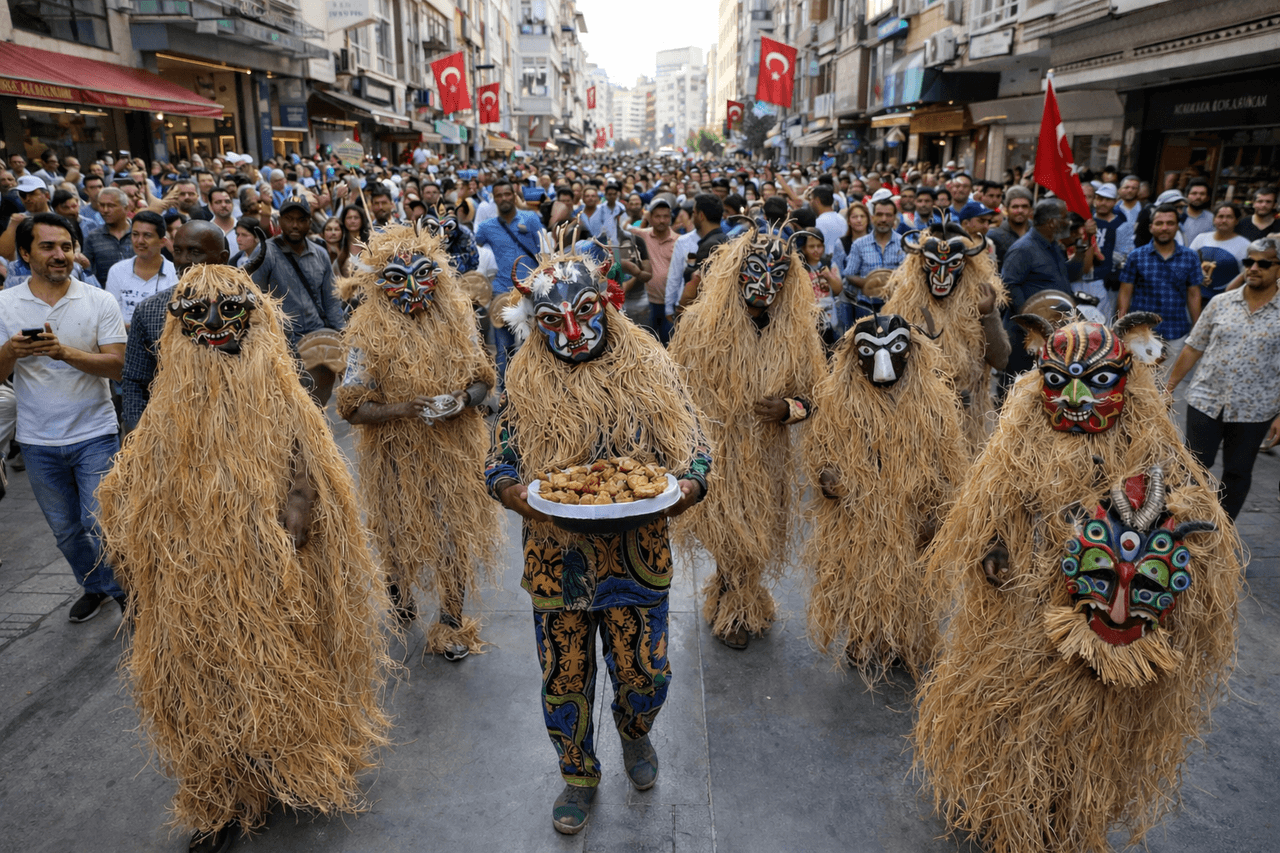
Dana Bayramı (Yapay Zeka ile Oluşturulmuştur.)
Dana Bayramı is a traditional festival rooted in the belief systems of the African diaspora, observed from the late 19th century until the 1920s primarily by the Afro-Turk community living in İzmir and its surroundings. It was celebrated to strengthen social solidarity and preserve cultural identity in the post-slavery era.
This process, organized by spiritual female leaders known as “godya,” consists of three phases: the “Dellal Week,” during which the festival is officially announced; the “Peştamal Week,” when aid is collected; and the main celebration week, during which a decorated bull is paraded with music and then sacrificed.
The historical origins of Dana Bayramı lie in the African slave trade, which was a significant component of the socio-economic structure of the Ottoman Empire during the 19th century and primarily aimed at meeting agricultural labor demands. During this period, Africans taken from regions such as Kenya, Ethiopia, Sudan, and Nigeria were brought to Anatolia via the Arabian Peninsula or North Africa. They carried with them not only their physical presence but also their ancestral belief systems, musical rhythms, and healing traditions.
The years during which the festival began to institutionalize correspond to a transitional period in the Ottoman Empire when slavery was gradually being outlawed after the Tanzimat reforms, yet the social integration of the “freed slave” class remained problematic. In this context, Afro-Turks working on farms and in domestic service in Aegean regions such as İzmir, Aydın and Muğla adopted this traditional celebration as a “tool of identity preservation” to overcome the alienation brought by the transition from slavery to freedom and to maintain their internal cultural bonds.
Culture Transferred from Africa to Anatolia: Dana Bayramı (VOA Türkçe)
The spiritual dimension of the tradition reflects a synthesis between African-origin beliefs such as “Bori” and local Islamic and Sufi elements in Anatolia. The central institution of the festival’s organization, the “godyalık” position, is a reflection of African tribal healing and spiritual leadership traditions on Ottoman lands.
These women leaders, known as “godya,” were recognized as both spiritual guides and managers of the community’s mutual aid networks, granting Dana Bayramı legitimacy within this hierarchical structure. Thus, this festival served as a way for a community with a history of slavery to assert “we are here” within the Ottoman Empire’s cosmopolitan framework. This process continued until the 1920s, preserving its role as the public cultural representation of Afro-Turks through the transition from empire to republic and the ensuing policies of nation-building and cultural homogenization.
Godyas were not merely spiritual leaders within the Afro-Turk community; they also functioned as semi-official authorities who mediated social harmony and were consulted in legal disputes during the transition from the Ottoman Empire to the Republic. In many cases, from family disagreements to court-worthy conflicts, even kadis sought their counsel【1】.
This group, generally composed of freed female slaves, assumed the role of a living memory, documenting the entire lifecycle of the community—from birth to death, marriage to migration. Known to number more than one per neighborhood or village depending on need, godyas were regarded as protective figures who dispensed healing through supernatural powers and herbal remedies【2】.
After the ban of 1925, Dana Bayramı withdrew from public life and retreated into secrecy. Oral historical records indicate that even in the 1940s, the festival was still being celebrated “silently and without fanfare” on isolated plateaus behind hills in areas such as Torbalı, Hasköy, Selçuk, and Tulum in İzmir, to avoid persecution【3】. Afro-Turks from all regions would arrive en masse at dawn and disperse discreetly in small groups by sunset to avoid drawing attention【4】.
Historically, Dana Bayramı unfolded over a three-week ritual cycle governed by a specific hierarchy and timeline. At its center are the “godyas,” recognized as both spiritual and secular leaders of the Afro-Turk community. Godyas are the highest-ranking figures who ensure community unity, preserve traditional knowledge, and manage all logistical aspects of the festival. The festival process consists of three main phases: social solidarity, religious obligation, and cultural celebration.
The first phase, the “Dellal Week,” symbolizes the festival’s commencement. During this week, designated dellals officially announce the festival’s start to the local population and the Afro-Turk community. This proclamation, held on the first Friday, also marks the beginning of a spiritual preparation period for community members. During this time, godyas define the scope of the celebrations and organize the aid distribution plan.
The second phase is the “Peştamal Week,” an economic and social cooperation process. Throughout this week, godyas and their assistants visit merchants and households to collect monetary donations, fabric, and foodstuffs to fund the festival. The term “peştamal” derives from the traditional practice of carrying collected donations wrapped in peştamals【5】. The collected resources were used to purchase the festival’s central element—the bull—as well as to finance communal meals and distribute aid to community members in need, functioning as a social safety net.
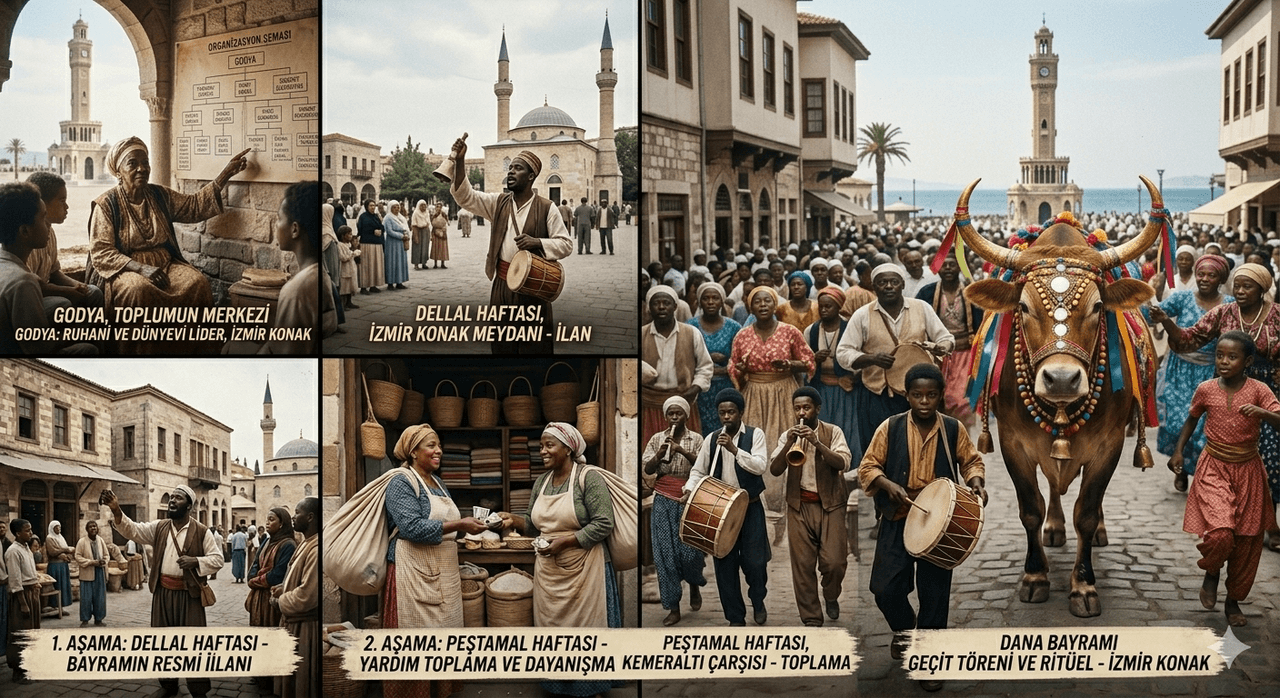
A Visual Depicting the Rituals and Phases (Generated by Artificial Intelligence)
During the third week of the celebration, the “Dana Bayramı” is enacted through a grand procession and sacrificial ritual. The carefully selected and purchased bull is washed beforehand; its horns are gilded and its body adorned with colorful ribbons, mirrors, bells, and beads. Following Friday prayers, a large crowd led by the godyas and community members parades through the city center, accompanied by traditional musical instruments (drum, zurna, and unique rhythmic string instruments). The rhythmic dances performed during this procession represent the public expression of the African cultural heritage.
In the final stage of the ceremony, meals are prepared from the sacrificed bull’s meat, distributed to all participants, and communal feasts are held. Today, this tradition continues as a modern cultural event under the format of a “spring festival,” facilitated by civil society organizations.
Dana Bayramı and its associated rituals were known by local names across different centers of the Ottoman territory. In İzmir and its surroundings, the tradition crystallized as “Dana Bayramı,” while in Istanbul it was celebrated under the name “Arap Düğünü,” particularly on the hills of Çamlıca. In Istanbul’s celebrations, the person assuming leadership was not called “godya” as in İzmir, but rather “kolbaşı.” Despite these regional variations, the core origin of the tradition lies in the Yoruba culture of present-day Nigeria and its belief system【6】.
The withdrawal of Dana Bayramı from public life and the cessation of its practice are directly linked to the modernization initiatives and legal reforms of the early Turkish Republic. The concrete turning point was the enactment on 30 November 1925 of Law No. 677, the “Law on the Closure of Tekkes, Zaviyes, and Türbes and the Abolition of Titles Such as Sheikh and Dervish”【7】. This law not only closed religious structures but also outlawed traditional healing practices deemed “witchcraft, incantation, and sorcery,” along with associated titles such as “sheikh” and “dervish.” The “godyalık” institution, due to its ritualistic and belief-based elements, was included within this legal scope. The legal erasure of godyas’ social status and the prohibition of traditional ceremonies led to the collapse of the festival’s institutional structure.
In addition to legal barriers, the nation-building and cultural homogenization policies adopted during the Republic era suppressed the Afro-Turk community’s distinct identity. The tendency to avoid appearing as a “different” group in public life pushed the community inward, accelerating assimilation. During this period, Afro-Turks chose to become invisible under the identity of “modern Turkish citizens,” distancing themselves from the trauma of slavery and the rituals that evoked it.
Another dimension of the forgetting process is collective memory loss. For approximately eighty years, from the 1920s to the 2000s, knowledge of Dana Bayramı survived only in the memories of the elderly generation. The discontinuation of rituals led to the loss of their symbolic meanings and the weakening of the ethno-cultural bonds that united the Afro-Turk community.
The return of Dana Bayramı to public life after nearly eighty years of silence resulted from a “cultural revival” movement that began in the mid-2000s. The institutional foundation of this movement was laid by the Afrikalılar Kültür, Dayanışma ve Yardımlaşma Derneği (Association for African Culture, Solidarity, and Mutual Aid), founded in Ayvalık in 2006 and later relocating its headquarters to İzmir【8】. Through the personal initiative of the association’s founding president, Mustafa Olpak, and the efforts of community members, Dana Bayramı was revived in İzmir and its surroundings from 2007 onward under a modern organizational structure.
Current celebrations have shifted from the historical focus on “sacrifice” and “spiritual healing” to a public-facing “Spring Festival” format. The primary aim of this transformation is to heal the memory of slavery, remove Afro-Turk identity from discriminatory frameworks based on skin color, and anchor it firmly within a framework of cultural heritage.
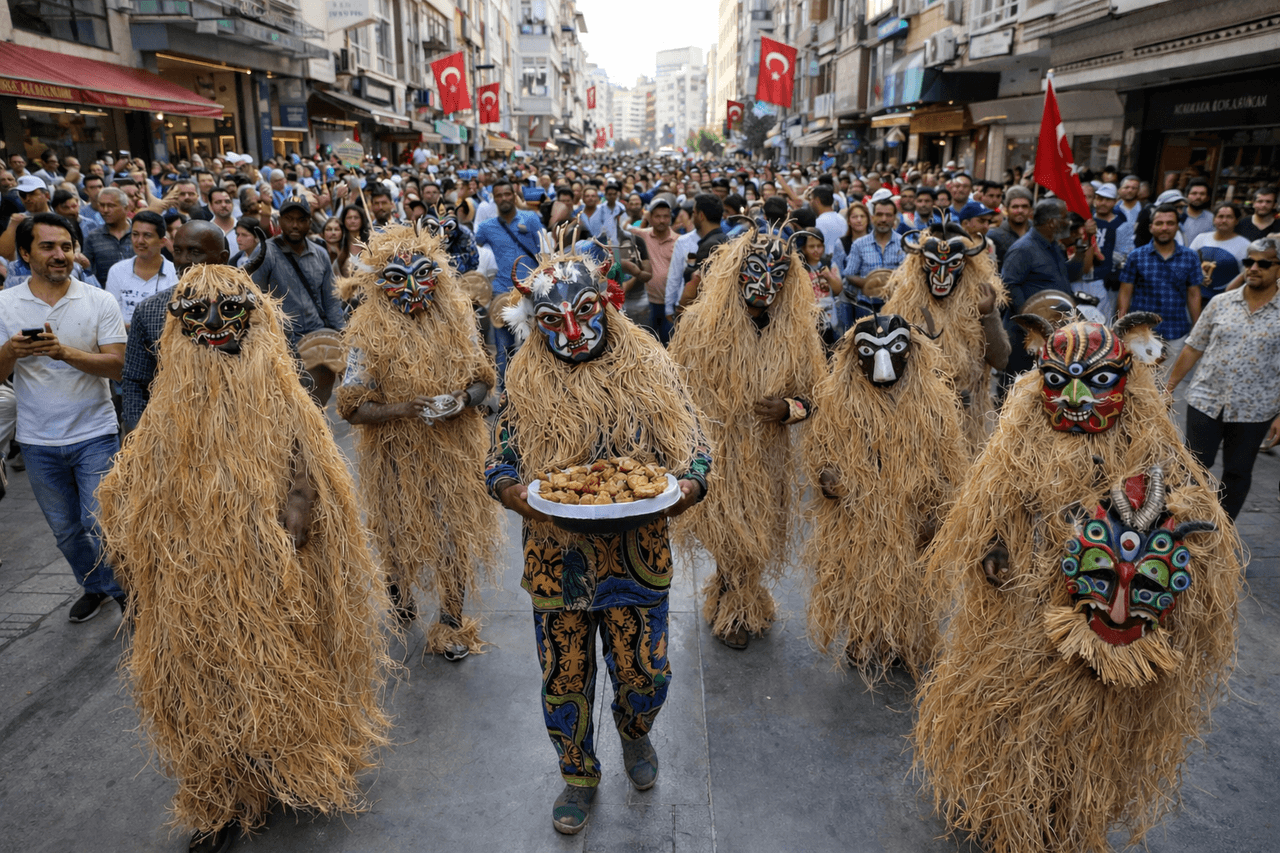
A Visual Depicting Dana Bayramı (Generated by Artificial Intelligence)
Events have been developed to include symposiums, photo exhibitions, traditional food tastings, and musical parades. With the support of the Ministry of Culture and Tourism, local municipalities, and civil society organizations, this process has transformed the festival from a local tradition into a nationally and internationally recognized “cultural heritage” element.
In this new era, Dana Bayramı serves not only as a gathering point for the Afro-Turk community but also as a platform for public awareness. Guided by the slogan “We are here too,” the community uses this celebration to research, document, and assert its right to representation in the public sphere【9】. The visibility generated by modern celebrations has increased academic interest in the subject and led to a rise in ethnographic studies on Afro-Turks.
Historically, Dana Bayramı functioned for the Afro-Turk community not merely as a seasonal celebration but as a mechanism for social solidarity, identity representation, and cultural transmission. Although organized directly by the Afro-Turk community and its spiritual leaders, the godyas, the public nature of the events granted the festival a festival-like character open to the entire city population. In cosmopolitan centers such as İzmir, diverse ethnic and religious groups followed these ceremonies with interest.
A prominent sociological function of the festival is collective performance, which strengthens internal group bonds. Competitive games, rhythmic performances, and processions organized between Afro-Turk groups from different neighborhoods or regions created spaces of both competition and solidarity that enhanced the community’s internal hierarchy and sense of belonging.
From the perspective of cultural memory, Dana Bayramı served as a “memory space” preserving the historical roots, beliefs, and social norms of the African diaspora【10】. For a community without a written history, this festival was a vital platform for transmitting oral traditions, healing knowledge, and origin narratives to new generations.
[1]
Mustafa Olpak, “Osmanlı İmparatorluğu’nda Köle, Türkiye Cumhuriyeti’nde Evlatlık: Afro-Türkler”. Ankara Üniversitesi SBF Dergisi 68 (01): 131. https://doi.org/10.1501/SBFder_0000002275.
[2]
Mustafa Olpak, “Osmanlı İmparatorluğu’nda Köle, Türkiye Cumhuriyeti’nde Evlatlık: Afro-Türkler”. Ankara Üniversitesi SBF Dergisi 68 (01): 132. https://doi.org/10.1501/SBFder_0000002275.
[3]
Mustafa Olpak, “Osmanlı İmparatorluğu’nda Köle, Türkiye Cumhuriyeti’nde Evlatlık: Afro-Türkler”. Ankara Üniversitesi SBF Dergisi 68 (01): 131-132. https://doi.org/10.1501/SBFder_0000002275.
[4]
Mustafa Olpak, “Osmanlı İmparatorluğu’nda Köle, Türkiye Cumhuriyeti’nde Evlatlık: Afro-Türkler”. Ankara Üniversitesi SBF Dergisi 68 (01): 131-132. https://doi.org/10.1501/SBFder_0000002275.
[5]
Füsun Kökalan Çımrın, "Kayıp Geçmişin İzinde: Ege Bölgesinde Yaşayan Afro-Türkler Üzerine Etnografik Bir Araştırma." Sosyal ve Beşeri Bilimler Araştırmaları Dergisi, 25(55), 187, Erişim 28 Şubat 2026. https://doi.org/10.70854/sobbiad.1553561.
[6]
Mustafa Olpak, “Osmanlı İmparatorluğu’nda Köle, Türkiye Cumhuriyeti’nde Evlatlık: Afro-Türkler”. Ankara Üniversitesi SBF Dergisi 68 (01): 132. https://doi.org/10.1501/SBFder_0000002275.
[7]
Füsun Kökalan Çımrın, "Kayıp Geçmişin İzinde: Ege Bölgesinde Yaşayan Afro-Türkler Üzerine Etnografik Bir Araştırma." Sosyal ve Beşeri Bilimler Araştırmaları Dergisi, 25(55), 186, Erişim 28 Şubat 2026. https://doi.org/10.70854/sobbiad.1553561.
[8]
Mustafa Olpak, “Osmanlı İmparatorluğu’nda Köle, Türkiye Cumhuriyeti’nde Evlatlık: Afro-Türkler”. Ankara Üniversitesi SBF Dergisi 68 (01): 135-136. https://doi.org/10.1501/SBFder_0000002275.
[9]
Mustafa Olpak, “Osmanlı İmparatorluğu’nda Köle, Türkiye Cumhuriyeti’nde Evlatlık: Afro-Türkler”. Ankara Üniversitesi SBF Dergisi 68 (01): 141. https://doi.org/10.1501/SBFder_0000002275.
[10]
Mustafa Olpak, “Osmanlı İmparatorluğu’nda Köle, Türkiye Cumhuriyeti’nde Evlatlık: Afro-Türkler”. Ankara Üniversitesi SBF Dergisi 68 (01): 129-130. https://doi.org/10.1501/SBFder_0000002275.

Dana Bayramı (Yapay Zeka ile Oluşturulmuştur.)
Historical Background and Origins
Godyas and Healing in Popular Memory
Celebration Rituals and Organization
Regional Names and Cultural Origins
Suppression and Forgetting
Revival Period
Socio-Cultural Function and Participation