


This article was automatically translated from the original Turkish version.
+1 More
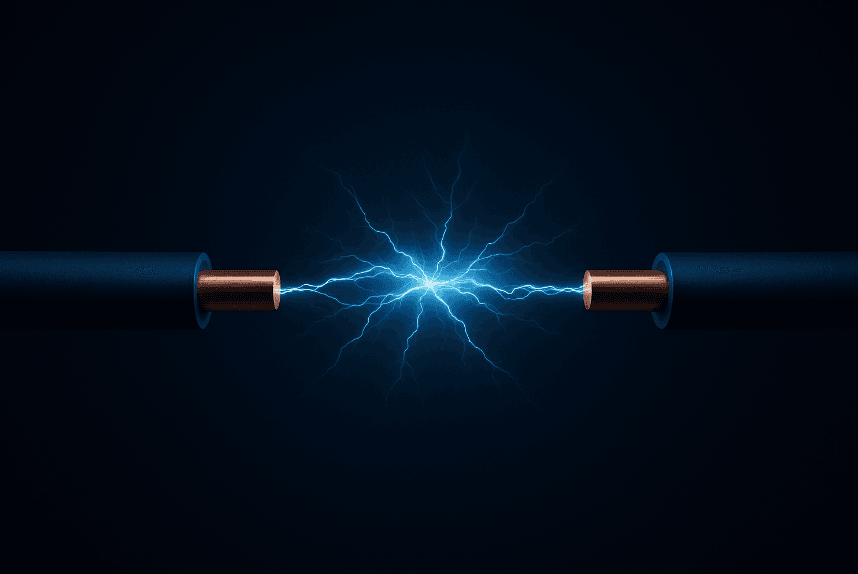
Electric Arc
What Is an Electric Arc? | An electric arc is a continuous discharge created by high current in a gaseous medium. | ||||||||
|---|---|---|---|---|---|---|---|---|---|
Typical Duration | Milliseconds | ||||||||
Typical Current Level | 10-100 kA | ||||||||
Standard | IEC 60909 | ||||||||
Protective Devices | Fuse, Relay, Circuit Breaker | ||||||||
An electric arc is a continuous electrical discharge that occurs when a high electric current flows between two conductive surfaces through air or another gaseous medium. This phenomenon, commonly observed in low-voltage, high-current environments, has numerous industrial applications including welding, electric circuit breakers, and plasma generation. Due to the intense heat and light it emits, an electric arc can be both technologically useful and hazardous from a safety perspective.

Electric Arc (Generated by Artificial Intelligence)
An electric arc typically forms when electrical contact between two conductors is broken or when a switch is opened. In this situation, the voltage difference exceeds the dielectric strength of the intervening gas, initiating ionization. Free electrons in the medium accelerate and collide with gas molecules, ionizing them and forming a plasma channel. Current continues to flow steadily through this channel, allowing the arc to sustain itself.

Formation of an Electric Arc (Generated by Artificial Intelligence)
The ionization of gas molecules forms the basis of an electric arc. When a sufficient electric field is established, free electrons gain energy and collide with gas atoms, producing additional free electrons. This chain reaction creates a plasma environment that ensures the continuity of the arc.
An electric arc is characterized by low voltage (typically 30–100 V) and high current (several thousand amperes). Temperatures during arcing can exceed 3,000 °C, making it powerful enough to melt surrounding metals and potentially cause fires. Due to its intense light emission, an arc must not be observed without proper welding eye protection.
Electric arcs are classified into different types based on their environment and method of control.
Formed when two conductive surfaces move apart. Commonly encountered in welding machines and circuit breakers.
Arcs directed within specific boundaries in an insulating gaseous medium. Used in plasma cutters and industrial plasma devices.
An electric arc formed in a vacuum environment, commonly observed in vacuum contactors. Due to the different ionization properties of a vacuum, its conduction mechanism differs from that in gaseous media.
Under controlled conditions, electric arcs serve as highly functional tools.
The most common application. An arc is generated between two metal surfaces to melt and join them together.
Arcs are used to interrupt excessive current in electrical circuits. Special arc-extinguishing chambers are employed to prevent uncontrolled propagation.
Electric arcs are utilized to produce plasma. High-temperature plasmas generated in this way are used in industrial furnaces and material processing.
Exposure to an electric arc can lead to serious health and safety hazards. Therefore, personal protective equipment such as protective clothing, gloves, and eye protection must always be worn. Additionally, automatic arc detection and circuit interruption systems are critical for workplace safety.

Protective Clothing Equipment (Generated by Artificial Intelligence)
Institute of Electrical and Electronics Engineers. IEEE Standard 1584-2018: Guide for Performing Arc-Flash Hazard Calculations. New York: IEEE, 2018.
Küçük, Mehmet. "Elektriksel Arkın Teorisi ve Uygulamaları." TMMOB Elektrik Mühendisleri Odası Dergisi 15, no. 2 (2010): 22–30.
Lieberman, Michael A., and Allan J. Lichtenberg. Principles of Plasma Discharges and Materials Processing. Hoboken, NJ: Wiley, 2005.

Electric Arc
What Is an Electric Arc? | An electric arc is a continuous discharge created by high current in a gaseous medium. | ||||||||
|---|---|---|---|---|---|---|---|---|---|
Typical Duration | Milliseconds | ||||||||
Typical Current Level | 10-100 kA | ||||||||
Standard | IEC 60909 | ||||||||
Protective Devices | Fuse, Relay, Circuit Breaker | ||||||||
Formation of an Electric Arc
Ionization Process
Characteristics of an Electric Arc
Types of Electric Arcs
Free Arc
Controlled Arc
Vacuum Arc
Industrial Applications
Arc Welding
Circuit Breakers
Plasma Generation
Safety Measures