


This article was automatically translated from the original Turkish version.
+1 More
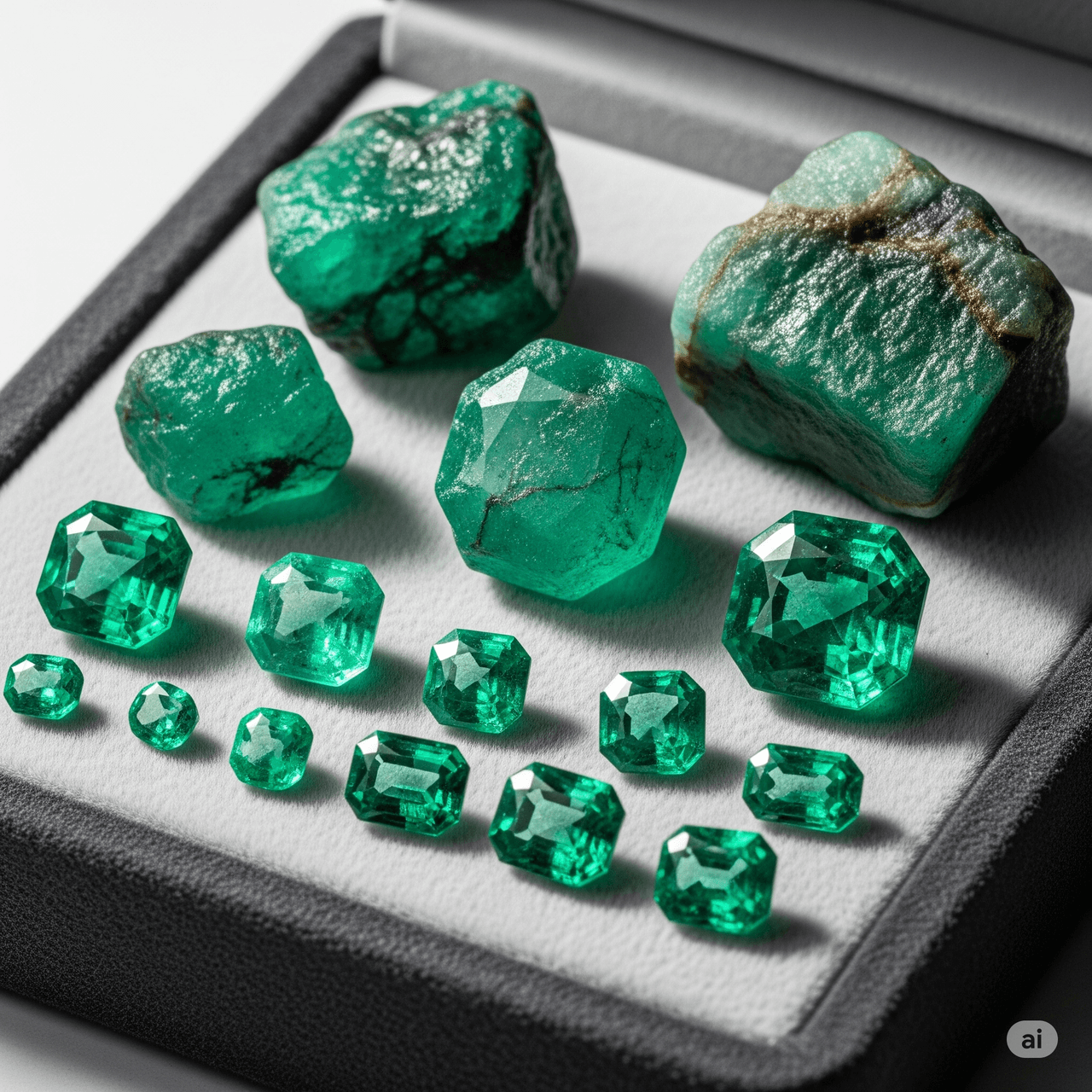
Emerald
Mineral Group | Beryl (Be₃Al₂Si₆O₁₈) | ||||||||
|---|---|---|---|---|---|---|---|---|---|
Color | Green (Chromium and/or Vanadium Source) | ||||||||
Hardness (Mohs) | 7.5–8 | ||||||||
Specific Gravity | 2.67–2.78 | ||||||||
Crystal System | Hexagonal | ||||||||
Major Production Regions | Russia Pakistan Afghanistan Brazil Zambia Colombia | ||||||||
Applications | Jewelry, Collection | ||||||||
Emerald is a precious and green variety of the beryl mineral group. The presence of chromium and vanadium imparts to emerald its characteristic green color. Throughout history, it has been valued by various civilizations for its aesthetic appeal, rarity, and symbolic meanings. Across a wide geographical range—from ancient Egypt to medieval Europe, and from South American civilizations to Asian cultures—emerald has been associated with concepts such as power, fertility, immortality, and protection. Today, emerald holds a significant place in the jewelry industry and is also valued for its role in collecting and cultural heritage.
Emerald is a variety of beryl, with the chemical formula Be₃Al₂Si₆O₁₈, enriched with chromium and/or vanadium. These elements are responsible for emerald’s distinctive green color. It has a hardness of 7.5–8 on the Mohs scale but is often brittle due to frequent inclusions within its internal structure.
Emeralds typically form through pegmatitic and hydrothermal processes. In these environments, beryl crystallizes in media rich in chromium and vanadium. Emerald deposits are usually associated with metamorphic rocks and require specific geological conditions for their formation.

Geological Formation of Emerald (Generated by Artificial Intelligence.)
Significant emerald deposits are found worldwide in Colombia, Zambia, Brazil, Afghanistan, Pakistan, and Russia. Colombia is particularly renowned for high-quality emeralds from the Muzo, Coscuez, and Chivor regions. In Zambia, the Kagem mine is a major source of emerald.
In ancient Egypt, emerald was regarded as a symbol of fertility and rebirth. Queen Cleopatra is known to have had a special affinity for emeralds and frequently used them in her jewelry. In ancient Rome, emerald was associated with Venus and viewed as a symbol of love.
In medieval Europe, emerald was believed to possess protective and healing properties. It was also thought to bring truth and loyalty to its wearer. During the Renaissance, emerald was seen as a source of inspiration for intellectual and artistic endeavors.
Today, emerald is associated with the month of May as a birthstone and is recognized as a symbol of love, fidelity, and rebirth. Moreover, emeralds occupy an important position in the world of jewelry as indicators of luxury and prestige.
Emerald is one of the most prized gemstones in the jewelry industry. It is commonly used in rings, necklaces, earrings, and bracelets. Due to its brittle nature, cutting and setting require great care. The “emerald cut,” a rectangular step-cut, is most frequently preferred.
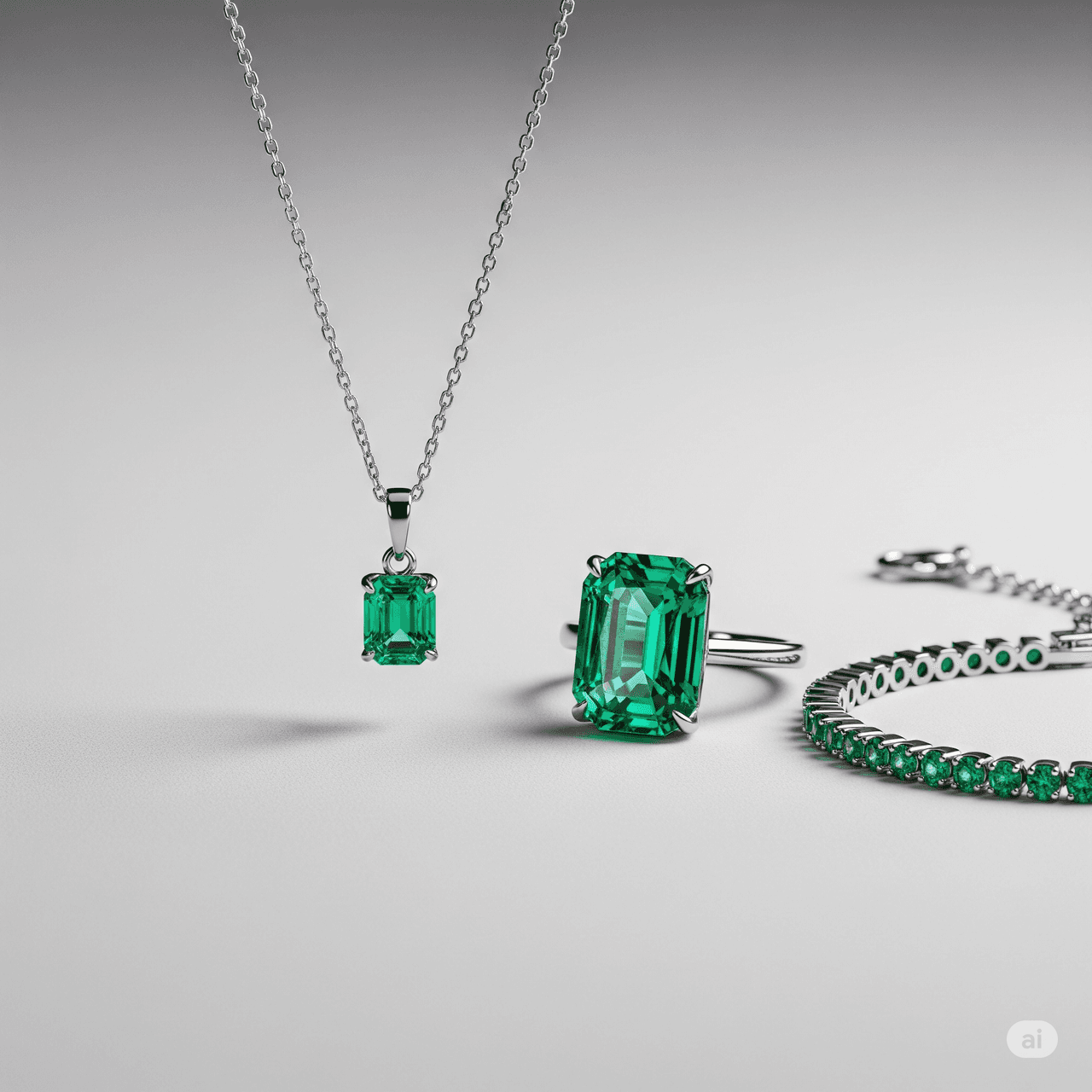
Use of Emerald in Ornamental Objects (Generated by Artificial Intelligence.)
Throughout history, emerald has been used not only in jewelry but also in ornamental objects and decorative items. In ancient Rome, emeralds were incorporated into mosaics and decorative artifacts. During the Middle Ages, they were used in religious objects and royal regalia. Today, emeralds serve as an aesthetic element in luxury watches, pens, and other decorative items.
Aurisicchio, Carlo, Aida M. Conte, Laura Medeghini, Luisa Ottolini, and Caterina De Vito. “Major and Trace Element Geochemistry of Emerald from Several Deposits: Implications for Genetic Models and Classification Schemes.” *Ore Geology Reviews* 94 (2018): 351–366. Accessed May 20, 2025. https://www.sciencedirect.com/science/article/abs/pii/S0169136817307886
Giuliani, Gaston, Lee Groat, Daniel Marshall, Andrew Fallick, and Yves Branquet. “Emerald Deposits: A Review and Enhanced Classification.” *Minerals* 9, no. 2 (2019): 105. Accessed May 22, 2025. https://doi.org/10.3390/min9020105
Jennings, R. H., R. C. Karnmerling, A. Kovaltchouk, G. R. Calderon, M. K. El Baz, J. I. Koivula. “Emeralds And Green Beryls Of Upper Egypt.” Gems & Gemology 29, no. 2 (1993): 100–115. Accessed May 22, 2025. https://www.gia.edu/doc/Emeralds-and-Green-Beryls-of-Upper-Egypt.pdf
Krzemnicki, Michael S., H. A. O. Wang, Martin Wälle, Pierre Lefèvre, Wen Zhou, and Laurent E. Cartier. “Gemmological Characterisation of Emeralds from Musakashi, Zambia, and Implications for Their Geographic Origin Determination.” *The Journal of Gemmology* 39, no. 4 (2024): 338–350. Accessed May 22, 2025. https://www.ssef.ch/wp-content/uploads/2024/12/2024-Krzemnicki-et-al-musakashi-emeralds.pdf

Emerald
Mineral Group | Beryl (Be₃Al₂Si₆O₁₈) | ||||||||
|---|---|---|---|---|---|---|---|---|---|
Color | Green (Chromium and/or Vanadium Source) | ||||||||
Hardness (Mohs) | 7.5–8 | ||||||||
Specific Gravity | 2.67–2.78 | ||||||||
Crystal System | Hexagonal | ||||||||
Major Production Regions | Russia Pakistan Afghanistan Brazil Zambia Colombia | ||||||||
Applications | Jewelry, Collection | ||||||||
Geological Properties and Formation Process
Mineralogical Structure
Geological Formation
Main Emerald Deposits
Cultural and Historical Significance
Ancient Periods
Medieval and Renaissance Periods
Modern Era
Use in Jewelry and Ornamental Objects
Jewelry Industry
Ornamental and Decorative Use