


This article was automatically translated from the original Turkish version.
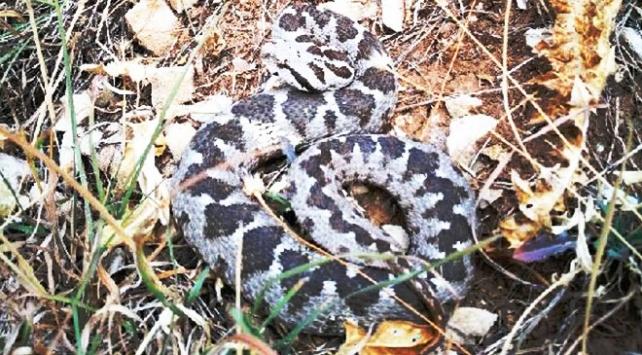
Engereggillidae
World | Animalia | ||||||||
|---|---|---|---|---|---|---|---|---|---|
Branch | Chordata | ||||||||
Class | Reptilia | ||||||||
Team(s) | Squamata | ||||||||
Family | Viperidae | ||||||||
Synonym | Viperidae Viperini Viperae | ||||||||
Viper is a general term encompassing venomous snake species belonging to the family Viperidae (vipers). These snakes are typically recognized by their stout bodies, triangular-shaped heads, and venomous fangs. Vipers exhibit a wide distribution across the continents of Europe, Asia, and Africa. Türkiye is a significant geographical region due to its hosting of many species within this family. These snakes play an important ecological role in their natural habitats and are also closely monitored due to their venomous nature.
Vipers are typically snakes with thick, short bodies and coloration ranging from gray, brown to yellow tones. Their heads are distinctly separated from the body and triangular in shape. They possess vertical, slit-shaped pupils. Their fangs are capable of folding forward and are used to immobilize prey.
These snakes generally range in length from 30 to 100 centimeters. Their skin often features zigzag or spotted patterns, which may vary depending on the environment they inhabit.
Vipers predominantly inhabit stony slopes, shrublands, forest clearings, and semi-arid regions. They favor basking in sunlight and are often observed in open areas during the hottest parts of the day. They are less active during nighttime. In Türkiye, they have been observed living in a wide variety of habitats, from the Black Sea forests to the arid slopes of Southeastern Anatolia.
The venom of vipers in most species exhibits hemotoxic (damaging to blood cells) or cytotoxic (causing tissue destruction) effects. Common symptoms at the bite site include severe pain, swelling, and discoloration. In advanced cases, tissue necrosis or systemic symptoms may develop. Due to their risk to human health, these species are closely monitored, especially in rural areas.
In cases of envenomation, prompt medical intervention is critical. Antivenom administration should be carried out in a healthcare facility under expert supervision whenever possible.
Many viper species are ovoviviparous, meaning they develop eggs internally and give birth to live young. Females typically reproduce once per year and may give birth to several to dozens of offspring. The young are venomous from birth and are immediately capable of independent life.
Vipers primarily feed on small mammals, lizards, frogs, and bird chicks. They ambush their prey while lying in wait. After venom immobilizes the prey, it is swallowed whole. These snakes can also provide indirect benefits to agricultural areas by helping to control rodent populations.
Türkiye is one of the richest countries in terms of viper species diversity. The following viper species naturally occur in various regions of Türkiye:
Some of these species are endemic to Türkiye, restricted to limited areas, and their conservation holds special importance.
Some viper species are threatened by habitat loss, climate change, and human activity. Particularly, endemic species have narrow distribution ranges, making population conservation critically important. In Türkiye, certain viper species are legally protected, and harming them in the wild is prohibited.
Snakes have carried various symbolic meanings throughout human history. Vipers have at times been associated with fear, and at other times with wisdom or healing. In ancient Anatolian beliefs, certain snake species were regarded as “protectors” or “doctor snakes.” The snake symbol used in modern medicine is historically rooted in observations of these species.
Baran, İbrahim, and Mehmet K. Atatür. *Türkiye Herpetofaunası: Kurbağa ve Sürüngenler*. Ankara: T.C. Çevre Bakanlığı, 1998. Accessed May 12, 2025. .
Göçmen, Bayram, and Mehmet Tosunoğlu. “Türkiye Engereklerinin Taksonomisi ve Yayılımı.” *Zooloji Dergisi*, 2001. Accessed May 12, 2025. .
Mallow, David, David Ludwig, and Göran Nilson. *True Vipers: Natural History and Toxinology of Old World Vipers*. Malabar, FL: Krieger Publishing Company, 2003. Accessed May 12, 2025. .
World Health Organization. *Guidelines for the Management of Snake-Bites*. 2nd ed. Geneva: WHO Regional Office for South-East Asia, 2010. Accessed May 12, 2025. https://www.who.int/publications/i/item/9789290225300.

Engereggillidae
World | Animalia | ||||||||
|---|---|---|---|---|---|---|---|---|---|
Branch | Chordata | ||||||||
Class | Reptilia | ||||||||
Team(s) | Squamata | ||||||||
Family | Viperidae | ||||||||
Synonym | Viperidae Viperini Viperae | ||||||||
Taxonomy
Definition and General Characteristics
Habitat and Distribution
Venom Properties
Reproduction
Diet
Species Found in Türkiye
Conservation Status
Cultural Implications