


This article was automatically translated from the original Turkish version.
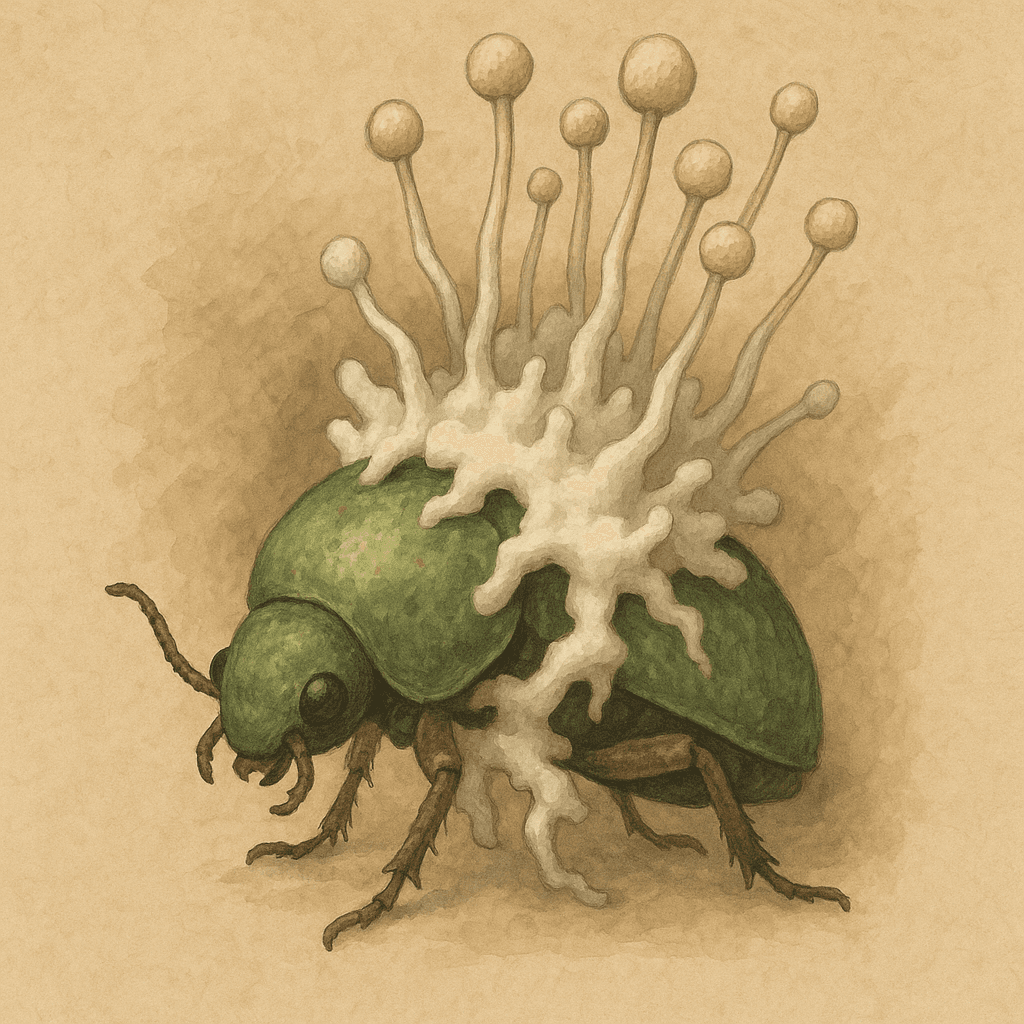
Entomopathogenic Fungi (Generated by Artificial Intelligence.)
Discovery(ies) | 1835 – Agostino Bassi | ||||||||
|---|---|---|---|---|---|---|---|---|---|
Important Team | Hypocreales | ||||||||
Important Species | Entomophthora muscae Cordyceps spp. Isaria fumosorosea Lecanicillium lecanii Metarhizium anisopliae Beauveria bassiana | ||||||||
Entomopathogenic fungi are pathogenic microorganisms commonly found in nature that infect insects and other arthropods, leading to their death. The term, derived from the Greek words “entomo” (insect) and “pathogen” (disease-causing), describes organisms that function as natural enemies in ecosystems and play a crucial role in suppressing pest insect populations. Their use in agriculture, forestry, and public health as biological control agents is increasingly widespread due to their environmental friendliness and ability to reduce the negative impacts of chemical pesticides.
Entomopathogenic fungi hold a significant place in the history of science regarding the discovery of pathogens. In 1835, Italian scientist Agostino Bassi demonstrated that a lethal disease affecting silkworms was caused by a fungus named Beauveria bassiana. This finding is recognized as the first scientific evidence that a fungus could cause an insect disease. Bassi’s work marked a turning point not only for entomology and microbiology but also for understanding the microbial origins of infectious diseases.
Taxonomically, entomopathogenic fungi are distributed across different phyla of the fungal kingdom, with the greatest species diversity found in the Ascomycota and Zygomycota divisions. The order Hypocreales, in particular, includes many species of major importance in agricultural biological control. Agriculturally significant species include B. bassiana, Metarhizium anisopliae, Lecanicillium lecanii, Isaria fumosorosea, and species of Cordyceps. B. bassiana is effective against cotton leafworm (Spodoptera littoralis), thrips, and whiteflies; M. anisopliae is used against locusts, soil pests, termites, and some forest insects; L. lecanii is preferred for controlling whiteflies and aphids. Additionally, Entomophthora muscae, belonging to the order Entomophthorales, is a species capable of causing natural outbreaks in flies. Species of Cordyceps are known for their visually striking sporulating structures that emerge from the bodies of infected insects.
The infection process begins when fungal spores (conidia) come into contact with the insect’s outer skeleton (cuticle).
Entomopathogenic fungi are key biotic factors that naturally regulate pest insect populations in ecosystems. They have broad application potential in agricultural settings including greenhouses, open fields, orchards, and forest ecosystems. For example, B. bassiana has been effective against cotton leafworm (Spodoptera littoralis), thrips, and whiteflies; M. anisopliae has shown efficacy against locusts (Locusta migratoria), wireworms (Agriotes spp.), and termites. Some Metarhizium and Beauveria isolates also show potential against mosquito larvae and are being evaluated for controlling vector-borne diseases such as malaria and dengue fever.
Entomopathogenic fungi offer advantages such as environmental safety, high specificity toward target pests, and slow development of resistance in insects. However, their efficacy is directly influenced by environmental factors including temperature, humidity, and UV radiation. Additionally, commercial production and formulation of some species can be costly. Therefore, ensuring suitable environmental conditions in field applications and developing effective formulations are of great importance.
In recent years, research on entomopathogenic fungi has focused on enhancing their efficacy under laboratory conditions and overcoming limitations encountered in field applications. Genetic engineering and molecular biology techniques are intensively used to increase toxin production capacity, confer resistance to environmental stressors (UV radiation, low humidity, high temperature), and optimize host specificity. Gene editing technologies, particularly the CRISPR/Cas9 system, enable manipulation of fungal pathogenicity genes, offering faster and more effective lethality against target pests.
Nanotechnology-based formulation studies are drawing attention for their ability to protect fungal spores and enhance targeted delivery. Nanoencapsulation techniques isolate fungal spores from environmental factors, extending shelf life and improving post-application efficacy. Particularly oil-based nanoformulations provide prolonged adhesion to leaf surfaces and protection against moisture loss.
Another research direction investigates the ability of entomopathogenic fungi to promote plant growth and enhance stress tolerance. Some Metarhizium and Beauveria species have been shown to colonize plant roots and adopt an endophytic lifestyle, thereby supporting plant health and naturally suppressing pests approaching the rhizosphere. This characteristic holds significant potential for integrating biological control with plant growth promotion.
Combination strategies are also gaining importance. Applying entomopathogenic fungi alongside entomopathogenic nematodes, bacteria (Bacillus thuringiensis), or low doses of selected chemical pesticides creates synergistic effects and reduces the risk of pest resistance. In addition, systems that release fungal spores in conjunction with pheromone traps are being developed to directly infect pests and have yielded promising results in field trials.
The spread of new pest species due to climate change and shifts in population dynamics of existing species are further increasing the importance of entomopathogenic fungi. In tropical and subtropical regions, rising temperatures and humidity may expand the natural distribution range of these fungi, while in arid regions, research continues to develop drought-tolerant strains for effective use. In the coming years, entomopathogenic fungi are expected to find broader applications not only as biopesticides but also as essential components of ecosystem restoration, vector-borne disease control, and integrated pest management programs.
Güner, Pınar, Tülin Aşkun, and Aylin Er. "Entomopathogenic Fungi and Their Potential Role In The Sustainable Biological Control Of Storage Pests." *Commagene Journal of Biology* 7(1) (2023): 90-97. Accessed August 13, 2025. https://doi.org/10.31594/commagene.1284354
Idrees, A., Qadir, Z.A., Akutse, K.S., Afzal, A., Hussain, M., Islam, W., et al. "Effectiveness of Entomopathogenic Fungi on Immature Stages and Feeding Performance of Fall Armyworm, Spodoptera frugiperda (Lepidoptera: Noctuidae) Larvae." *Insects*, 12, (2021): 1044. Accessed August 13, 2025. https://doi.org/10.3390/insects12111044
Meyling, N.V. and Pell, J.K. "Detection and Avoidance of an Entomopathogenic Fungus by a Generalist Insect Predator." *Ecological Entomology*, 31(2) (2006): 162–71. Accessed August 13, 2025. https://doi.org/10.1111/j.0307-6946.2006.00781.x

Entomopathogenic Fungi (Generated by Artificial Intelligence.)
Discovery(ies) | 1835 – Agostino Bassi | ||||||||
|---|---|---|---|---|---|---|---|---|---|
Important Team | Hypocreales | ||||||||
Important Species | Entomophthora muscae Cordyceps spp. Isaria fumosorosea Lecanicillium lecanii Metarhizium anisopliae Beauveria bassiana | ||||||||
No Discussion Added Yet
Start discussion for "Entomopathogenic Fungi" article
History
Taxonomy and Species Diversity
Life Cycle and Infection Mechanism
Ecological and Agricultural Importance
Advantages and Limitations
Current Research