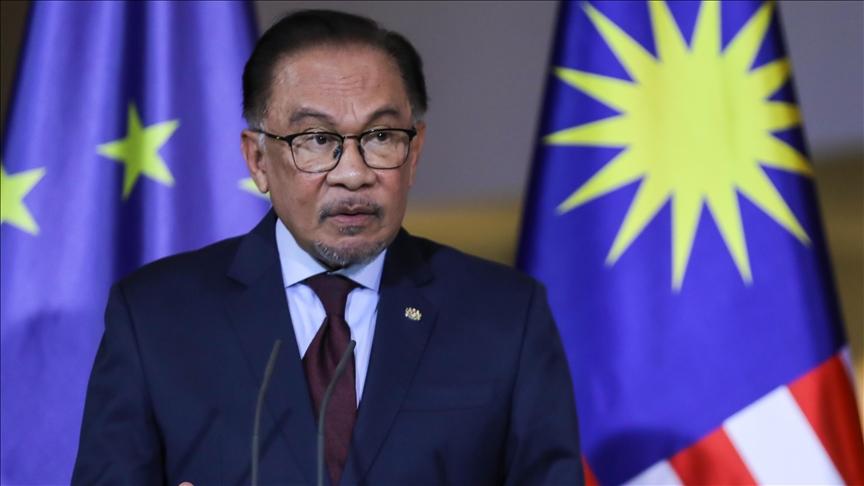
Doğum tarihi | 1947-08-10 | ||||||||
|---|---|---|---|---|---|---|---|---|---|
Eş | Wan Azizah Wan Ismail | ||||||||
Place of Birth | Malaysia | ||||||||
Education | University of Malaya - Malay Studies | ||||||||
Yaş | 78 | ||||||||
Anwar Ibrahim (b. 1947) is a politician whose career spans from student movements in Malaysian politics to the center of power, marked by prolonged imprisonment and eventual ascent to prime minister. His career has been directly shaped by the country’s political transformations over the last half century.
Anwar bin Ibrahim was born on 10 August 1947 in Bukit Mertajam, in the state of Penang, Malaysia. He completed his primary and secondary education in Penang. During secondary school he studied at Malay College Kuala Kangsar, where he became involved in student activities and intellectual debates. He continued his university education at the University of Malaya, earning a bachelor’s degree in Malay Studies. During his university years he gained recognition for his activism focused on student movements social justice and rural poverty a period that proved decisive in shaping his later political and social orientation.
In his youth he played an active role in student movements particularly standing out in protests addressing rural poverty income inequality and food security. During this time he adopted a political stance that combined Islamic thought with an emphasis on social justice.
In the 1970s he assumed a leadership role in activities centered around Angkatan Belia Islam Malaysia (ABIM) one of the key organizations of Malaysia’s Islamic youth movement. These activities brought him into public prominence and attracted the attention of state security apparatuses. He was arrested and detained under security laws.
In 1982 Anwar Ibrahim joined the United Malays National Organisation (UMNO) at the invitation of then Prime Minister Mahathir Mohamad. This move marked a turning point that transitioned him from a critic of the system to a central figure within the ruling establishment.
He rose rapidly within UMNO holding various cabinet positions including those related to youth and sports agriculture and education. In 1993 he was appointed Deputy Prime Minister and simultaneously Minister of Finance. During this period Anwar Ibrahim was regarded as a potential successor to Mahathir Mohamad and became associated with economic management and public administration reforms.
During the 1997 Asian financial crisis significant policy disagreements emerged between Anwar Ibrahim and Mahathir Mohamad over economic management corruption control and governance philosophy. In 1998 Anwar Ibrahim was dismissed from his posts and expelled from UMNO.
Later that year he was arrested on charges of corruption and sodomy. His trial generated widespread反响 both domestically and internationally. It was later officially acknowledged that he had been beaten during detention. This period laid the groundwork for the Reformasi movement a mass protest movement that emerged demanding democratization rule of law and an end to corruption.
Following his conviction in 1998 Anwar Ibrahim entered prison. In 2004 the Federal Court overturned his sodomy conviction and ordered his release. After his release he became a central figure in opposition politics.
During this period he continued his political activities through the Keadilan movement led by his wife Wan Azizah Ismail and later through multi-party opposition coalitions. In the 2008 and 2013 general elections opposition blocs weakened the long-standing parliamentary dominance of the Barisan Nasional coalition.
During the period when the opposition gained strength Anwar Ibrahim was retried on new sodomy charges and sentenced to prison again in 2015. This trial occurred under the administration of Najib Razak. The legal proceedings were widely viewed by opposition groups and civil society as politically motivated.
Prior to the 2018 general elections a political reconciliation was reached between Anwar Ibrahim and Mahathir Mohamad. After the opposition coalition won the elections Anwar Ibrahim was pardoned by the King of Malaysia and released. This period was shaped by expectations that Mahathir Mohamad would hand over the prime ministership to Anwar Ibrahim. However due to internal developments within the government this transition never occurred.
The November 2022 general elections produced a parliamentary outcome in which no single coalition secured a clear majority for the first time in Malaysian history. After several days of political uncertainty the King of Malaysia appointed Anwar Ibrahim to form a government. Thus after a political struggle and interruptions spanning approximately twenty-five years Anwar Ibrahim was sworn in as Malaysia’s 10th Prime Minister.
Upon assuming office he announced his goal of forming a national unity government and identified combating corruption economic recovery and social balance as his top priorities.
He is married to Wan Azizah Wan Ismail a medical doctor and politician. During Anwar Ibrahim’s periods of imprisonment Wan Azizah played an active role in sustaining the political struggle and emerged as one of the leading figures of Malaysia’s opposition movement.
Al Jazeera. "The Wild Ride of Anwar Ibrahim." Al Jazeera, May 3, 2013. Accessed January 7, 2026. https://www.aljazeera.com/features/2013/5/3/the-wild-ride-of-anwar-ibrahim
Anadolu Ajansı. "Malezya Başbakanı İbrahim: ABD, Burada İşlenen Ağır Suçları Ayakta Alkışlıyor." Anadolu Ajansı, September 5, 2024. Accessed January 7, 2026. https://www.aa.com.tr/tr/dunya/malezya-basbakani-ibrahim-abd-burada-islenen-agir-suclari-ayakta-alkisliyor/3322311
BBC News. “Who Is Anwar Ibrahim, the Malaysian PM?” BBC News, October 28, 2025. Accessed January 7, 2026. https://www.bbc.com/news/articles/clykv99zrnro
CBC News. “Anwar Ibrahim’s Hard-to-Believe Journey from Prisoner to New Malaysian Prime Minister.” CBC News, November 24, 2022. Accessed January 7, 2026. https://www.cbc.ca/news/world/malaysia-anwar-ibrahim-profile-1.6662722
CNN. Chen, Heather. “From Prisoner to Prime Minister: The Remarkable Rise of Malaysia’s Anwar Ibrahim.” CNN, November 25, 2022. Accessed January 7, 2026. https://edition.cnn.com/2022/11/25/asia/anwar-ibrahim-malaysia-new-prime-minister-explainer-intl-hnk
Center for Strategic and International Studies (CSIS). Lemière, Sophie. “The Death of Reformasi: Anwar Ibrahim, UMNO, and the Betrayal of a Movement.” CSIS, November 1, 2024. Accessed January 7, 2026.
WIONews. "The Roller-Coaster Life of Malaysia’s Anwar Ibrahim." WIONews, May 15, 2018. Accessed January 7, 2026. https://www.wionews.com/south-asia/the-roller-coaster-life-of-malaysias-anwar-ibrahim-137384

Doğum tarihi | 1947-08-10 | ||||||||
|---|---|---|---|---|---|---|---|---|---|
Eş | Wan Azizah Wan Ismail | ||||||||
Place of Birth | Malaysia | ||||||||
Education | University of Malaya - Malay Studies | ||||||||
Yaş | 78 | ||||||||
Early Life Education and Student Activism
Joining UMNO and Rise Within the State
Asian Financial Crisis and the Reformasi Movement
Imprisonment Release and Leadership of the Opposition
Retrial and Second Imprisonment
2018 Political Reconciliation and Royal Pardon
2022 Elections and Prime Ministership
Family Life