

This article was automatically translated from the original Turkish version.
+2 More
Nickname(s) | De Zwaan (Swan) | ||||||||
|---|---|---|---|---|---|---|---|---|---|
Length(s) | 802 metres | ||||||||
Height(s) | 139 metres | ||||||||
Type(s) | Cable-stayed Bridge | ||||||||
Design | Ben van Berkel | ||||||||
Opening Year | 1996 | ||||||||
River | Nieuwe Maas | ||||||||
Location | Rotterdam Netherlands | ||||||||
Transportation Types | Vehicle Pedestrian Bicycle Tram | ||||||||
Support System | Steel Pylon Cable System | ||||||||
Regions Connected | Kop van Zuid City Center | ||||||||
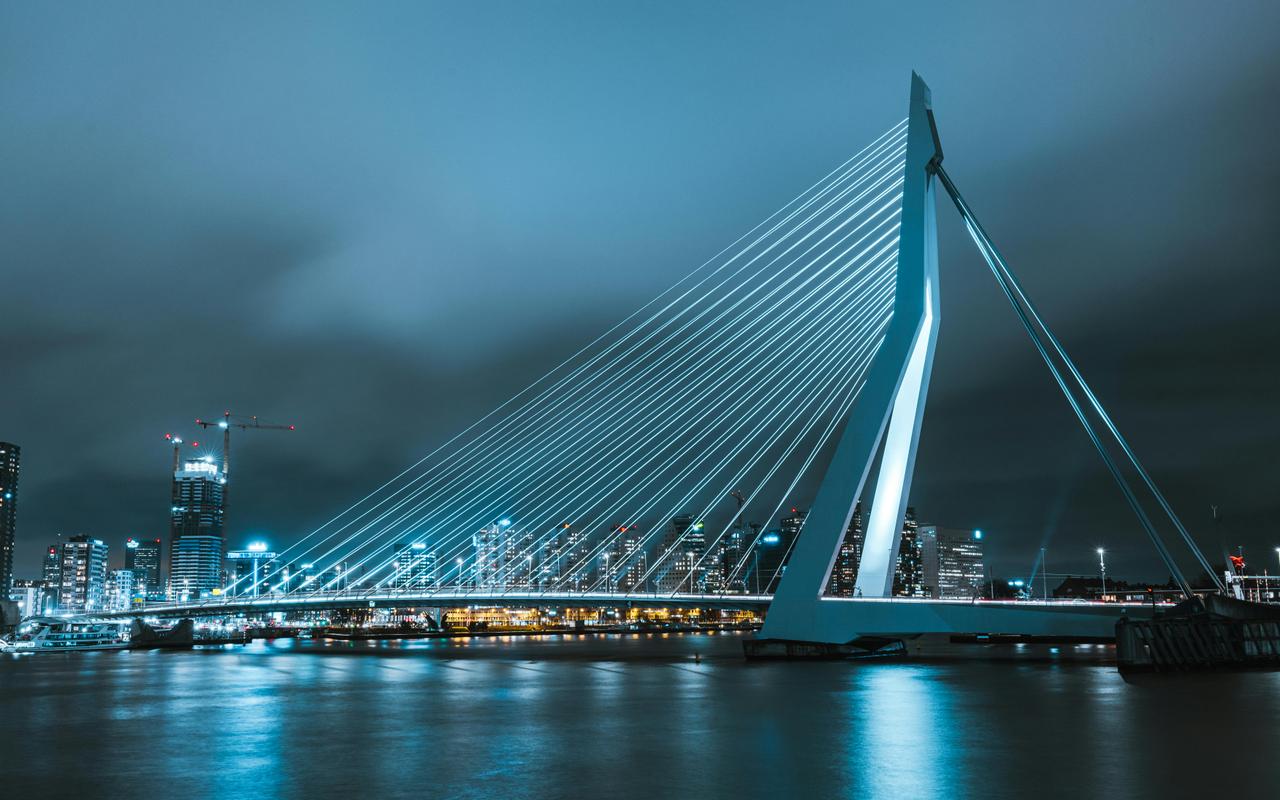
Erasmus Bridge is a bridge spanning the Nieuwe Maas River in the city of Rotterdam, Netherlands, connecting the northern and southern banks of the city. The bridge links the city center with the Kop van Zuid area on the southern bank. It carries lanes for motor vehicle traffic, tram lines, a bicycle path, and a pedestrian walkway. The bridge is also known by the nickname De Zwaan (The Swan). The bridge was opened to service in 1996.
Erasmus Bridge (Pixabay)
The design of the Erasmus Bridge was completed in 1990 by Ben van Berkel. Construction began in 1992 and lasted four years. The bridge was officially opened on 4 September 1996, with the ceremony performed by Queen Beatrix of the Netherlands. The bridge was planned as part of Rotterdam’s urban transformation following its reconstruction after World War II, aiming to connect the city center with the newly developed Kop van Zuid area. Its opening established a new transportation link within the city. 【1】
The engineering and construction process of the Erasmus Bridge encompassed the transformation of its design into a feasible structure and the establishment of its load-bearing system. Key structural components including the steel pylon, cable system, and bridge deck were manufactured and assembled, with construction activities tailored to the bridge’s location over the Nieuwe Maas.
Erasmus Bridge (Pexels)
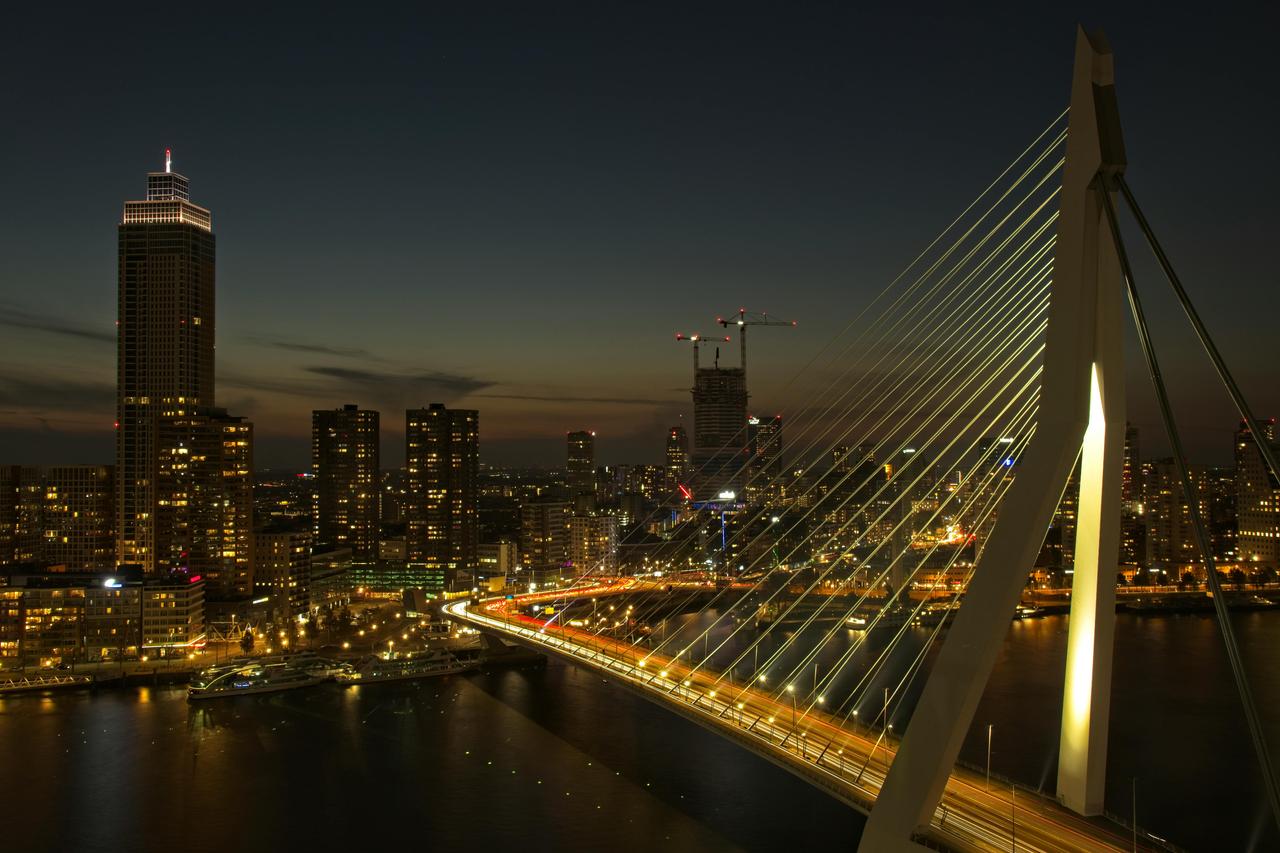
The design process of the Erasmus Bridge adopted an approach in which architectural vision decisively shaped the structural design. Key structural decisions included an asymmetric pylon arrangement and a inclined cable system. The design considered both the functional requirements of the load-bearing system and the bridge’s urban context. During the engineering phase, the complex geometry of the pylon and the force transfer mechanism of the cable system were analyzed, and the bridge’s behavior under various load conditions became a central consideration in the design.
Steel structural elements were the primary materials used in the construction of the Erasmus Bridge. The pylon was fabricated from high-strength steel, while steel cables were selected for the cable system to withstand tensile forces. The bridge deck was supported on steel box girders, with various cross-sectional elements added to enhance rigidity. Large-scale steel components were manufactured and assembled using computer-aided design and production techniques, with digital modeling methods employed especially to realize the pylon’s complex geometry.
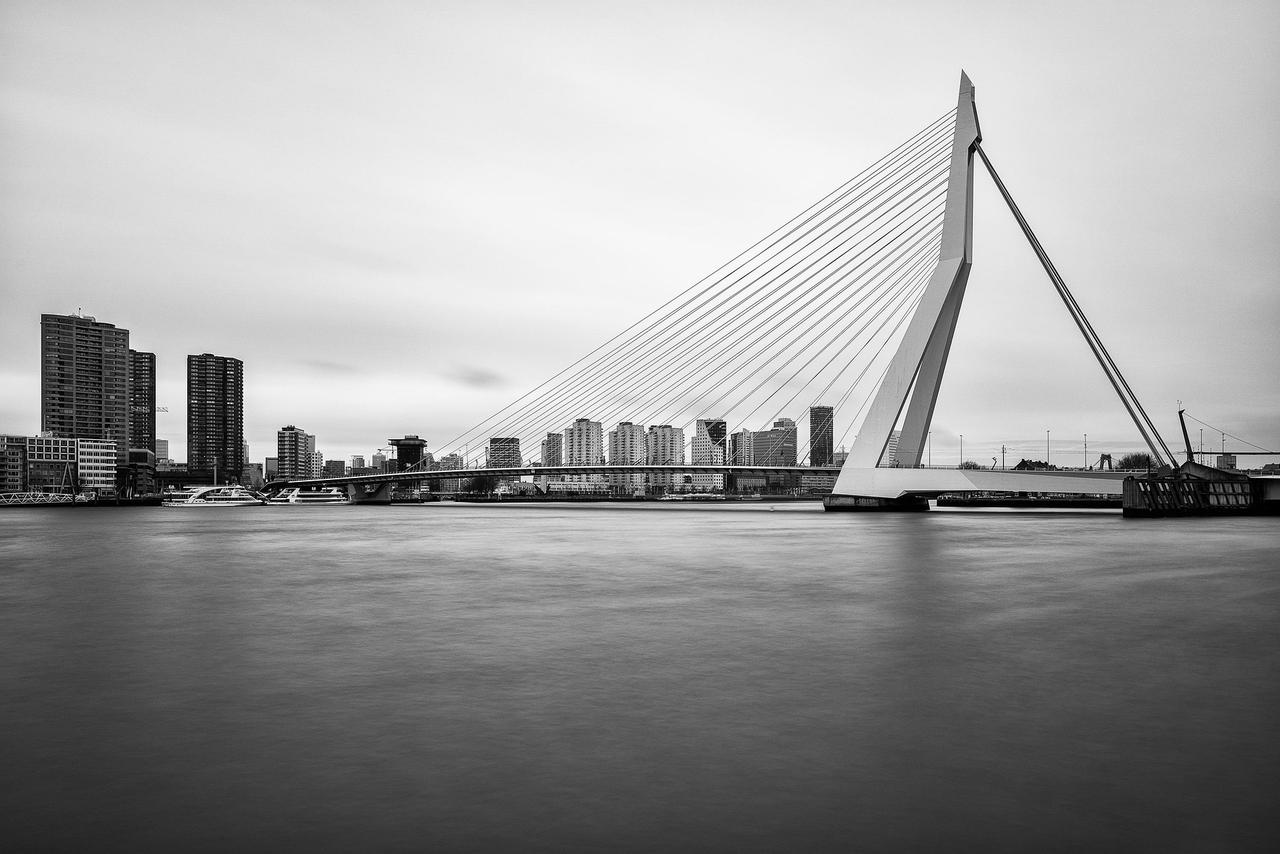
The architectural design of the Erasmus Bridge is based on a single-pylon and cable-stayed bridge type. The bridge was designed with an asymmetric load-bearing system to connect the northern and southern banks of the Nieuwe Maas. With a total length of 802 meters, the bridge features a steel pylon 139 meters in height. 【2】 The structure is regarded both as a functional infrastructure element and as an architectural landmark within the city skyline. The bridge’s structural features rely on the load-transfer arrangement between the pylon, cable system, and bridge deck.
Erasmus Bridge (Pixabay)
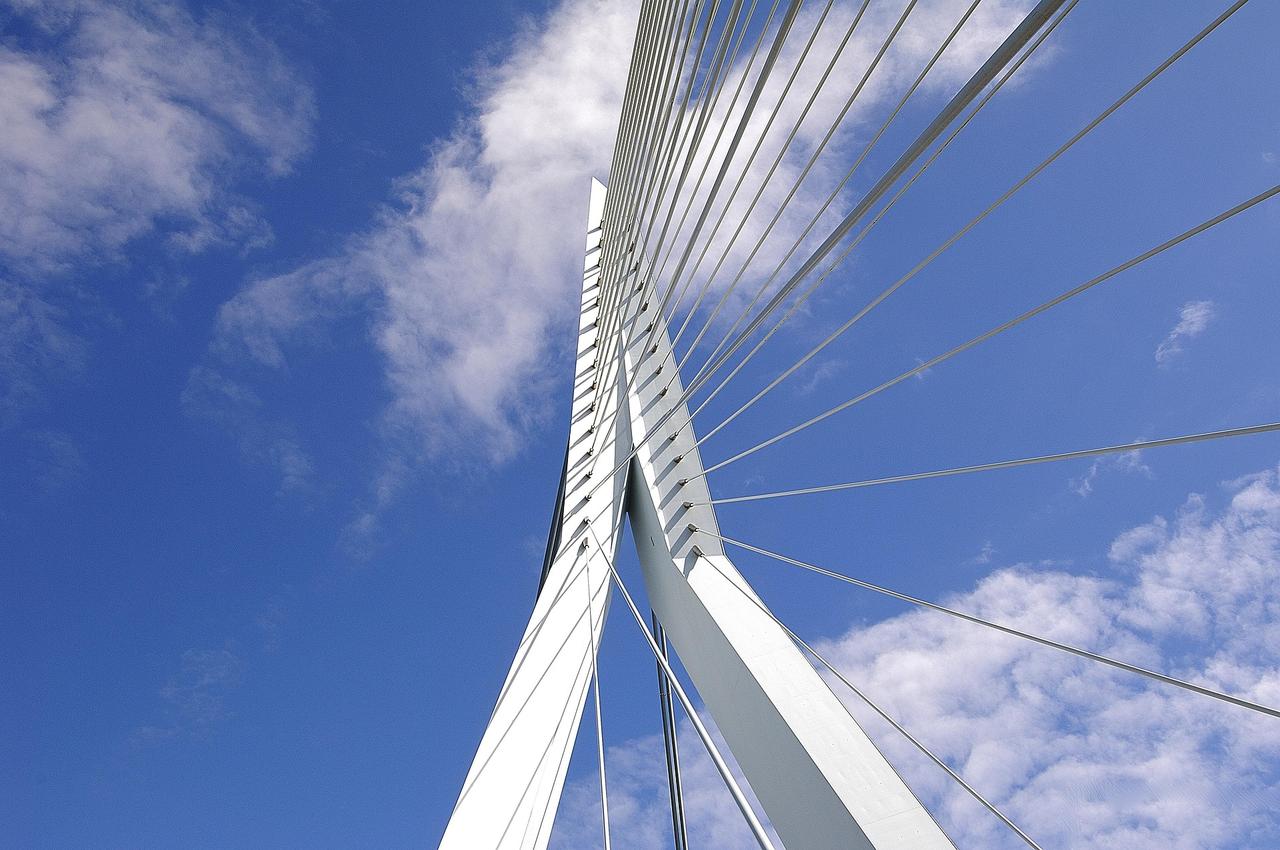
The pylon of the Erasmus Bridge is constructed from steel and stands 139 meters tall. It serves as the primary load-bearing element of the cable system and connects to the bridge deck via 40 cables. The pylon weighs approximately 1,800 tons and constitutes a significant portion of the bridge’s total mass. Its design incorporates an asymmetrical geometry and inclined form to accommodate the load distribution from the cable connection points. Internal vertical and horizontal elements ensure structural stability and provide access for maintenance and inspection activities. 【3】
The cable system of the Erasmus Bridge consists of load-bearing elements that transfer loads between the pylon and the bridge deck. The bridge features a total of 40 steel cables, symmetrically arranged on both sides of the pylon. The longest cable measures 280 meters in length, and the total combined length of all cables is approximately 6.2 kilometers. The cables connect to various points along the bridge deck, transferring loads from the deck to the pylon and ultimately to the ground. The system is designed to evenly distribute static and moving loads across the deck.【4】
The total length of the Erasmus Bridge is 802 meters, with the main cable-stayed span measuring 410 meters. The bascule (swing) section of the bridge is 89 meters long and provides a navigational clearance of 50 meters in width. The bridge deck has a width of 33.8 meters and employs a steel box girder system for rigidity and load-bearing capacity. The main span is 284 meters, forming the central span of the cable-stayed system. 【5】
The pylon reaches a height of 139 meters, while the rigid deck structure attains a maximum elevation of approximately 17 meters. The steel pylon weighs 1,800 tons, and the total bridge weight is estimated at approximately 6,800 tons. The bridge deck is designed to carry loads transmitted from the cable connection points, using steel box girders and transverse girders spaced at 4.9-meter intervals. The bridge was planned to accommodate a daily traffic load of approximately 32,000 vehicles. 【6】
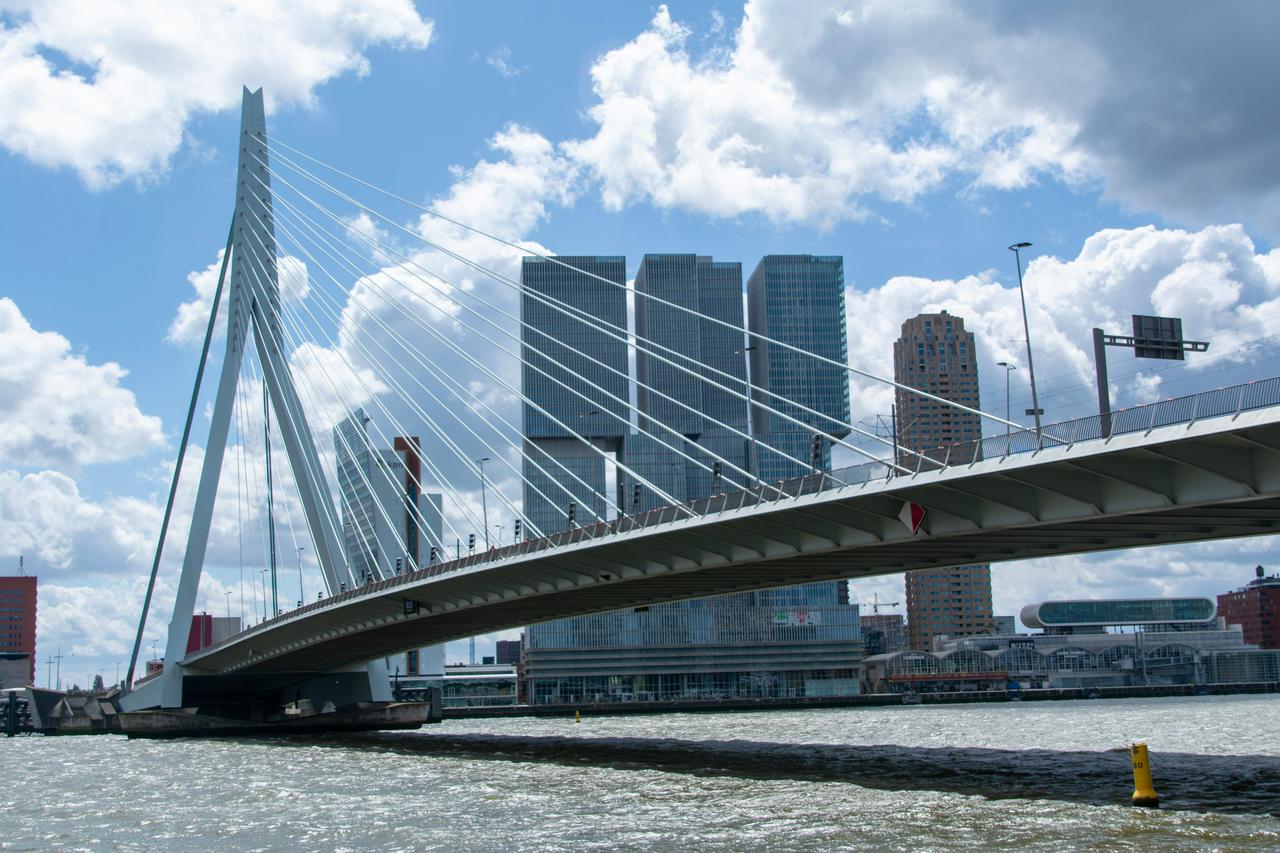
Erasmus Bridge (Pexels)
Maintenance and renovation works on the Erasmus Bridge are carried out to ensure its long-term usability and preserve its physical integrity. These works include surface cleaning, repainting, and repair of worn components. In 2024, a comprehensive maintenance program involved cleaning the entire bridge and repainting it in its original light blue color. A new wear-resistant layer was applied to the bicycle paths, and damaged sections of the pedestrian walkways were repaired. The bridge’s load-bearing and surface elements are regularly inspected to determine maintenance needs and implement necessary renewal measures.
The Erasmus Bridge serves as a transportation structure connecting the northern and southern banks of the Nieuwe Maas Riverin Rotterdam. It carries lanes for motor vehicle traffic, tram lines, a bicycle path, and a pedestrian walkway. The tram line is used by multiple routes, making the bridge an integral part of the city’s public transport network. In addition to motor vehicles, the bridge is open to pedestrian and bicycle traffic, enabling the coexistence of multiple modes of transport on a single structure. Beyond its transportation function, it also serves as a key urban transit point.
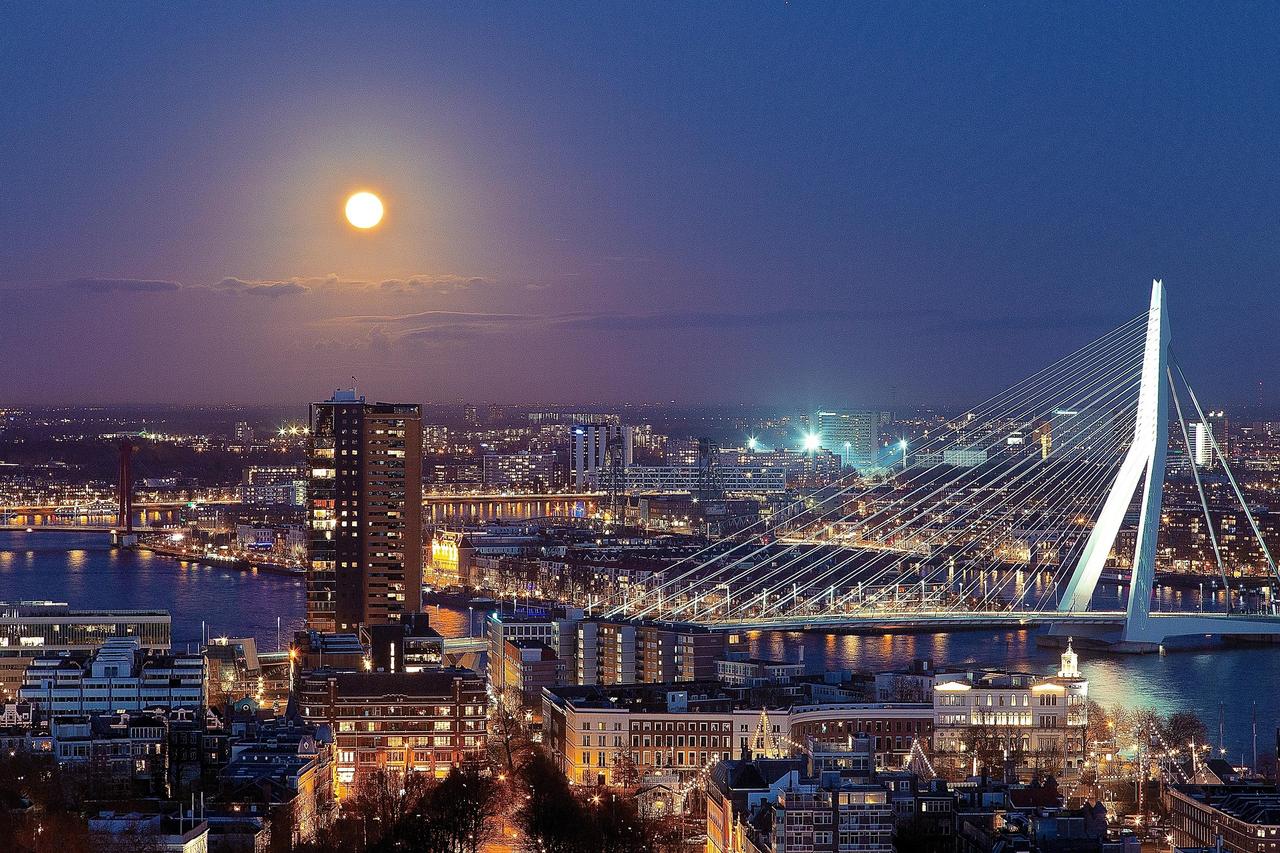
Erasmus Bridge (Pixabay)
The Erasmus Bridge functions not only as a vital urban connector between the northern and southern banks of Rotterdam but also stands out as a prominent landmark in the city skyline. By physically linking the city center with the Kop van Zuid district, the bridge contributes to urban integration. Due to its location and architectural features, it serves as a focal point within the city and operates as a convergence zone for diverse modes of transport. The bridge is used as a venue for various events and has become an integral part of urban life. It also carries urban representational value as one of the structures most closely associated with Rotterdam’s contemporary urban identity.
De Jong, M. and J. Annema. "The Erasmus Bridge: Success Factors According to Those Involved in the Project." *European Transport Conference Proceedings.* (2010): 1-11. Accessed May 7, 2026. https://aetransport.org/past-etc-papers/conference-papers-pre-2012/conference-papers-2010?abstractId=3374&state=b
Derooijfotografie. “Erasmus Köprüsü, Yavaş Çekim Hızı, Yüksek ve Güçlü Görseli.” Pixabay. Accessed May 7, 2026. https://pixabay.com/tr/photos/erasmus-k%c3%b6pr%c3%bcs%c3%bc-yava%c5%9f-%c3%a7ekim-h%c4%b1z%c4%b1-4152383/
Felten, Theo. “Erasmus Köprüsü'nün ve Rotterdam şehir silüetinin canlı ışıklarla muhteşem gece manzarası.” Pexels. Accessed May 7, 2026. https://www.pexels.com/tr-tr/fotograf/rotterdam-daki-erasmus-koprusu-gece-manzarasi-30691859/
JATBLAD. “Köprü, Rotterdam, Hollanda görseli.” Pixabay. Accessed May 7, 2026. https://pixabay.com/tr/photos/k%c3%b6pr%c3%bc-rotterdam-hollanda-mimari-5312835/
Lettinck. “Rotterdam, Euromast, Hollanda görseli.” Pixabay. Accessed May 7, 2026. https://pixabay.com/tr/photos/rotterdam-euromast-hollanda-kule-4142597/
Passchier, Igor. “Rotterdam, ZH, Netherlands.” Pexels. Accessed May 7, 2026. https://www.pexels.com/tr-tr/fotograf/kent-sehir-kent-simgesi-gorulecek-yer-17017614/
Reusink, Jaco, and Martin Kuijpers. “Designing the Erasmus Bridge, Rotterdam.” *Structural Engineering International* 8, no. 4 (1998): 275–277. Accessed May 7, 2026. https://www.tandfonline.com/doi/abs/10.2749/101686698780488794
Rotterdam Municipality. “Oeververbindingen – Erasmusbrug.” *Gemeente Rotterdam.* Accessed May 7, 2026. https://www.rotterdam.nl/oeververbindingen#erasmusbrug
Uitagenda Rotterdam. "Erasmus Bridge." Uitagenda Rotterdam. Accessed May 7, 2026. https://www.uitagendarotterdam.nl/en/locations/location/erasmus-bridge/
Van der Wolf, Jan. “Bulutlu bir günde modern mimariyi ve şehir silüetini sergileyen Rotterdam'daki Erasmus Köprüsü.” Pexels. Accessed May 7, 2026. https://www.pexels.com/tr-tr/fotograf/erasmus-koprusu-rotterdam-ufuk-cizgisini-kapsiyor-31601983/
Vink, Larry. “Rotterdam, Netherlands.” Pexels. Accessed May 7, 2026. https://www.pexels.com/tr-tr/fotograf/isiklar-su-kopru-bag-11387361/
[1]
Rotterdam Municipality, “Oeververbindingen – Erasmusbrug,” Gemeente Rotterdam, Last Access: 7 May 2026, https://www.rotterdam.nl/oeververbindingen#erasmusbrug
[2]
“Oeververbindingen – Erasmusbrug - In Cijfers,”
[3]
“Oeververbindingen – Erasmusbrug - In Cijfers,”
[4]
“Oeververbindingen – Erasmusbrug - In Cijfers,”
[5]
“Oeververbindingen – Erasmusbrug - In Cijfers,”
[6]
“Oeververbindingen – Erasmusbrug - In Cijfers,”

Nickname(s) | De Zwaan (Swan) | ||||||||
|---|---|---|---|---|---|---|---|---|---|
Length(s) | 802 metres | ||||||||
Height(s) | 139 metres | ||||||||
Type(s) | Cable-stayed Bridge | ||||||||
Design | Ben van Berkel | ||||||||
Opening Year | 1996 | ||||||||
River | Nieuwe Maas | ||||||||
Location | Rotterdam Netherlands | ||||||||
Transportation Types | Vehicle Pedestrian Bicycle Tram | ||||||||
Support System | Steel Pylon Cable System | ||||||||
Regions Connected | Kop van Zuid City Center | ||||||||
History
Engineering and Construction Process
Design and Engineering Approach
Materials and Techniques Used
Architectural Design and Structural Features
Pylon Design
Cable System
Technical Dimensions and Structural Data
Maintenance and Renovation Works
Function and Uses
Urban and Symbolic Significance