This article was automatically translated from the original Turkish version.
+2 More
Eskişehir Eti Archaeology Museum is a cultural institution established to preserve, display and scientifically document the cultural heritage of the region spanning a broad historical spectrum from the Neolithic Age to the end of the Ottoman period. It holds a unique place in the history of Turkish museology as the first museum in Türkiye constructed with private sector funding and donated to the state.
The origins of museum activities in Eskişehir date back to the early years of Republic. In 1945, a storage museum was established in Alaeddin Mosque to safeguard artifacts collected from local excavation sites. As the collection grew and the need for classification became apparent, the medrese section of the Kurşunlu Külliyesi in the Odunpazarı neighborhood was restored in 1966 and the Museum Directorate was officially established. Although the museum was relocated in 1974 to a newly constructed building in Akarbaşı Mahallesi, the increasing number of artifacts and evolving modern museum standards eventually necessitated a more comprehensive facility.
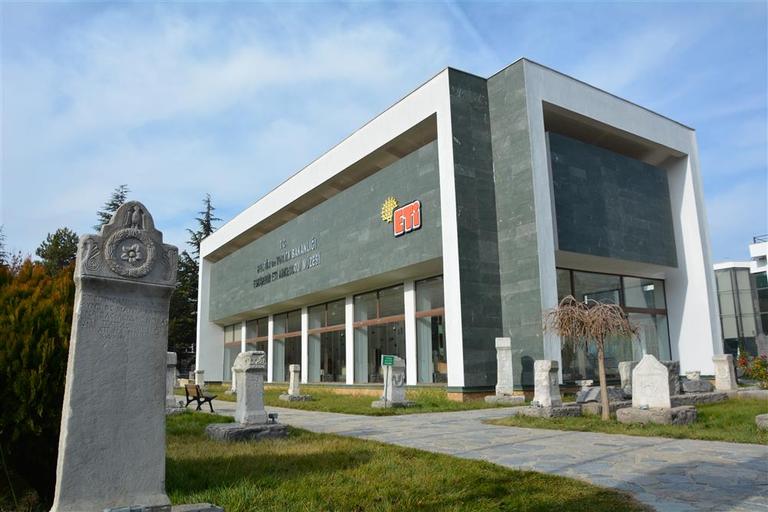
The current museum complex was realized through a sponsorship protocol signed between Culture and the Ministry of Tourism and the Eti Companies Group. Built with financial support from Firuz Kanatlı, founder and Honorary President of the Eti Group, the building is notable as the first museum in Türkiye constructed by the private sector and transferred to the ministry. The modern structure, whose foundation was laid in 2007, opened to the public in 2011 under the name "Eti Archaeology Museum".

Eskişehir Eti Archaeology Museum (Eskişehir Provincial Directorate of Culture and Tourism)
The museum consists of three main blocks designed in accordance with contemporary museological principles. Exhibition units covering approximately 1,300 square meters include both permanent galleries and temporary exhibition spaces. The complex also houses administrative offices, laboratories for artifact conservation and restoration, a photo archive and library for scholarly research, a conference hall, educational workshops for children, a cafeteria and souvenir sales areas. This spatial arrangement has transformed the museum from a mere exhibition space into a multifaceted cultural center.
The museum’s exhibition narrative begins with a natural history section covering periods predating human history. This area displays animal and plant fossils dating back millions of years that attest to the geological past of Eskişehir and its surroundings. Fossils of elephants, mastodons and various plant remains from the region constitute significant evidence of the prehistoric fauna and flora of Anatolia.
This section, symbolizing the transition to settled life and the emergence of agricultural societies, features finds from local mounds, particularly from centers such as Çakmakbaşı and Keçiçayırı. Exhibited items include pottery vessels, bone tools, stone axes, obsidian blades and grinding stones from the Neolithic (Polished Stone) and Chalcolithic (Copper-Stone) periods. These artifacts provide insights into the daily life practices, dietary habits and tool technologies of the region’s earliest settlers.
One of the museum’s richest collections comprises artifacts from the Early Bronze Age dating to around 3000 BCE. At the heart of this section are finds from the Demircihüyük excavations, which hold key significance for Eskişehir archaeology. Exhibited objects include characteristic beak-spouted jars, idols used in rituals (stylized goddess figurines), metal weapons and grave goods. The finds from the “Sarıket” burial site are particularly important for illustrating the funerary traditions and advanced level of metallurgy of the period.
The museum’s collection also includes artifacts from the Hittite Empire (2nd millennium BCE), the first centralized political entity in Anatolia. This section documents Eskişehir’s strategic position within Hittite geography through characteristic ceramic forms, seal impressions and various administrative artifacts. These imperial-era objects reveal the region’s cultural and political interactions with Central Anatolia.
Eskişehir, known in antiquity as Dorylaeum, is one of the centers where Phrygian civilization was most densely present and left enduring cultural traces. The Phrygian artifacts on display reflect the artistic and religious depth of this civilization. Altar stones and figurines associated with the cult of “Kybele” (Mother Goddess), geometrically decorated painted ceramics unique to the Phrygians, and fibulae—regarded as the pinnacle of Phrygian metalwork—are central elements of this section. Additionally, finds from major Phrygian centers such as Pessinus (Ballıhisar) and Midas City (Yazılıkaya) enrich the collection.
A significant portion of the museum’s inventory consists of artifacts from the Hellenistic, Roman and Byzantine periods. Presented chronologically, this section displays Roman marble portraits and statues, pottery vessels used in daily life, glass perfume bottles, lamps and metal objects. Byzantine crosses, religious ritual items and architectural sculptures document the region’s role in Christian history. Particularly, data obtained from excavations at Şarhöyük (Dorylaeum) has enabled a clearer understanding of the city’s urban fabric during these periods.
Stone artifacts displayed both within the museum’s interior and in its outdoor lapidarium shed light on the region’s epigraphic and architectural history. This group includes marble sarcophagi, ossuaries, votive and funerary stelae (grave markers), milestone stones and column capitals dating from the Roman and Byzantine periods. The reliefs and inscriptions on the funerary stelae provide primary source material regarding the socio-economic status, occupations and belief systems of ancient inhabitants.

Stone Artifacts and Sarcophagi (Museum)
The museum’s specially secured sections present its numismatic collection and ancient jewelry to visitors. The coin collection spans a broad chronological range from the Archaic period through the Hellenistic kingdoms, the Roman Empire, the Byzantine Empire and into the Ottoman era. These coins reflect the economic structures and political propaganda of their times. The jewelry section displays gold and silver earrings, necklaces, rings, diadems and ornamental items made of precious stones, embodying the aesthetic sensibilities of the ancient world.
Eskişehir Eti Archaeology Museum functions not merely as an exhibition space but as a living cultural center. The conference hall, library and multipurpose rooms within the museum complex host scholarly meetings and cultural events. Educational and hands-on workshops specifically designed for children aim to instill awareness of archaeology and foster a culture of preserving historical heritage among younger generations.

No Discussion Added Yet
Start discussion for "Eskişehir Eti Archaeology Museum" article
Founding History and Development
Eti Sponsorship and the New Museum Building
Architectural Design and Spatial Organization
Natural History and Fossil Collection
Neolithic and Chalcolithic Artifacts
Early Bronze Age and Demircihüyük Culture
Remnants of the Hittite and Imperial Periods
The Phrygian Period and Dorylaeum Culture
Classical Periods: Hellenistic, Roman and Byzantine
Stone Artifacts and Sarcophagi Section
Coin and Jewelry Treasury
Cultural Activities and Educational Function