This article was automatically translated from the original Turkish version.
Registration Number | 250 | ||||||||
|---|---|---|---|---|---|---|---|---|---|
Registration Date | 30.11.2017 | ||||||||
Application Number | C2010/026 | ||||||||
Application Date | 12.05.2010 | ||||||||
Name of the Geographical Indication | Eskişehir Met Helvası | ||||||||
Name of the Product | Helva | ||||||||
Type of Geographical Indication | Mahreç işareti | ||||||||
Applicant/Registrant(s) | Eskişehir Ticaret Odası | ||||||||
Address of the Registrant | İki Eylül Cad. No: 28/6 ESKİŞEHİR | ||||||||
Geographical Boundary | Eskişehir | ||||||||
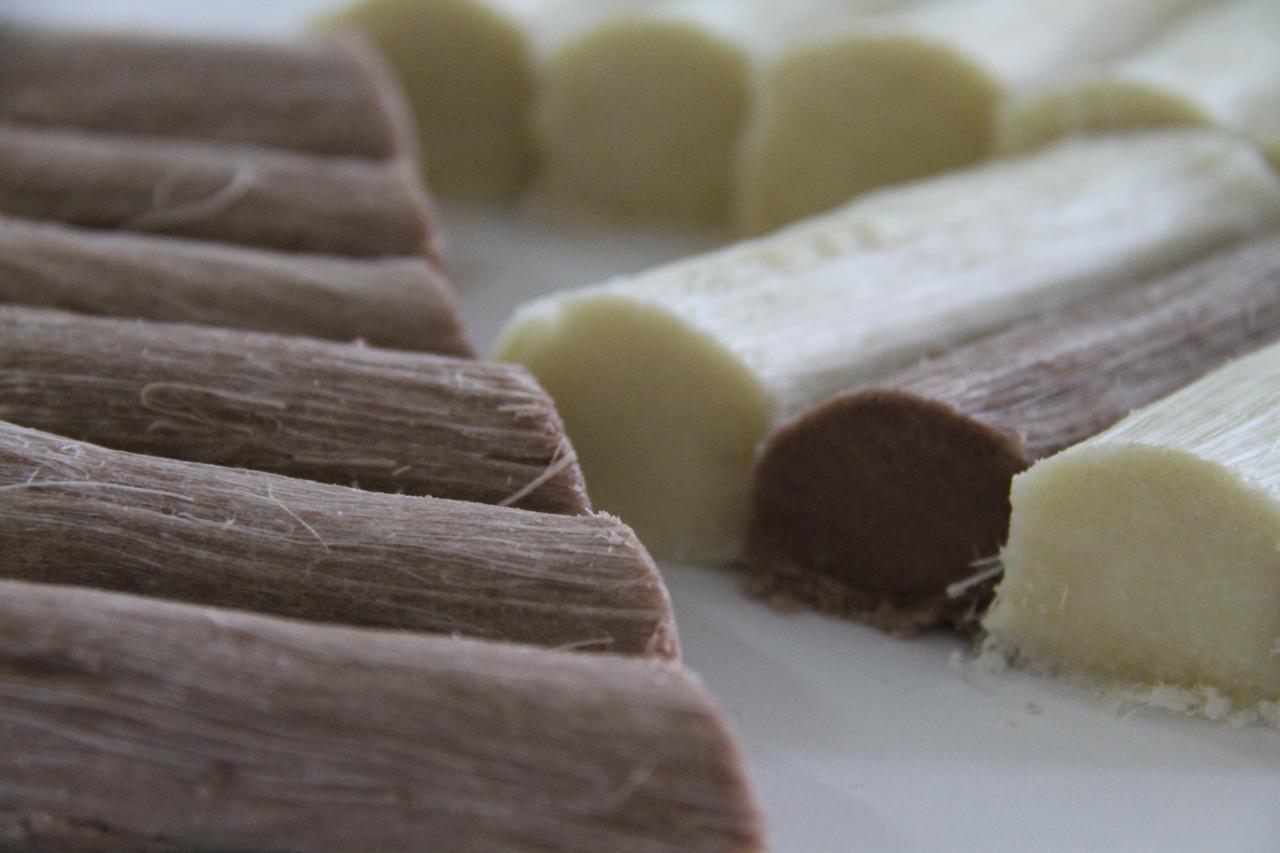
Eskişehir met helva is a traditional confection unique to the province of Eskişehir. Made from flour, sunflower oil, sugar, citric acid monohydrate, and water, this helva is distinguished by its fibrous texture and cylindrical shape, measuring approximately 2 cm in diameter and 7.5 cm in length. Its production involves a series of sequential steps including prolonged roasting of flour in oil, boiling and bleaching of sugar syrup, and combining the two components to form a filamentous mass.
Eskişehir met helva is a fibrous confection made from flour, oil, sugar, citric acid monohydrate, and water, formed into cylindrical shapes approximately 2 cm in diameter and 7.5 cm in length. The product is presented in a horizontally sliced form and is notable for its fibrous structure. The name of the confection derives from a traditional children’s game played with a stick known locally as “met” and a sheep’s knuckle bone. It is said that in this game, the losing side was required to pull the helva, which led to the tradition of consuming it. In this sense, the product is not merely a food item but also a carrier of a local cultural practice.
The production of Eskişehir met helva consists of six stages:
In production, 50 kilograms of baklava-grade flour with a yield ratio of 50/55 and 18 liters of first-class refined, winterized edible sunflower oil are used. The flour is placed into a dough mixing tank; low heat is applied and the oil is added, after which the mixture is continuously stirred and roasted at a temperature of 75–85 °C for approximately 4 to 4.5 hours. The resulting dough is then rested at room temperature for one day. If a chocolate variant is to be produced, 200 grams of cocoa are added at this stage.
For the syrup, 12 kilograms of powdered sugar, 4–5 liters of water, and 12 milliliters of citric acid monohydrate are placed in a pot. The sugar is boiled until it reaches a temperature of 140 °C. The resulting syrup is then spread onto a marble countertop to cool.
The cooled sugar syrup is bleached using special racks. During this process, the syrup is first shaped into cylinders and then into rings. This step ensures the whitening and thickening of the product.
The previously prepared dough is spread onto a tray to a thickness of 4–5 cm. The ring-shaped syrup is placed on top of the dough and then covered again with a layer of dough. Five to seven people line up around the tray and stretch the mixture by pulling it. The stretched dough-syrup mixture is folded and reopened repeatedly. This kneading and pulling process continues until a homogeneous structure is achieved.
The homogeneous mixture is broken into pieces approximately 30–35 cm in length and then drawn into filaments measuring 120–125 cm in length and 2 cm in diameter. These filaments are then cut into 7.5 cm lengths and prepared for packaging.
The finished product is offered for consumption either unpackaged or in packaged form. Its shelf life is approximately three months when stored at room temperature. However, when vacuum-packed with a food-grade gas mixture of 25% carbon dioxide and 75% nitrogen, the shelf life can be extended up to 12 months.
Compliance of Eskişehir met helva production with registration requirements is coordinated by the Eskişehir Chamber of Commerce. The inspection commission consists of one person appointed by the Eskişehir Chamber of Commerce Management Board, one expert from the Chamber’s Agricultural Products Manufacturing and Trade Professional Committee, and one expert from the Eskişehir Provincial Directorate of Agriculture and Forestry. Inspections are carried out at least once annually, with additional inspections conducted upon complaint or when deemed necessary.
Production of the product occurs exclusively within the boundaries of Eskişehir Province. It was officially registered under a geographical indication on 30 November 2017, with the registration application submitted by the Eskişehir Chamber of Commerce on 12 May 2010.
Turkish Patent and Trademark Office. "Eskişehir Met Helvası Tescil Belgesi (PDF)." Accessed July 20, 2025. https://ci.turkpatent.gov.tr/Files/GeographicalSigns/f5950c94-eed4-4880-a7ac-3455354d321e.pdf.
Turkish Patent and Trademark Office. "Eskişehir Met Helvası." Accessed July 20, 2025. https://ci.turkpatent.gov.tr/cografi-isaretler/detay/38026.

Registration Number | 250 | ||||||||
|---|---|---|---|---|---|---|---|---|---|
Registration Date | 30.11.2017 | ||||||||
Application Number | C2010/026 | ||||||||
Application Date | 12.05.2010 | ||||||||
Name of the Geographical Indication | Eskişehir Met Helvası | ||||||||
Name of the Product | Helva | ||||||||
Type of Geographical Indication | Mahreç işareti | ||||||||
Applicant/Registrant(s) | Eskişehir Ticaret Odası | ||||||||
Address of the Registrant | İki Eylül Cad. No: 28/6 ESKİŞEHİR | ||||||||
Geographical Boundary | Eskişehir | ||||||||
No Discussion Added Yet
Start discussion for "Eskişehir Met Helva" article
Distinctive Characteristics
Production Method
Dough Preparation
Syrup Boiling
Bleaching
Pulling
Filament Formation and Cutting
Packaging
Control Mechanism
Geographical Boundary and Registration Information