

This article was automatically translated from the original Turkish version.
+1 More
Type of Geographical İndication | Mahreç Sign | ||||||||
|---|---|---|---|---|---|---|---|---|---|
Application Date | 21.06.1996 | ||||||||
Registration Number | 23 | ||||||||
Registration Date | 14.11.1997 | ||||||||
Product / Product Group(s) | Rugs and kilims | ||||||||
Applicant/Registrant(s) | Eşme Municipality | ||||||||
Place of Production | Uşak, Türkiye | ||||||||
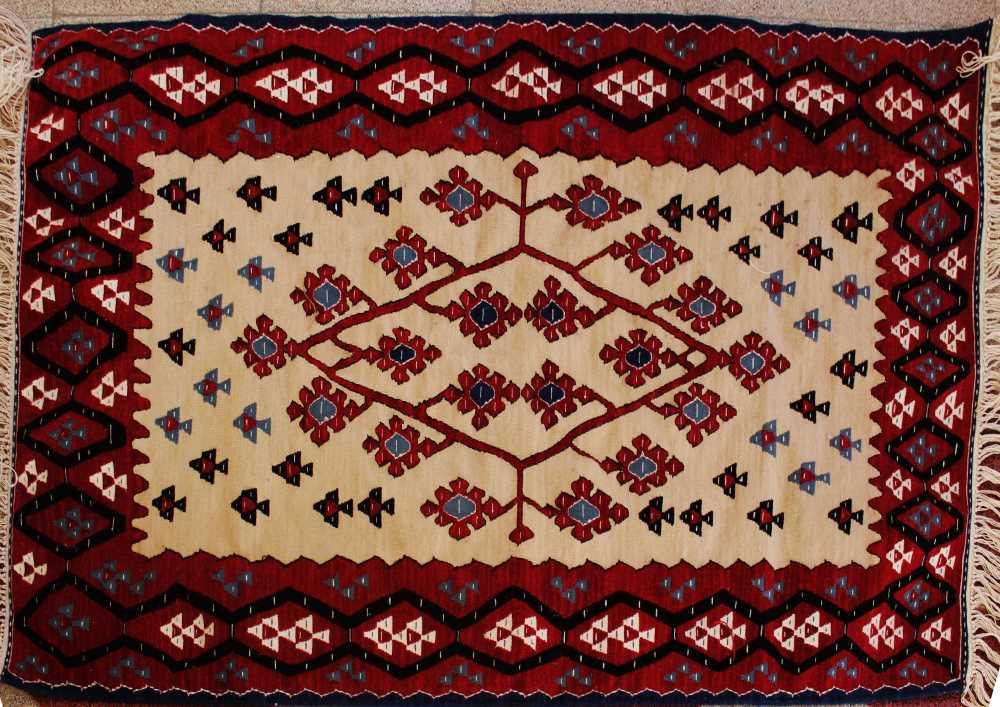
Eşme Yörük Kilim is a traditional woven textile originating from the Eşme district of Uşak Province in Türkiye, with roots stretching back centuries and distinguished by its technical and cultural characteristics. This type of kilim has been protected under a geographical indication since November 14, 1997, and its production and marketing are subject to strict oversight.

Eşme Yörük Kilim (Culture Portal)
Eşme is one of the settlements in Türkiye that preserves traces of the nomadic lifestyle of the Yörük-Turkmen people, extending from antiquity to the present day. This cultural heritage is particularly evident in the local tradition of home-based kilim weaving and the use of root dyes. Traditional Eşme kilims are woven by women on vertical looms known as "ıstar" within households. Historically, the yarns used were spun and dyed at home using natural root pigments. Each kilim serves as a narrative carrier, reflecting the region’s collective memory through its motifs and composition.
Kilim type: Eşme Yörük Kilim
Quality standard: 40×240
Material type: Warp and weft threads are 100% wool
Warp thread: 4/2 Nm
Thick weft thread: 3.5/2 Nm
Yarn consumption (g/m²): Warp 350 g, thick weft 1600 g, total 1950 g
These values serve as indicators of the kilims’ durability and tightly woven structure. The production process and technical specifications are monitored under the supervision of authorized institutions.

Eşme Yörük Kilim (Culture Portal)
The colors used in Eşme kilims are predominantly pastel and muted tones, including red, blue, green, black, brown, white, and navy. These colors have acquired deep symbolic meanings within the regional culture:
Green: Murat
Blue: Hope
Red: Passionate love
Purple: Sorrow
These symbolic associations transform the kilim from a mere craft object into a visual narrator of emotion and lived experience.
Historically, the Eşme kilim was not only used as floor covering but also served multiple purposes in daily life, being adapted into items such as saddlebags, cushion covers, pillows, bags, and tablecloths. In modern contexts, it is also favored for car seat coverings and wall panels.
Eşme kilims are renowned for their rich repertoire of motifs and compositional arrangements. Each motif and layout carries distinct aesthetic and narrative meanings.
Features characteristic motifs such as "Eli belinde kız" and "tavşan opuğu".
The border and ground areas are adorned with original motifs including bintepe, kurbağacık, yılıkıç, bukağı.
The composition is typically symmetrical and embodies regional symbolism.
Hexagonal medallions called "top" are arranged in single or double rows.
Named according to the number of medallions: "Üç toplu", "Yedi toplu", etc.
Variants with additional medallions placed between the main ones are known as "yan toplu kilim".
Resembles a leftward spiral structure but features a completely original motif arrangement.
The ground is divided into three sections with hexagonal medallions aligned along a single axis.
Empty spaces are filled with motifs such as zülüf, çıtırık, oynatma.
The ground is filled with hexagonal medallions arranged in three sections.
Common motifs include bıçkın, karagöz, çakmak, eli belinde kız.
Symbolize the transition from birth to death.
Also woven specifically as offerings to mosques.
Types are known by names such as selvili, hayat ağacı, turunçlu.
Ministry of Culture and Tourism. "Eşme Kilimleri." Kültür Portalı. Accessed July 3, 2025. https://www.kulturportali.gov.tr/turkiye/usak/nealinir/esme-kilimleri.
Turk Patent and Trademark Office. "Eşme - Yörük Kilimi." Geographical Indications Portal. Accessed July 3, 2025. https://ci.turkpatent.gov.tr/cografi-isaretler/detay/37886.
Uşak Belediyesi. "Eşme Kilimleri." Accessed July 3, 2025. https://www.usak.bel.tr/icerik/esme-kilimleri.

Type of Geographical İndication | Mahreç Sign | ||||||||
|---|---|---|---|---|---|---|---|---|---|
Application Date | 21.06.1996 | ||||||||
Registration Number | 23 | ||||||||
Registration Date | 14.11.1997 | ||||||||
Product / Product Group(s) | Rugs and kilims | ||||||||
Applicant/Registrant(s) | Eşme Municipality | ||||||||
Place of Production | Uşak, Türkiye | ||||||||
Geographical and Cultural Context
Technical Features
Colors and Symbolism
Applications
Motif Types and Kilim Groups
Altınbaş Kilim
Toplu Kilim
Ablaş Kilim
Takmak Kilim
Namazlağlar (Prayer Rugs)