


This article was automatically translated from the original Turkish version.
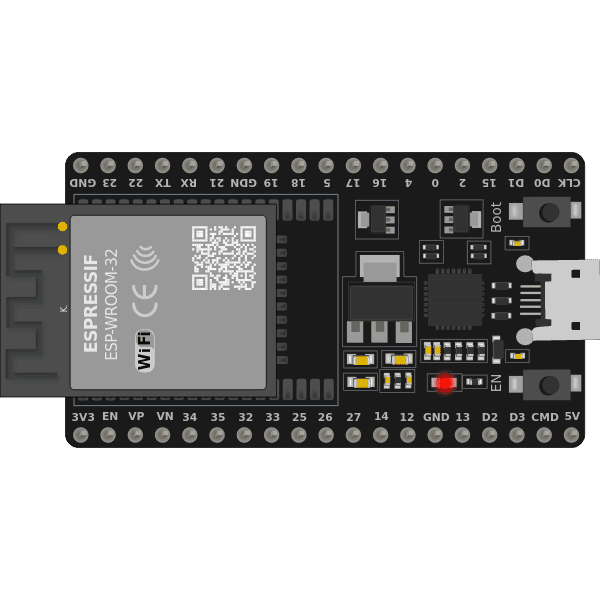
Espressif Systems. “Official Website.” Accessed: 24.03.2025. https://www.espressif.com.
About ESP32
Developer(s) | Espressif Systems | ||||||||
|---|---|---|---|---|---|---|---|---|---|
Publication Date | 2016-09-06 | ||||||||
ESP32 is a low-cost, low-power system-on-chip (SoC) series developed by the Chinese company Espressif Systems. First released in 2016, the ESP32 has become a popular choice for Internet of Things (IoT) projects and various embedded system applications by combining Wi-Fi and Bluetooth capabilities. Thanks to its integrated wireless communication features and powerful processor architecture, the ESP32 is widely used in projects requiring data collection, device control, and wireless network connectivity.
The origins of the ESP32 are based on Espressif Systems’ earlier product, the ESP8266. The ESP8266 gained significant popularity among hobbyist projects and IoT developers due to its Wi-Fi capabilities and low cost. The ESP32 was designed to build on the success of the ESP8266 by offering enhanced features and higher performance. Since its initial release in 2016, the ESP32 series has expanded with various models tailored to different needs. These models include the ESP32-WROOM-32, ESP32-WROVER, and ESP32-SOLO-1, among others, each featuring different combinations of memory, flash, and connectivity options. Throughout its development process, continuous software and hardware improvements have been made based on user feedback and technological advancements.
The ESP32 is built around the Tensilica Xtensa LX6 microprocessor core and delivers high processing power through its dual-core architecture. Integrated 2.4 GHz Wi-Fi (802.11 b/g/n) and Bluetooth (v4.2 BR/EDR and BLE) connectivity features make the ESP32 ideal for applications requiring wireless communication. Low power consumption provides a significant advantage for battery-operated applications and energy-efficient projects. The ESP32 offers a variety of peripherals and interfaces, including GPIO (General Purpose Input/Output) pins, UART, SPI, I2C, I2S, ADC (Analog-to-Digital Converter), DAC (Digital-to-Analog Converter), and capacitive touch sensors. It also provides internal and external memory options such as SPI flash and SRAM.
The ESP32’s wide range of features makes it suitable for numerous applications. It is frequently used in Internet of Things (IoT) applications such as sensor data collection, smart home systems, industrial automation, agricultural technologies, and environmental monitoring. In wearable technology, its low power consumption and compact size make it a preferred choice for smart watches, fitness trackers, and health monitoring systems. Additionally, it is widely used in hobbyist projects, educational applications, prototyping, and product development processes. The ESP32’s versatility provides developers with a broad spectrum of application possibilities.
The ESP32 development process is supported by a variety of tools and resources. Espressif Systems provides a comprehensive software development kit called ESP-IDF (ESP32 IoT Development Framework). This framework enables development in the C programming language and grants low-level hardware access. Thanks to Arduino IDE support, it also offers an easy starting point for developers familiar with the Arduino ecosystem. Support for MicroPython and other high-level languages caters to developers with different programming preferences. A large online community and extensive documentation play a crucial role in resolving development challenges and sharing knowledge. Various development boards (such as the ESP32 DevKitC and ESP32-WROOM-32 Board) and modules simplify prototyping and application testing.
ESP-IDF Dokümantasyonu. Accessed March 24, 2025. https://docs.espressif.com/projects/esp-idf/en/latest/esp32/.
Espressif Systems. "Resmi Web Sitesi." Accessed March 24, 2025. https://www.espressif.com.
Random Nerd Tutorials. "ESP32 Projeleri." Accessed March 24, 2025. https://randomnerdtutorials.com/projects-esp32/.

Espressif Systems. “Official Website.” Accessed: 24.03.2025. https://www.espressif.com.
About ESP32
Developer(s) | Espressif Systems | ||||||||
|---|---|---|---|---|---|---|---|---|---|
Publication Date | 2016-09-06 | ||||||||
History and Development
Key Features
Applications
Development Environment and Ecosystem