

This article was automatically translated from the original Turkish version.
+2 More
Engine(s) | RTM322 Turboshaft | ||||||||
|---|---|---|---|---|---|---|---|---|---|
Producer(s) | Eurocopter | ||||||||
First Flight(s) | 2010 | ||||||||
Country | France | ||||||||
Crew | 2-3 people | ||||||||
Maximum Speed | 472 km/s | ||||||||
Propeller | 5 Palli | ||||||||
Number of Engines | 2 | ||||||||
Design | Experimental Hybrid | ||||||||
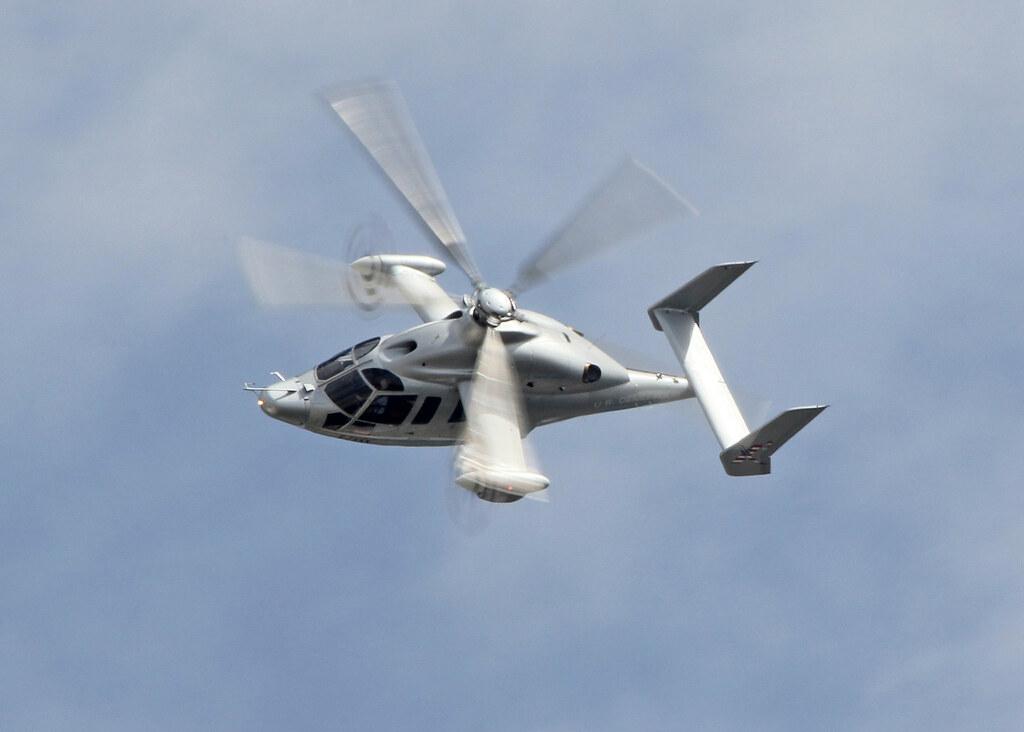
Eurocopter X3 (commonly known as X-Cubed) is an experimental compound rotorcraft developed to overcome the speed limitations inherent in conventional helicopter designs and achieve flight speeds exceeding 250 miles per hour. It was produced in 2010 in France by Eurocopter, known at the time by that name and now called Airbus Helicopters. 【1】 This aircraft is classified as a compound system that combines the vertical takeoff and landing (VTOL) capability of a helicopter with the cruise speed of a turboprop aircraft. Designed solely as a concept and technology demonstrator, only one unit was built and the project did not proceed to series production.
The aircraft’s primary aerodynamic structure is based on a heavily modified Eurocopter EC155 fuselage. Like the EC155, it features a streamlined nose design, with a cockpit immediately behind the nose and a passenger compartment located further aft. Unlike conventional helicopters, the X3 model lacks a tail rotor; instead, it is equipped with two short-span fixed wings mounted on either side of the fuselage, each fitted with a single side-mounted propeller. These propellers provide forward thrust by redirecting energy that would otherwise be consumed by a tail rotor in traditional helicopters.

Eurocopter X3 (Flickr)
The propulsion system consists of two Rolls-Royce Turbomeca RTM322 series turboshaft engines, each producing 2,270 shaft horsepower (shp). 【2】 These engines simultaneously drive the five-bladed main rotor mounted on the fuselage and the two five-bladed side propellers on the fixed wings. 【3】 The torque effect generated by the rotation of the main rotor is counterbalanced by operating the left-side propeller at a lower rotational speed (RPM) than the right-side propeller.
To minimize aerodynamic drag, the landing gear is designed as a fully retractable wheeled system integrated into the fuselage. In academic research, this design approach is categorized as a "compound" aircraft configuration, in which lift and forward thrust are generated by independent propulsion systems. Various wind tunnel tests, including those conducted in the ONERA L2 wind tunnel, have been used to evaluate the aerodynamic interactions between the rotor and propellers. Additionally, some sources indicate that the helicopter incorporates hybrid technology, integrating both electrical and fuel-based components.【4】
The Eurocopter X3 was engineered to overcome the aerodynamic limitations—such as compressibility and retreating blade stall—that typically cap rotorcraft speeds below 200 knots. These constraints are mitigated by the combined thrust of the side propellers and the lift generated by the fixed wings.【5】 During level flight tests using only 80 percent of the available engine power, a cruise speed of 232 knots (approximately 267 miles per hour) was achieved. Official statistics indicate that the aircraft’s maximum cruise speed reached 254.88 knots (472 km/h), while its never-exceed dive speed (Vne) was measured at 262.98 knots (487 km/h).【6】
The aircraft’s maximum takeoff weight (MTOW) is 5,200 kilograms (11,465 pounds). With this weight at sea level, its rate of climb reaches 28.3 meters per second (5,500 feet per minute), and its estimated service ceiling is 12,500 feet (3,810 meters).【7】 Flight tests revealed that the aircraft demonstrated very low vibration levels during high acceleration, deceleration, and climb rates without requiring any passive or active vibration damping systems. Crew capacity varies between two and three personnel across different data sources.

Eurocopter X3 (Flickr)
The development of the X3 from conceptual stage to flight testing was entirely funded by Eurocopter and completed in less than three years.【8】 The first flight took place on 6 September 2010, and within a short time, the aircraft achieved a level-flight speed of 180 knots (333 km/h). Flight testing continued after a gearbox upgrade in March 2011 enabled full-power operations.
On 12 May 2011, during a recorded flight, the aircraft exceeded the 267-mile-per-hour speed barrier. Subsequently, under pilot Hervé Jammayrac, a test flight achieved a cruise speed of 472 km/h and a dive speed of 487 km/h, surpassing the previous compound rotorcraft speed record held by the Sikorsky X2.【9】 In June 2012, the aircraft was transported by cargo plane from the Istres Flight Test Center in France to the United States, where it completed an extensive series of military and civil demonstration flights from the American Eurocopter facility in Texas to the Pentagon.
As a completed concept demonstrator, the Eurocopter X3 was developed with potential applications in both military and civil sectors. This compound helicopter configuration is envisioned for civil uses including long-range search and rescue, coastal patrol, border surveillance, intercity passenger transport, and logistical support to offshore facilities.
Eurocopter X3 (Youtube)
In military applications, its integration of high cruise speed with VTOL capability has been assessed as a viable platform for special operations, troop transport, combat search and rescue (CSAR), and medical evacuation missions.【10】 In the literature, compound helicopters such as the X3, featuring separate propulsion systems for lift and thrust, continue to be the subject of comparative studies against conventional tiltrotor systems, particularly regarding specific aerodynamic characteristics such as rotor disk loading and hover efficiency.
Accessed November 26, 2025. https://www.aa.com.tr/tr/kultur/ahlatta-acilan-kurslarla-geleneksel-tas-isciligi-yasatiliyor/3116279.
Accessed November 26, 2025. https://www.aa.com.tr/tr/kultur/ahlatta-acilan-kurslarla-geleneksel-tas-isciligi-yasatiliyor/3116279.
Accessed November 26, 2025. https://www.aa.com.tr/tr/kultur/ahlatta-acilan-kurslarla-geleneksel-tas-isciligi-yasatiliyor/3116279.
Accessed November 26, 2025. https://www.aa.com.tr/tr/kultur/ahlatta-acilan-kurslarla-geleneksel-tas-isciligi-yasatiliyor/3116279.
Accessed November 26, 2025. https://www.aa.com.tr/tr/kultur/ahlatta-acilan-kurslarla-geleneksel-tas-isciligi-yasatiliyor/3116279.
Accessed November 26, 2025. https://www.aa.com.tr/tr/kultur/ahlatta-acilan-kurslarla-geleneksel-tas-isciligi-yasatiliyor/3116279.
Aerospace Manufacturing and Design. "Eurocopter X3 Hybrid to Showcase in U.S.". Aerospace Manufacturing and Design. June 14, 2012. Accessed March 15, 2026.
BlueSkyRotor. "Eurocopter X3". BlueSkyRotor. 2010. Accessed March 15, 2026.
Grueschow, Ulrich. "Photos: Eurocopter X3". MilitaryAircraft.de. November 30, 2025. Accessed March 15, 2026.
Gunner, Jerry. "Eurocopter X3 F-ZXXX". Flickr. September 14, 2012. Accessed March 15, 2026.
Lefevre, Lauriane, Vianney Nowinski, Jérôme Delva, and Antoine Dazin. "Experimental velocity fields evaluation of the rotor/propeller interactions for high-speed helicopters with different propeller positions". Research Square. December 2022. Accessed March 15, 2026. https://www.researchgate.net/figure/Eurocopter-X3-left-and-Airbus-Helicopters-RACER-right-However-the-multiplication-of_fig1_361479322
Military Factory. "Airbus Helicopters X3 (X Cubed) Experimental Compound Helicopter". MilitaryFactory.com. August 7, 2018. Accessed March 15, 2026.
Salard, Eric. "F-ZXXX LBG SIAE 2015". Flickr. June 20, 2015. Accessed March 15, 2026.
The provided text contains only a link structure with placeholder tokens (`https://www.flickr.com/photos/13722921`, `https://www.flickr.com/photos/13722921`) and no actual citation content, author names, titles, dates, or access information to translate. Since there is no Turkish text requiring translation — only raw HTML with placeholder URLs — no translation is needed. **Output:** ```
https://www.flickr.com/photos/13722921@N06/7985939809/
```
Ulaşım Online. "Dünyanın en hızlı helikopteri Eurocopter X3". Ulaşım Online. June 25, 2013. Accessed March 15, 2026.
Whittle, Richard. "Eurocopter's X3 Is Cool Enough For James Bond; But Helicopters Aren't On DoD's Shopping list". Breaking Defense. August 2, 2012. Accessed March 15, 2026.
Yang, Menglin, Zhiqiang Wan, De Yan, Jingwei Chen, and Ruihan Dong. "Initial Weight Modeling and Parameter Optimization for Collectible Rotor Hybrid Aircraft in Conceptual Design Stage". *Drones* 9, no. 10, October 2025. Accessed March 15, 2026. https://www.researchgate.net/figure/Eurocopter-X3-left-and-airbus-helicopters-RACER-right_fig1_366211310
YouTube. PLANEtalking. "Eurocopter X3 Helicopter Test Flight". Accessed March 15, 2026.
https://www.blueskyrotor.com/performance/datasheet/Eurocopter/X3-X3
https://www.flickr.com/photos/airlines470/18975934852
[1]
Military Factory. "Airbus Helicopters X3 (X Cubed) Experimental Compound Helicopter". MilitaryFactory.com. 7 August 2018. Access date: 15 March 2026.
https://www.militaryfactory.com/aircraft/detail.php?aircraft_id=880#google_vignette
[2]
Military Factory. "Airbus Helicopters X3 (X Cubed) Experimental Compound Helicopter". MilitaryFactory.com. 7 August 2018. Access date: 15 March 2026.
https://www.militaryfactory.com/aircraft/detail.php?aircraft_id=880#google_vignette
[3]
BlueSkyRotor. "Eurocopter X3". BlueSkyRotor. 2010. Access date: 15 March 2026.
https://www.blueskyrotor.com/performance/datasheet/Eurocopter/X3-X3
[4]
Ulaşım Online. "The World’s Fastest Helicopter: Eurocopter X3". Ulaşım Online. 25 June 2013. Access date: 15 March 2026.
http://www.ulasimonline.com/ekonomi-finans/50340/dunyanin-en-hizli-helikopteri-eurocopter-x3.html
[5]
Whittle, Richard. "Eurocopter's X3 Is Cool Enough For James Bond; But Helicopters Aren't On DoD's Shopping list". Breaking Defense. 2 August 2012. Access date: 15 March 2026.
https://breakingdefense.com/2012/08/eurocopters-x3-is-cool-enough-for-james-bond-but-helicopters-a/
[6]
BlueSkyRotor. "Eurocopter X3". BlueSkyRotor. 2010. Access date: 15 March 2026.
https://www.blueskyrotor.com/performance/datasheet/Eurocopter/X3-X3
[7]
Experimental Compound Helicopter". MilitaryFactory.com. 7 August 2018. Access date: 15 March 2026.
https://www.militaryfactory.com/aircraft/detail.php?aircraft_id=880#google_vignette
[8]
Aerospace Manufacturing and Design. "Eurocopter X3 Hybrid to Showcase in U.S.". Aerospace Manufacturing and Design. 14 June 2012. Access date: 15 March 2026.
https://www.aerospacemanufacturinganddesign.com/news/aerospace-hybrid-eurocopter-x3-061412/
[9]
Ulaşım Online. "The World’s Fastest Helicopter: Eurocopter X3". Ulaşım Online. 25 June 2013. Access date: 15 March 2026.
http://www.ulasimonline.com/ekonomi-finans/50340/dunyanin-en-hizli-helikopteri-eurocopter-x3.html
[10]
Aerospace Manufacturing and Design. "Eurocopter X3 Hybrid to Showcase in U.S.". Aerospace Manufacturing and Design. 14 June 2012. Access date: 15 March 2026.
https://www.aerospacemanufacturinganddesign.com/news/aerospace-hybrid-eurocopter-x3-061412/

Engine(s) | RTM322 Turboshaft | ||||||||
|---|---|---|---|---|---|---|---|---|---|
Producer(s) | Eurocopter | ||||||||
First Flight(s) | 2010 | ||||||||
Country | France | ||||||||
Crew | 2-3 people | ||||||||
Maximum Speed | 472 km/s | ||||||||
Propeller | 5 Palli | ||||||||
Number of Engines | 2 | ||||||||
Design | Experimental Hybrid | ||||||||
Design Features and Aerodynamic Structure
Performance and Flight Data
Development Process and Flight Tests
Applications and Classification