


This article was automatically translated from the original Turkish version.
Event cameras are innovative imaging sensors that mimic the biological retinal system by detecting brightness changes at the pixel level in an asynchronous manner. Unlike traditional cameras that capture the entire scene at fixed intervals, these sensors generate data only when changes occur, distinguishing themselves through high temporal resolution, low latency, and a wide dynamic range (HDR). As a result, they deliver exceptional performance in tracking fast-moving objects, low-light conditions, or high-contrast scenes. Thanks to their neuromorphic architecture, they reduce data volume while enabling efficient processing and offer significant potential in fields such as robotics, autonomous driving, augmented reality, and artificial intelligence.

Comparison of Event Camera and Traditional Camera Outputs on a Rapidly Rotating Disk Image (University of Zurich, Robotics and Perception Group, Davide Scaramuzza)
Event cameras do not capture continuous full-frame images of the scene. Instead, they generate data only in response to changes in brightness (log-intensity changes). Each pixel acts as an independent sensor that triggers a “event” when it detects a brightness change exceeding a specific threshold. Each event consists of four fundamental components: pixel coordinates (x, y), a timestamp, and the polarity of the change (positive or negative).
This process is entirely asynchronous, with each pixel producing data only when needed. This results in advantages over traditional frame-based cameras, including lower data volume, high temporal resolution (at the microsecond level), low latency, and a high dynamic range. Consequently, event cameras can provide significantly clearer and more meaningful information in scenes with rapid motion or low illumination. Due to their similarity to the functioning of the biological retinal system, event cameras are classified as neuromorphic sensors.
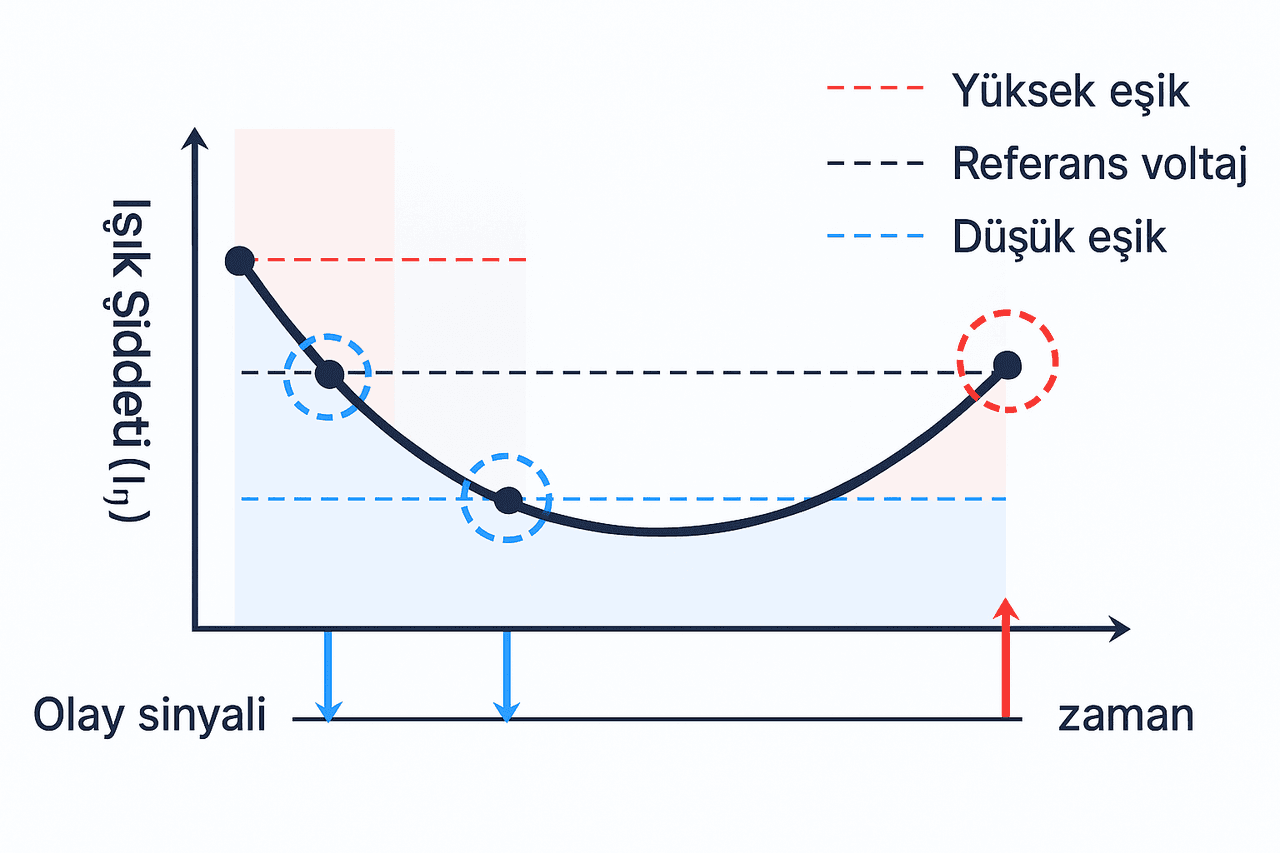
Principle of Positive and Negative Event Generation in Event Cameras (Sony)
Event cameras have application potential across various fields, including:
with applications in these areas designed to leverage the temporal sensitivity and data efficiency offered by event cameras.
High FPS cameras continuously record the scene in complete frames. Regardless of how high the FPS, every frame captures the entire image, resulting in high data volume, processing load, and latency. Additionally, motion blur can occur during fast movements, and abrupt changes may be missed between frames.
Event cameras, also known as event-based cameras, are asynchronous sensors in which each pixel responds only to brightness changes. They generate an “event” only when a change occurs and produce no data from static regions. As a result:
These differences make event cameras far more advantageous than high FPS cameras in applications requiring fast scenes, low-light conditions, or real-time responsiveness.

Comparison of Traditional Camera Output with Event Camera Output After Converting Event Data into Frames, Left: Traditional Camera Output, Right: Event Camera Output (University of Zurich, Robotics and Perception Group, Davide Scaramuzza)
Event cameras offer a novel visual perception approach based on biological principles, surpassing traditional imaging systems. With advantages such as high temporal resolution, low latency, and data efficiency, they hold strong potential across applications from autonomous systems to robotics. However, their widespread adoption faces technical barriers, including incompatibility with conventional methods, challenges in data processing, and limited datasets. In the future, as specialized hardware and software solutions for event-based sensing continue to evolve, event cameras are expected to become more effective and reliable across a broader range of applications.
Gallego, Guillermo, Tobi Delbrück, Garrick Orchard, Chiara Bartolozzi, Brian Taba, Andrea Censi, Stefan Leutenegger, Andrew J. Davison, Jorg Conradt, Kostas Daniilidis, and Davide Scaramuzza. 2022. “Event-Based Vision: A Survey.” IEEE Transactions on Pattern Analysis and Machine Intelligence 44 (1): 154–180. https://doi.org/10.1109/TPAMI.2020.3008413.
GitHub. "Event-Based Vision Resources." Robotics and Perception Group (RPG). Accessed April 21, 2025. Accessed Adresi.
Scaramuzza, Davide. *Tutorial on Event-based Cameras*. Zurich: Robotics and Perception Group, University of Zurich, 2019. Accessed April 21, 2025. Accessed Adresi.
Sony Semiconductor Solutions Corporation. "Event-based Vision Sensor (EVS) Technology." Accessed April 21, 2025. Accessed Adresi.

No Discussion Added Yet
Start discussion for "Event Camera (Neuromorphic, Event-Based Camera)" article
Working Principle
Application Areas
High FPS (Frames Per Second) Camera vs Event Camera Comparison
Disadvantages and Technical Challenges