This article was automatically translated from the original Turkish version.
Falcon Heavy Rocket
Producer(s) | SpaceX | ||||||||
|---|---|---|---|---|---|---|---|---|---|
Country of Origin | United States of America | ||||||||
Number of Launches | 3 | ||||||||
Engine(s) | Merlin 1D | ||||||||
Thrust | 7607 kN (1323000 lbf) | ||||||||
Fuel | LOX/RP-1 | ||||||||
Cost Per Launch | Up to 8000 kg for 90 million dollars | ||||||||
Number of Stages | 2 | ||||||||
Payload Capacity | 22200 kg (46700 lb) - (Geostationary Transfer Orbit) 54000 kg (117000 lb) - (LEO) | ||||||||
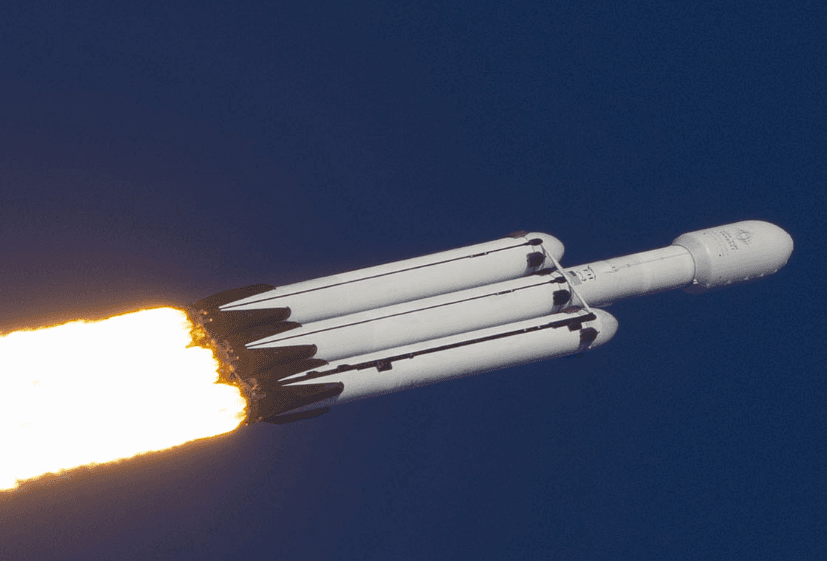
Falcon Heavy is a reusable super heavy-lift launch vehicle designed and manufactured by the American aerospace and space company SpaceX. Fundamentally, it is created by adding two Falcon 9 first stages as side boosters on either side of a structurally reinforced Falcon 9 core. Falcon Heavy is one of the most powerful operational rockets and was developed to place large satellites, national security payloads and interplanetary missions into orbit. Its most distinctive feature is the ability of all three first-stage boosters to perform vertical landings after launch for reuse.

Initial Concept and Delays SpaceX first announced the Falcon Heavy concept in 2011 with an initial target for its first flight in 2013. However, the engineering complexity of integrating three Falcon 9 cores became apparent. The company faced significant challenges in managing aerodynamic and structural loads between the three cores, synchronizing the simultaneous operation of 27 Merlin engines, and ensuring the reliability of separation mechanisms. These technical obstacles caused the project to be delayed by several years. CEO Elon Musk later described the project’s difficulty as “much, much harder than we originally thought”.

The initial design concept included an ambitious fuel system called “cross-feed”, in which the two side boosters would pump fuel not only to their own engines but also to the core stage’s engines. This would have left the core’s fuel tanks nearly full after booster separation, significantly increasing the rocket’s performance. However, due to the hardware complexity and associated risks, SpaceX abandoned this idea. Instead, a simpler and more reliable flight profile was adopted. In this profile, shortly after launch, the core stage’s engines reduce thrust to conserve fuel while the side boosters continue operating at full power. After the side boosters separate, the core stage’s engines reignite to full power.

Falcon Heavy’s highly anticipated first test flight was successfully conducted on 6 February 2018 from Launch Complex 39A (LC-39A) at Kennedy Space Center. For this mission, Elon Musk’s personal Tesla Roadster was used as a simulated payload. The vehicle, with a mannequin dressed in a spacesuit named “Starman”, was sent into space.

Falcon Heavy Two Core Landings (SpaceX)
During the flight, the two side boosters successfully separated after launch and performed synchronized vertical landings at Landing Zones 1 and 2 (LZ-1 and LZ-2) in Cape Canaveral. The core stage attempted a landing on an autonomous drone ship (ASDS) in the Atlantic Ocean. However, due to depletion of the TEA-TEB igniter fluid, only one engine ignited, causing the core to strike the ship at high speed and break apart. Despite this partial failure, the test flight was widely regarded as a major success and demonstrated the validity of the rocket’s fundamental design and reusability concept.
In reusable modes, payload capacity decreases depending on the landing profile and fuel margin.
Falcon Heavy has the capacity to deliver high-mass payloads to various orbits. This capacity varies depending on the launch profile and reusability objectives.
The first stage of Falcon Heavy consists of three Falcon 9 cores, totaling 27 Merlin 1D rocket engines.

Ignition of 27 Merlin Engines (SpaceX)
The fairing, which protects the payload from aerodynamic and thermal forces during atmospheric flight, is 13.1 metres tall and 5.2 metres in diameter. These fairings are recovered by parachute systems and guidance thrusters, descending to the ocean where they are retrieved by specialized vessels for reuse.
Falcon Heavy is positioned as a strategic platform for heavy satellite launches, interplanetary missions, and future potential human spaceflight programs using current technology.
The first stage consists of three Falcon 9 cores and contains a total of 27 Merlin 1D engines.

SpaceX Merlin 1D Engine (SpaceX)
After separation of the core stage, the second stage, responsible for placing the payload into its final orbit, is equipped with a single Merlin 1D Vacuum (MVac) engine optimized for operation in vacuum. For missions requiring complex orbital maneuvers, the engine can be restarted multiple times. The second stage, mounted atop the core stage, is tasked with delivering the payload to its final orbit.

Falcon Heavy Two Booster Landings (SpaceX)
Falcon Heavy is designed for high reusability to reduce costs.
A typical Falcon Heavy mission follows these steps:
NASA Science. "Psyche." Accessed July 6, 2025. https://science.nasa.gov/mission/psyche/
NASA. "NASA Awards Contract to Launch Initial Elements for Lunar Outpost." Accessed July 6, 2025. https://www.nasa.gov/news-release/nasa-awards-contract-to-launch-initial-elements-for-lunar-outpost/
Simberg. "Elon Musk on SpaceX's Reusable Rocket Plans". Accessed July 5, 2025. https://www.popularmechanics.com/space/rockets/a7446/elon-musk-on-spacexs-reusable-rocket-plans-6653023/
SpaceX. "Falcon Heavy Demo." Accessed July 6, 2025. https://www.spacex.com/launches/mission/?missionId=falcon-heavy-demo/
SpaceX. "Falcon Heavy." Accessed July 6, 2025. https://www.spacex.com/vehicles/falcon-heavy/

Falcon Heavy Rocket
Producer(s) | SpaceX | ||||||||
|---|---|---|---|---|---|---|---|---|---|
Country of Origin | United States of America | ||||||||
Number of Launches | 3 | ||||||||
Engine(s) | Merlin 1D | ||||||||
Thrust | 7607 kN (1323000 lbf) | ||||||||
Fuel | LOX/RP-1 | ||||||||
Cost Per Launch | Up to 8000 kg for 90 million dollars | ||||||||
Number of Stages | 2 | ||||||||
Payload Capacity | 22200 kg (46700 lb) - (Geostationary Transfer Orbit) 54000 kg (117000 lb) - (LEO) | ||||||||
No Discussion Added Yet
Start discussion for "Falcon Heavy Rocket" article
History and Development
Design Challenges
First Flight
Design and Technical Specifications
Overview
Payload Capacity
Boosters and Core Stage
Payload Fairing
First Stage
Second Stage
Reusability
Flight Profile
Significant Missions