


This article was automatically translated from the original Turkish version.
+1 More
Origin(s) | It evolved from the dueling culture of medieval Europe | ||||||||
|---|---|---|---|---|---|---|---|---|---|
Modernization | With the standardization of rules in 19th century France | ||||||||
Entry into the Olympics | Since the 1896 Athens Olympics | ||||||||
International Institution | International Fencing Federation (FIE) | ||||||||
Disciplines | Foil, Épée, Sabre | ||||||||
Piste Dimensions | Length: 14 m, Width: 1.5–2 m | ||||||||
Protective Equipment | Mask, Jacket, Trousers, Gloves, Chest Protector, Electronic Vest | ||||||||
Fencing in Türkiye | Turkish Fencing Federation (TFF), established in 1923 | ||||||||
Prominent Athletes in Türkiye | İrem Karamete, Candeniz Berrak | ||||||||
National Achievements | Medals in European and World Championships, Participation in the 2016 Rio Olympics | ||||||||
Official Website(s) | https://fie.org / www.eskrim.org.tr | ||||||||
Fencing is an individual sport in which two athletes compete against each other under specific rules, using pointed or blunt swords, requiring quick reflexes, strategy, and technical skill. This European-origin sport evolved from dueling culture into its modern form. Fencing is practiced in three distinct disciplines: foil, épée, and sabre. Each discipline has different rules, target areas, and weapons.
In its modern form, fencing has been part of the Olympic Games since 1896 and is governed by the International Fencing Federation (FIE). Fencing competitions, held in both individual and team categories for men and women, combine strategic thinking with high levels of physical agility.
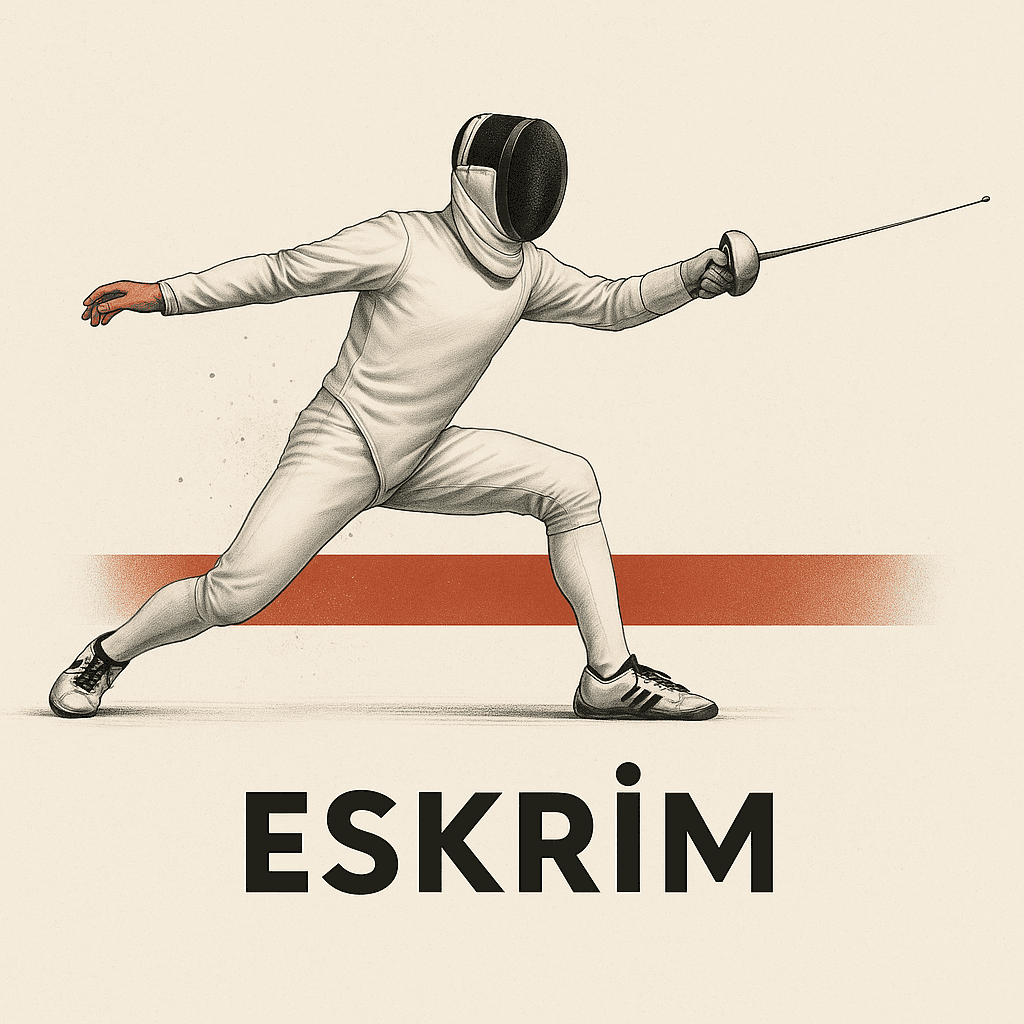
Fencing Representative Image (Generated by Artificial Intelligence)
The roots of fencing lie in medieval European sword combat. During this period, knights participated in one-on-one duels to hone their swordsmanship skills. In the 14th and 15th centuries, the crude, force-based sword fighting of battlefields gradually transformed into regulated and controlled contests.
Spain, Italy, and France were pioneering nations in the development of fencing art. In these countries, sword masters, known as “fencing master” or “maestro d’armi,” taught specialized techniques to aristocrats and military personnel. These techniques were later documented in books and incorporated into formal training systems.
By the late 19th century, fencing had fully adopted a sportive identity. Lethal duels faded into history, while safe training sessions and tournaments held in salons came to the forefront. During this period:
Fencing was first included in the modern Olympic Games at the 1896 Athens Olympics. Since then, it has been featured in every Summer Olympics. Initially, only men competed. Women began participating in the foil category at the 1924 Paris Olympics. Today, women also compete in épée and sabre categories, making fencing a model sport in terms of gender equality.
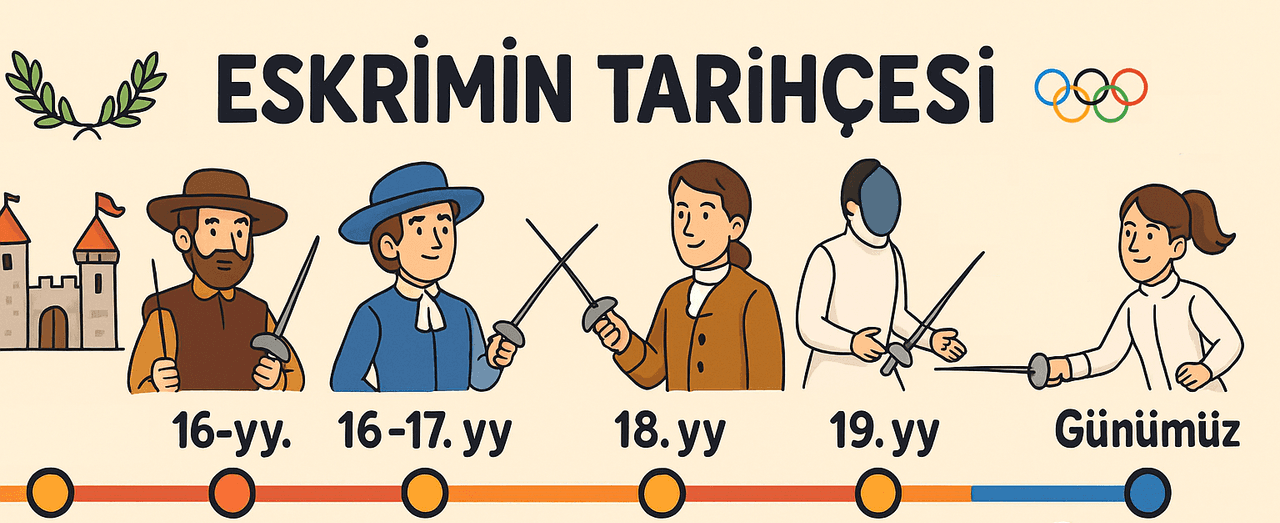
History of Fencing (Generated by Artificial Intelligence)
Fencing is divided into three main disciplines, each with distinct rules, scoring systems, and weapons:
Foil is the most technical and rule-sensitive discipline of fencing.
Due to its intensity in tactics and reflexes, foil is often preferred for children at beginner levels to build a strong technical foundation.
Épée is the fencing discipline with the largest target area.
Épée requires patience, concentration, and strategy. The most effective method is to wait for the opponent to make a mistake.
Sabre is the fastest and most aggressive discipline of fencing.
Sabre emphasizes speed and agility. Reaction time and attacking power are crucial.
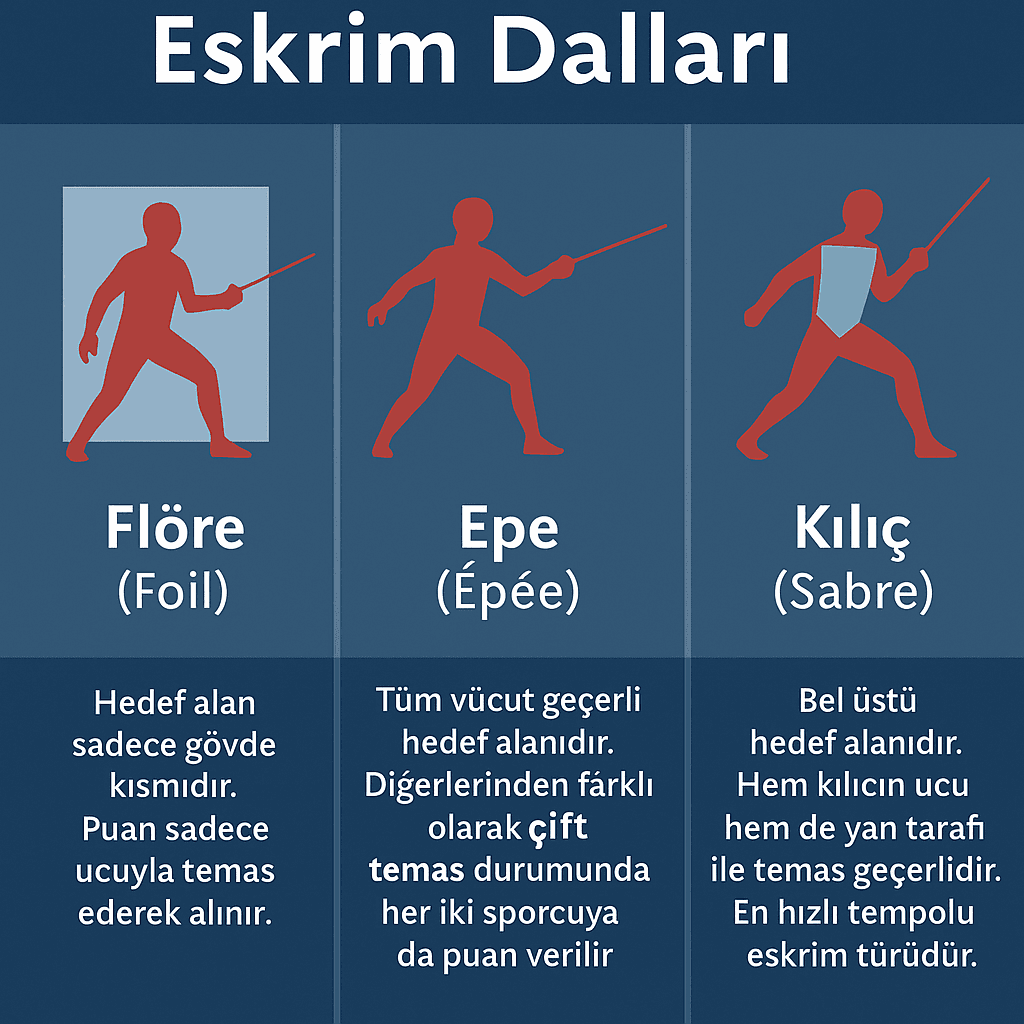
Fencing Disciplines (Generated by Artificial Intelligence)
Fencing is conducted in specially designed halls or on platforms set up for competitions. These platforms are called “piste.” The piste is a designated area that allows fencers to compete according to specific rules and in a safe manner.
Modern fencing pistes are equipped with electronic scoring systems. Sensors located at the tips of the fencers’ weapons detect touches on the opponent and automatically record points. These systems ensure fair and accurate evaluation of bouts.
Fencing is performed using specialized gear designed to ensure the safety of participants:
The Turkish Fencing Federation (TFF), established in 1923, is the primary organization responsible for supporting and governing fencing in Türkiye. The federation has achieved numerous successes at national and international levels. TFF conducts various activities to promote fencing across Türkiye. As of 2015, fencing activities are present in 53 of Türkiye’s 81 provinces, with 2,615 active athletes.
The federation organizes national championships and international tournaments annually for various age groups. The 2025 activity calendar includes national championships for U10, U12, and U14 categories, as well as open tournaments for juniors and seniors. The efforts of the Turkish Fencing Federation and the achievements of its athletes make significant contributions to the development of fencing in Türkiye.

Logo of the Turkish Fencing Federation (Turkish Fencing Federation)
Deladrier, Clovis. Modern Fencing: A Comprehensive Manual for Foil, Épée & Sabre. New York: Echo Point Books & Media, 2020.
FIE. "History of Fencing." *Fédération Internationale d’Escrime*. Accessed May 9, 2025. https://fie.org/fie/history
Gaugler, William M. The History of Fencing: Foundations of Modern European Swordplay. Budapeşte: Corvina Press, 2009.
International Fencing Federation (FIE). "Rules and Documents." Accessed May 9, 2025. https://fie.org/fie/documents/rules
International Olympic Committee. “Fencing Equipment and History.” olympics.com. Accessed May 9, 2025. https://www.olympics.com/en/sports/fencing/
Olympedia. “Fencing at the Olympic Games.” Accessed May 9, 2025. https://www.olympedia.org/sports/FEN
Türkiye Eskrim Federation. "Eskrim in Türkiye." *eskrim.org.tr*. Accessed May 9, 2025. https://www.eskrim.org.tr/turkiye-de-eskrim-33.html

Origin(s) | It evolved from the dueling culture of medieval Europe | ||||||||
|---|---|---|---|---|---|---|---|---|---|
Modernization | With the standardization of rules in 19th century France | ||||||||
Entry into the Olympics | Since the 1896 Athens Olympics | ||||||||
International Institution | International Fencing Federation (FIE) | ||||||||
Disciplines | Foil, Épée, Sabre | ||||||||
Piste Dimensions | Length: 14 m, Width: 1.5–2 m | ||||||||
Protective Equipment | Mask, Jacket, Trousers, Gloves, Chest Protector, Electronic Vest | ||||||||
Fencing in Türkiye | Turkish Fencing Federation (TFF), established in 1923 | ||||||||
Prominent Athletes in Türkiye | İrem Karamete, Candeniz Berrak | ||||||||
National Achievements | Medals in European and World Championships, Participation in the 2016 Rio Olympics | ||||||||
Official Website(s) | https://fie.org / www.eskrim.org.tr | ||||||||
History of Fencing
16th–18th Century: Transition to Sportive Fencing
19th Century: Birth of Modern Fencing
1896 to Present: Olympic Fencing
Fencing Disciplines
Foil
Épée
Sabre
Characteristics of Fencing
Where Is Fencing Practiced?
Piste Dimensions and Features
Markings on the Piste
Piste Usage and Rules
Safety and Electronic Systems on the Piste
Protective Equipment
Fencing in Türkiye
Current Activities
Notable Achievements