


This article was automatically translated from the original Turkish version.
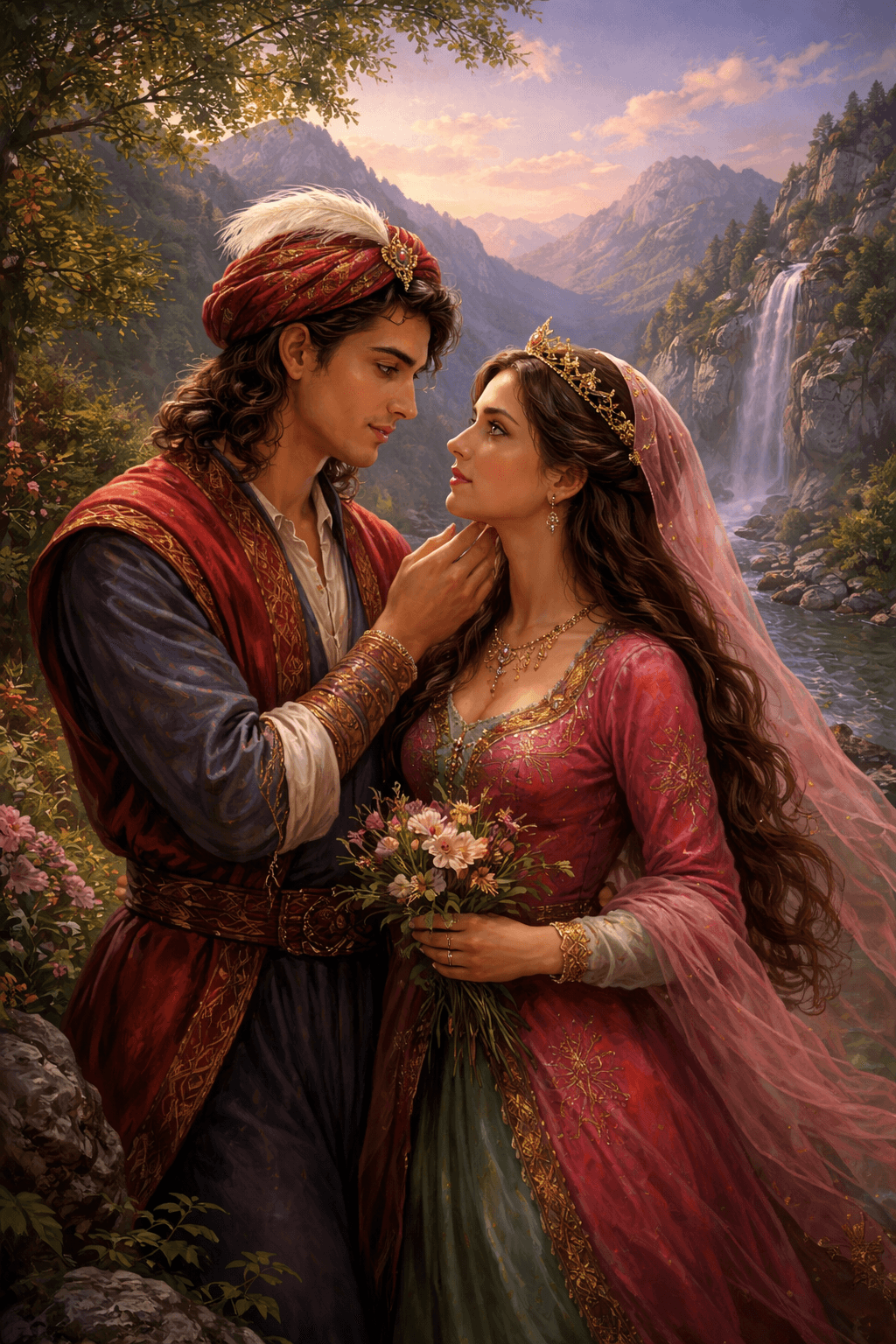
Ferhat and Shirin (Generated with Artificial Intelligence.)
Subject(s) | The love between Ferhat and Shirin failing to materialize due to social obstacles | ||||||||
|---|---|---|---|---|---|---|---|---|---|
Type(s) | Folk Tale | ||||||||
Core Themes | Patience Sacrifice Impossible love | ||||||||
Ferhat and Shirin Turkish folk literature tradition features this anonymous folk tale. The story revolves around the love of a young man named Ferhat for Shirin and the obstacles standing in the way of this love. The narrative has been transmitted in both oral and written forms and combines poetic and prose elements. The tale has been preserved within the folk culture of Amasya and its surroundings and has been embodied in places such as the Museum of Lovers in Amasya.

Ferhat and Shirin Museum of Lovers (Amasya Provincial Directorate of Culture and Tourism)
The tale of Ferhat and Shirin emerged within the tradition of anonymous folk tales and has reached the present through the transition from oral to written culture. Written versions have been preserved especially in Amasya and its surroundings, transmitted alongside regional oral narratives. The story was adapted into Turkish folk culture in connection with the Persian literary tradition of Khosrow and Shirin and spread in oral and written forms across various regions, particularly in Amasya and the Caucasus. Although these transmission forms introduced some regional variations in plot and characters, the core structure of the tale has been preserved.
Ferhat and Shirin is an anonymous folk tale that combines both poetic and prose elements. The story is conveyed through prose narration alongside poetic passages expressing Ferhat’s emotions. In written versions, the poetic sections are detailed, while in oral transmission the tale is shorter and more summarized. Some versions include proverbs, folk song elements, and repetitions. These varied transmission forms have enabled the tale to be passed from generation to generation and embraced within folk culture.

Ferhat and Shirin (Generated by Artificial Intelligence)
One day, Ferhat hears the name of Shirin and learns of her beauty. These descriptions stir deep love within him. Shirin, however, is kept under strict surveillance by her family, especially her father, who forbids any contact between her and Ferhat and refuses to allow their relationship.
Ferhat embarks on a long and arduous journey to reunite with Shirin. Along the way, he encounters mountains, rivers, steep cliffs, and various natural obstacles. Enemies, rivals, and traps set along his path hinder his progress. Nevertheless, Ferhat remains steadfast in his love and tries different ways to overcome the challenges he faces. In some versions, individuals who assist Ferhat during his journey play a role in helping him surmount these obstacles. In certain variants, Shirin’s father imposes an impossible task on Ferhat to prove his worthiness: to dig through a mountain to bring water. Ferhat begins to dig into the mountain and spends a long time working on this task. The act of digging through the mountain is portrayed as part of the heavy and difficult struggle Ferhat undertakes for the sake of his love for Shirin. Throughout his journey, Ferhat expresses his feelings and thoughts through poetic passages. Themes of longing, love, and determination give the tale a rhythmic structure. Each obstacle Ferhat encounters reveals both the physical and emotional dimensions of his journey.
Shirin reciprocates Ferhat’s love but struggles to reach him due to familial pressure and social barriers. The rules and tasks imposed by her father constitute decisive obstacles to their union. In different variants of the tale, the love between Ferhat and Shirin ends in various ways: some versions conclude without their reunion, while others end in separation or tragedy. The journeys, tasks, and obstacles encountered form the dramatic structure and continuity of the tale of Ferhat and Shirin.
Amasya and surrounding variants: Ferhat’s journey is elaborated in detail in the Amasya region; the tale emphasizes his digging through mountains for love and the obstacles he confronts.【1】 Poetic sections sung in each village are detailed, and episodes highlighting love tested by obstacles are emphasized.【2】 In some versions, local places and cultural motifs are incorporated into the tale’s dramatic structure, reinforcing its identification with Amasya.【3】
Caucasus and surrounding variants:【4】: The obstacles and journeys faced by Ferhat and Shirin are conveyed with regional cultural elements; local names and characters influence the narrative’s variation. Some variants introduce additional obstacles or new characters, and the ending may differ regionally, with Ferhat and Shirin sometimes concluding the tale only through separation.
Written and oral transmission forms: Written versions emphasize poetic passages and detailed narratives; oral variants summarize the plot and convey it in a condensed form.【5】
The tale of Ferhat and Shirin holds an important place in folk culture and literature. Especially in Amasya and its surroundings, it has been transmitted orally, embraced by local communities, and embodied in places such as the Museum of Lovers. Ferhat’s poetic passages have been incorporated into folk music and song repertoires and have been performed in some regions through theater and meddah storytelling.
Regional cultural motifs and local narrative styles have contributed to the social and cultural life of the people. Different variants have enabled the tale to survive across various geographic areas, with both written and oral transmission forms supporting its intergenerational continuity.
Albayrak, Nurettin. “FERHAD ve ŞİRİN.” *TDV İslâm Ansiklopedisi*. TDV İslâm Araştırmaları Merkezi. Accessed January 25, 2026. https://islamansiklopedisi.org.tr/ferhad-ve-sirin
Amasya İl Kültür ve Turizm Müdürlüğü. “Ferhat ile Şirin.” T.C. Kültür ve Turizm Bakanlığı. Accessed January 25, 2026. https://amasya.ktb.gov.tr/TR-59489/ferhat-ile-sirin.html
Amasya İl Kültür ve Turizm Müdürlüğü. “Ferhat İle Şirin Aşıklar Müzesi.” T.C. Kültür ve Turizm Bakanlığı. Accessed January 25, 2026.
Bars, Mehmet Emin. “A. Olrik’in Epik Yasaları Işığında Ferhat ile Şirin Hikâyesi.” *Uluslararası Türkçe Edebiyat Kültür Eğitim Dergisi* 3, no. 1 (2014): 306–324. Accessed January 25, 2026. https://dergipark.org.tr/tr/download/article-file/136907
T.C. Ministry of Culture and Tourism Culture Portal. "Ferhat ile Şirin — Amasya." *Kültür Atlası. Accessed January 25, 2026.
Yeşilyurt, Şeyda. “Ferhat ile Şirin’e Metinlerarası Bir Yaklaşım.” *HİKMET-Akademik Edebiyat Dergisi / Journal of Academic Literature* 4, no. 9 (Fall 2018): 154–172. Accessed January 25, 2026.
[1]
Amasya Provincial Directorate of Culture and Tourism. “Ferhat and Shirin.” Ministry of Culture and Tourism of the Republic of Türkiye. Access date: January 25, 2026. https://amasya.ktb.gov.tr/TR-59489/ferhat-ile-sirin.html
[2]
Amasya Provincial Directorate of Culture and Tourism. “Ferhat and Shirin Museum of Lovers.” Ministry of Culture and Tourism of the Republic of Türkiye. Access date: January 25, 2026. https://amasya.ktb.gov.tr/TR-243789/ferhat-ile-sirin-asiklar-muzesi.html
[3]
Amasya Provincial Directorate of Culture and Tourism. “Ferhat and Shirin Museum of Lovers.” Ministry of Culture and Tourism of the Republic of Türkiye. Access date: January 25, 2026.https://amasya.ktb.gov.tr/TR-243789/ferhat-ile-sirin-asiklar-muzesi.html
[4]
Albayrak, Nurettin. “FERHAD and SHIRIN.” TDV Islamic Encyclopedia. TDV Islamic Research Center. Access date: January 25, 2026. https://islamansiklopedisi.org.tr/ferhad-ve-sirin
[5]
Yeşilyurt, Şeyda. “A Textual Approach to Ferhat and Shirin.” HİKMET-Academic Literature Journal / Journal of Academic Literature 4, no. 9 (Autumn 2018): 154–172. Access date: January 25, 2026. https://dergipark.org.tr/en/download/article-file/564237


Ferhat and Shirin (Generated with Artificial Intelligence.)
Subject(s) | The love between Ferhat and Shirin failing to materialize due to social obstacles | ||||||||
|---|---|---|---|---|---|---|---|---|---|
Type(s) | Folk Tale | ||||||||
Core Themes | Patience Sacrifice Impossible love | ||||||||
Origin and History of the Tale
Cast of Characters
Genre, Form, and Transmission
Plot
Variants of the Tale
Cultural Significance