

This article was automatically translated from the original Turkish version.
Original Title | The Elephant Man | ||||||||
|---|---|---|---|---|---|---|---|---|---|
Production Year / Country | 1980 / United Kingdom–USA co-production | ||||||||
Genre | Drama biographical period film | ||||||||
Director(s) | David Lynch | ||||||||
Screenplay(s) | Christopher De Vore David Lynch (inspired by Bernard Pomerance's stage work) Eric Bergren | ||||||||
Main Cast | John Hurt (John Merrick), Anthony Hopkins (Dr. Frederick Treves), Anne Bancroft, John Gielgud, Freddie Jones | ||||||||
Production Company / Distribution | Brooksfilms; Paramount Pictures | ||||||||
Language(s) | English | ||||||||
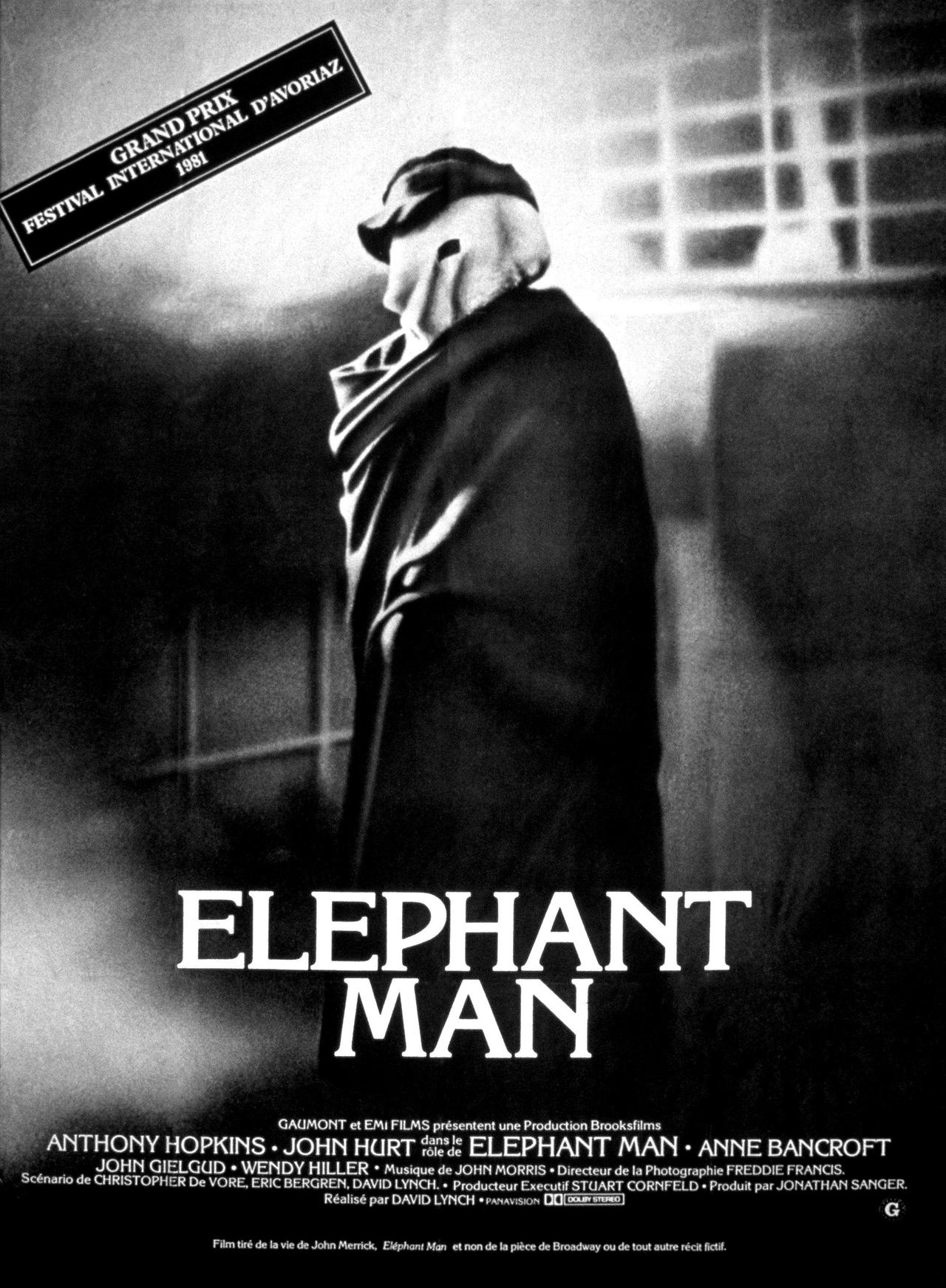
The Elephant Man is a feature-length drama centered on the life of Joseph Merrick, who lived in Victorian London (referred to as John Merrick in the film). The production explores themes of physical difference and human dignity against the tension between medical curiosity and the culture of spectacle. The narrative reveals issues of compassion, ethics, and social exclusion through the physician’s observations and the reactions of those around him. The black-and-white visual design underscores the period atmosphere and grounds the character’s world with a sense of authentic space. The editing rhythm balances moments of unease with periods of stillness, while the sound design establishes measured transitions between the noise of the crowded city and the silence of interior spaces. The audiovisual whole forms a framework that unites the personal drama with its social context. The result is a cinematic language that seeks to generate powerful emotional intensity without veering into melodrama.
The film examines the relationship between modern medical discourse and Victorian social propriety through its characters. The harshness of society’s gaze toward the “abnormal” is confronted with demands for compassion and respect. The camera leverages the power of close-ups to amplify the meaning of facial expressions and subtle gestures. Class distinctions of the era are made visible through set and costume decisions. The musical score provides emotional guidance without overshadowing the narrative. Power asymmetries between characters are reinforced through economical dialogue and framing choices. The film invites the audience to engage in both an ethical reckoning and a historical panorama.
The story begins when John Merrick, a man with severe deformities exhibited in a circus, is discovered by a surgeon and admitted to a hospital. Initially perceived as a “case,” he gradually comes to be recognized as an individual and elicits varied responses from his social environment. The narrative intertwines the struggle for protection from degradation and exploitation with the search for a new identity and dignity. Merrick’s means of self-expression emerges from the tension between the visibility of his body and the fragility of his voice. The boundary between curiosity and compassion is tested through visitors, journalists, and hospital administration. Certain scenes highlight how permeable the lines between privacy and exhibitionism can be. The film proposes an ethical confrontation through the recognition of the protagonist’s humanity.
The narrative follows a linear timeline, but the stages of trust between Merrick and the physician unfold as dramatic turning points. The protective space created against external threats generates a limited sense of freedom. The determining power of social status becomes evident in scenes such as banquets and theatrical experiences. Merrick’s re-exposure to public scrutiny sustains the narrative tension. The finale achieves an emotional resolution through a form of acceptance and pursuit of peace. In this way, the film explores the distinction between being “seen” and being “understood” through a personal story.
The production draws attention with its convincing set and costume design that authentically evokes the period; realistic details are preferred in both interior and exterior spaces. The choice of black-and-white cinematography sharpens the interplay of light and shadow and renders the era’s grim, industrial texture palpable. The camera predominantly operates with static or limited movement; this approach highlights the mise-en-scène and the actors’ performances. The editing focuses on interactions between characters, with a rhythm that fluidly alternates between intense emotional moments and quieter observations. In the sound design, crowd ambience, hospital silence, and the vibrations of stage performances are used in balanced proportion. The music supports emotional depth without amplifying dramatic tension. The overall technical ensemble aims to generate high expressive power through minimal gestures.
In the visual composition, surface textures, fabric details, and furniture function as class indicators. Makeup and prosthetics render the character’s physicality visible while maintaining an ethical distance. Framing choices clearly define the direction of gazes and power relations. In post-production, sound and music levels and rhythm are scaled according to the dramatic intent of each scene. Lighting combines natural sources with directed spotlights, emphasizing the volume of faces and spaces. The overall aesthetic relies on consistency and emotional truth rather than spectacle. The resulting effect is a measured stylistic unity sustained within the framework of a period film.

A scene from the film (IMDb)
John Hurt portrays John Merrick, the film’s central character, with a delicate yet dignified performance. Hurt’s portrayal conveys both the physical and emotional world of Merrick with unexaggerated but intense sensitivity. The character’s quest for human dignity is fully embodied in Hurt’s facial expressions, vocal tone, and body language. The audience bears direct witness to Merrick’s inner world of pain and grace. This performance is regarded as one of the most respected dramatic portrayals in film history. Merrick’s silence and the depth of his gaze shape the broader narrative of human dignity.
Anthony Hopkins portrays Dr. Frederick Treves, a physician torn between scientific curiosity and moral responsibility. Hopkins’s interpretation reveals both the character’s professional discipline and his emotional conflicts. Treves’s approach to Merrick evolves over time from experimental observation to humane protection. This transformation is made evident through Hopkins’s gestures and restrained tonal modulation. The character of Treves serves as a central figure representing the ethical boundaries of science. Hopkins’s performance simultaneously evokes trust and questioning in the viewer.
Anne Bancroft, as Mrs. Kendal, presents a woman engaged in the performing arts who demonstrates to Merrick how the outside world can approach him with kindness. Bancroft’s refined portrayal brings to the foreground the strength derived from empathy. Her scenes correspond to moments when societal prejudices are challenged. John Gielgud, as Carr Gomm, embodies the representative of institutional order and the voice of bureaucratic limits; Gielgud’s theater-trained discipline deepens the weight of the character. Freddie Jones, as Bytes, carries the film’s dark side as Merrick’s former exhibitor and exploiter; Jones’s performance sharply exposes the absence of social compassion. All supporting roles contribute functionally to complete the film’s ethical framework.
Beyazperde. "The Elephant Man – Oyuncular ve Kadro." Accessed October 8, 2025. https://www.beyazperde.com/filmler/film-180/oyuncular/
Beyazperde. "The Elephant Man." Accessed October 8, 2025. https://www.beyazperde.com/filmler/film-180/
IMDb. "The Elephant Man (1980)." Accessed October 8, 2025. https://www.imdb.com/title/tt0080678/
IMDb. "The Elephant Man – Awards." Accessed October 8, 2025. https://www.imdb.com/title/tt0080678/awards/?ref_=tt_ov_at_op_awd
IMDb. "The Elephant Man – Filming Locations." Accessed October 8, 2025. https://www.imdb.com/title/tt0080678/locations/?ref_=tt_ov_at_dt_flmg
IMDb. "The Elephant Man – Full Cast & Crew." Accessed October 8, 2025. https://www.imdb.com/title/tt0080678/fullcredits/?ref_=tt_ov_at_pop_cst
IMDb. "The Elephant Man – Media Index." Accessed October 8, 2025. https://www.imdb.com/title/tt0080678/mediaindex/?ref_=tt_ov_at_pop_ph
IMDb. "The Elephant Man – Plot Summary." Accessed October 8, 2025. https://www.imdb.com/title/tt0080678/plotsummary/?ref_=tt_ov_at_pl_pl
IMDb. "The Elephant Man – Release Info." Accessed October 8, 2025. https://www.imdb.com/title/tt0080678/releaseinfo/?ref_=tt_ov_at_dt_rdat
IMDb. "The Elephant Man – Technical Specs." Accessed October 8, 2025. https://www.imdb.com/title/tt0080678/technical/?ref_=tt_ov_at_dt_spec
MUBI. "The Elephant Man – Awards." Accessed October 8, 2025. https://mubi.com/tr/films/the-elephant-man/awards
MUBI. "The Elephant Man." Accessed October 8, 2025. https://mubi.com/tr/tr/films/the-elephant-man

Original Title | The Elephant Man | ||||||||
|---|---|---|---|---|---|---|---|---|---|
Production Year / Country | 1980 / United Kingdom–USA co-production | ||||||||
Genre | Drama biographical period film | ||||||||
Director(s) | David Lynch | ||||||||
Screenplay(s) | Christopher De Vore David Lynch (inspired by Bernard Pomerance's stage work) Eric Bergren | ||||||||
Main Cast | John Hurt (John Merrick), Anthony Hopkins (Dr. Frederick Treves), Anne Bancroft, John Gielgud, Freddie Jones | ||||||||
Production Company / Distribution | Brooksfilms; Paramount Pictures | ||||||||
Language(s) | English | ||||||||
Plot and Narrative Structure
Production and Technical Features
Cast and Characters
Awards