

This article was automatically translated from the original Turkish version.
Team(s) | Cetacea (Whales) | ||||||||
|---|---|---|---|---|---|---|---|---|---|
Subteam | Mysticeti (Baleen Whales) | ||||||||
Family | Balaenopteridae | ||||||||
Type(s) | Balaenoptera physalus | ||||||||
Size(s) | 18–22 metres | ||||||||
Weight(s) | 40–80 tonnes | ||||||||
Color | Back: Dark gray/brown-black, Belly: Light gray/white | ||||||||
Feeding Method | Filter feeding (with baleen plates on plankton and small fish) | ||||||||
Reproduction(s) | 11–12 month gestation Single calf birth | ||||||||
Habitat | All oceans Open seas and continental shelves | ||||||||
Migration Behavior | To the poles in summer, To the tropics in winter | ||||||||
Conservation Status (IUCN) | Vulnerable | ||||||||
Observation in Türkiye | Rare; especially along the Mediterranean coast | ||||||||
The fin whale (Balaenoptera physalus) is the second largest marine mammal after its close relative the blue whale (Balaenoptera musculus) and belongs to the family Balaenopteridae. A long-lived and migratory species the fin whale is classified as “Vulnerable” by the IUCN and is under international protection against various environmental threats.
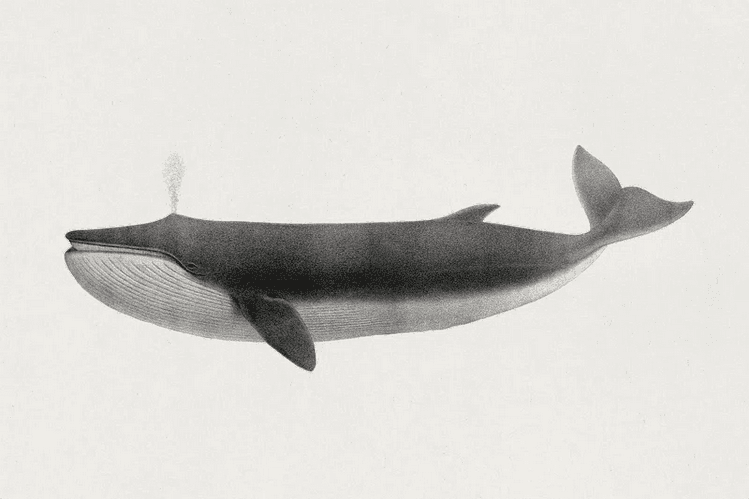
The fin whale (Balaenoptera physalus) is distinguished by its long cylindrical and streamlined body. Its coloration is markedly asymmetrical: the left side is dark while the right lower jaw area is visibly white. This color contrast is believed to serve a functional role in orientation and confusion during feeding.
Adult individuals range in length from an average of 18 to 22 metres with some reaching up to 25 metres. Their weight varies between 40 and 80 tonnes. The head is broad and flat. Between 50 and 100 longitudinal grooves extend from the lower jaw to the belly allowing the mouth to expand during feeding. The upper jaw contains 260 to 480 baleen plates each made of keratin which filter seawater to capture plankton and small fish. The paired blowhole on the top of the head produces a vertical spout of water vapor up to 5 to 6 metres high during exhalation.

Fin Whale (pixabay)
The fin whale is a widely distributed species found throughout all major oceans and some seas worldwide. It is particularly abundant in temperate and cold waters of the northern and southern hemispheres. It prefers open ocean habitats over shallow coastal areas. Seasonally migratory fin whales travel to polar waters during summer months to exploit high levels of food productivity and return to warmer waters in winter for breeding and calving. Fin whales have been documented along the coasts of Türkiye with observations concentrated in the Aegean Sea and the eastern Mediterranean. Since the 1990s beachings (stranding events) have also been reported along Turkish coasts.
Fin whales are microphagous feeders whose diet varies by region and season but primarily consists of krill planktonic crustaceans and small schooling fish such as herring and mackerel. During feeding they open their mouths widely to engulf large volumes of water and prey. By expanding the pleats of the lower jaw and pushing the water out with their tongues against the baleen plates they retain the trapped organisms. Daily food consumption is approximately two tonnes.
Female fin whales give birth every two to three years on average. Gestation lasts about eleven months and typically results in a single calf. A newborn calf is approximately six metres long and weighs about two tonnes. Nursing lasts for six to seven months. Females reach sexual maturity between six and twelve years of age while males mature between six and ten years. The average lifespan of fin whales ranges from 80 to 90 years.
This species generally travels alone or in pairs but larger groups have been observed in feeding areas. When surfacing they move rapidly in a straight line. Fin whales are highly agile underwater and can reach speeds of 35 to 40 kilometres per hour. Average dive durations are between six and ten minutes though dives lasting up to 20 minutes have been recorded.
Fin whales are among the most powerful and lowest frequency sound producers among marine mammals. Males especially produce calls between 16 and 40 Hz reaching up to 188 decibels during the breeding season. These sounds can travel thousands of kilometres underwater. Sound production is also used for navigation (echolocation) and social communication.
During the first half of the 20th century fin whale populations declined sharply due to commercial whaling. Protected since 1976 by the International Whaling Commission (IWC) the species still faces numerous threats today. Classified as “Vulnerable” by the IUCN and listed on Appendix I of CITES the fin whale is subject to a ban on international trade. Major threats include ship strikes noise pollution microplastic and chemical contamination entanglement in fishing gear and the negative impacts of climate change on the food chain.
Fin whales play a vital role in marine ecosystem nutrient cycles. By diving to deep waters and releasing nutrients through fecal plumes they enhance surface water productivity supporting phytoplankton growth. This process directly influences the ocean’s carbon cycle.
Joksimović, Aleksandar, Milica Mandić, and Mirko Đurović. “First Record of Fin Whale (Balaenoptera Physalus Linnaeus, 1758) in Kotor Bay (South Adriatic Sea)”. *Journal of Black Sea / Mediterranean Environment* 19, no. 1 (April 2013): 127–31. Accessed July 20, 2025. https://dergipark.org.tr/en/pub/jbme/issue/9832/121771
NOAA Fisheries. “Fin Whale.” *U.S. National Oceanic and Atmospheric Administration*. Accessed July 20, 2025. https://www.fisheries.noaa.gov/species/fin-whale
Pixabay. "Mavi balina, Ocean, Ücretsiz arka plan JPG." Pixabay. Accessed July 25, 2025. https://pixabay.com/tr/photos/mavi-balina-ocean-memeli-1198719/
Rawpixel. “Balaenoptera physalus (1872), vintage fin whale illustration JPG.” Rawpixel. Accessed July 25, 2025. https://www.rawpixel.com/image/11068307/image-art-vintage-illustrations
TÜBİTAK Bilim Genç. “Türkiye'nin Oluklu Balinası.” *Bilim Genç*. Accessed July 20, 2025. https://bilimgenc.tubitak.gov.tr/yeryuzu-turkiyenin-oluklu-balinasi
Unsplash. “a whale spouting out of the water JPG.” Unsplash. Accessed July 20, 2025. https://unsplash.com/photos/a-whale-spouting-out-of-the-water--NyqqDO6ZhY
Whale and Dolphin Conservation (WDC). "Fin Whale." *UK Whales*. Accessed July 20, 2025. https://uk.whales.org/whales-dolphins/species-guide/fin-whale/
World Wildlife Fund. “Fin Whale.” *WWF*. Accessed July 20, 2025. https://www.worldwildlife.org/species/fin-whale

Team(s) | Cetacea (Whales) | ||||||||
|---|---|---|---|---|---|---|---|---|---|
Subteam | Mysticeti (Baleen Whales) | ||||||||
Family | Balaenopteridae | ||||||||
Type(s) | Balaenoptera physalus | ||||||||
Size(s) | 18–22 metres | ||||||||
Weight(s) | 40–80 tonnes | ||||||||
Color | Back: Dark gray/brown-black, Belly: Light gray/white | ||||||||
Feeding Method | Filter feeding (with baleen plates on plankton and small fish) | ||||||||
Reproduction(s) | 11–12 month gestation Single calf birth | ||||||||
Habitat | All oceans Open seas and continental shelves | ||||||||
Migration Behavior | To the poles in summer, To the tropics in winter | ||||||||
Conservation Status (IUCN) | Vulnerable | ||||||||
Observation in Türkiye | Rare; especially along the Mediterranean coast | ||||||||
No Discussion Added Yet
Start discussion for "Fin Whale (Balaenoptera physalus)" article
Morphological Characteristics
Habitat and Distribution
Feeding Ecology
Reproduction and Life Cycle
Behavioral Characteristics
Acoustic Properties and Communication
Conservation Status and Human Impact
Ecological Role and Importance