


This article was automatically translated from the original Turkish version.
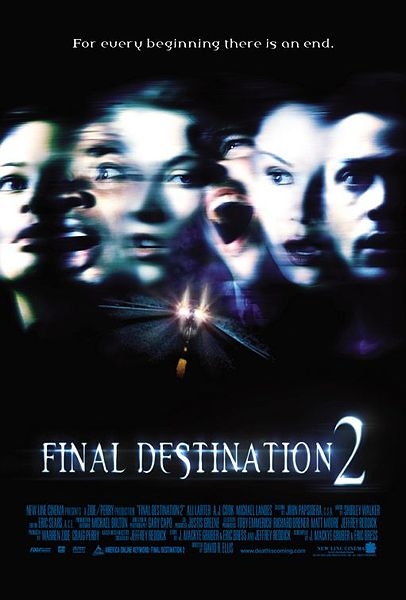
Final Destination 2 is a 2003 American supernatural horror-thriller film. Directed by David R. Ellis, it is the second installment in the series and takes place one year after the events of the first film. The screenplay was written by J. Mackye Gruber and Eric Bress. The film was distributed by New Line Cinema. The main cast includes A.J. Cook as Kimberly Corman, Ali Larter as Clear Rivers, Michael Landes as Thomas Burke, T.C. Carson as Eugene Dix, Jonathan Cherry as Rory Peters, Keegan Connor Tracy as Kat Jennings, Justina Machado as Isabella Hudson, and Tony Todd as William Bludworth. The film continues the narrative in which death is portrayed as a force that operates according to a specific sequence.
The film begins with university student Kimberly Corman having a premonition of a massive chain-reaction traffic accident on Route 23 while traveling with friends to Daytona Beach. As a result of this vision, Kimberly stops her car and prevents the vehicles behind her from entering the highway. This action saves several people, including police officer Thomas Burke, mother and son Nora and Tim Carpenter, businesswoman Kat Jennings, young man Rory Peters, pregnant woman Isabella Hudson, and teacher Eugene Dix. However, it soon becomes clear that these survivors are now being targeted by death in a predetermined order.
Kimberly seeks help from Clear Rivers, the sole survivor of the first film who is now residing in a psychiatric clinic. Clear explains that the original design of death has been disrupted and that the survivors are now facing efforts by death to reestablish its intended pattern. Throughout this process, the characters attempt to understand and outwit death’s sequence. Yet death targets them one by one through complex chains of cause and effect.
Final Destination 2 (2003) Trailer (BiCapsTrailer)
The film’s screenplay was written by J. Mackye Gruber and Eric Bress based on the original concept by Jeffrey Reddick, who created the series. David R. Ellis directed the film. Principal photography took place in the Canadian province of British Columbia, particularly in Vancouver. The film was released in the United States on January 31, 2003.
The film continues to explore themes of inevitability of death and the unchangeable nature of fate. Death is depicted not as a physical entity but as an abstract force that operates through intricate chains of cause and effect. The characters’ attempts to escape death typically lead to more complex and unavoidable outcomes. The film uses these themes as a narrative backdrop.
The film’s score was composed by Shirley Walker. The musical score was designed to intensify moments of tension and to convey the sense of death’s approaching presence. Visual effects and camera angles were combined with detailed choreography to create accidents based on chain reactions. This technical approach highlights the “domino effect” aesthetic, aligning with the film’s narrative structure.
The film was released in the United States on January 31, 2003. With a production budget of approximately $26 million, it earned approximately $90 million worldwide.
The film received mixed reviews from critics. On review aggregation platforms such as Rotten Tomatoes, it holds a critic score of approximately 48%. Audience ratings, however, were higher than this. The opening sequence featuring the chain-reaction traffic accident stands out as one of the most memorable scenes in the series.
Following the film’s success, three sequels were produced: Final Destination 3 (2006), The Final Destination (2009), and Final Destination 5 (2011). Each film features a different group of characters, but the central theme of death reclaiming its victims in a predetermined order remains constant. Each installment is structured around distinct death scenarios and initial disasters.
Final Destination 2 has been regarded as an example of a supernatural-subgenre within horror cinema. Unlike traditional slasher films, it generates tension without relying on a physical killer, earning it a unique position within the genre. In particular, the opening chain-reaction traffic accident scene has secured its place among the most unforgettable moments in film history.

No Discussion Added Yet
Start discussion for "Final Stop 2 (Film, 2003)" article
Plot
Production
Cast and Characters
Thematic Structure
Music and Technical Elements
Release and Box Office Performance
Criticism and Reception
Sequels and Series
Cultural Impact and Positioning