

This article was automatically translated from the original Turkish version.
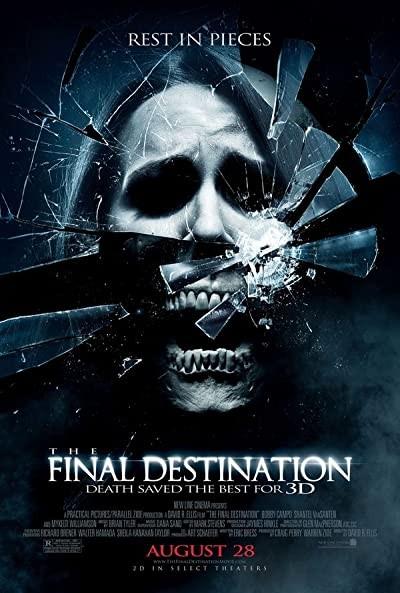
Final Destination 4, also known as The Final Destination, is a 2009 American supernatural horror-thriller film. The fourth installment in the series, it is the first Final Destination film shot using 3D technology. David R. Ellis directed the film, while Eric Bress wrote the screenplay. Craig Perry and Warren Zide produced it. The film was distributed by New Line Cinema, as were the previous entries in the series. The cast includes Bobby Campo as Nick O'Bannon, Shantel VanSanten as Lori Milligan, Nick Zano as Hunt Wynorski, Haley Webb as Janet Cunningham, and Mykelti Williamson as George Lanter. Although Tony Todd does not appear physically in this film, he provides the voice during the funeral scene.
The film centers on a group of young friends who survive a catastrophic accident at a race track. Nick O'Bannon experiences a premonition while sitting in the stands, foreseeing a massive disaster. He convinces several people to leave the area just before the accident occurs, thereby escaping death. Shortly afterward, it becomes clear that his premonition was accurate: the crash results in numerous fatalities. The survivors begin to die one by one in seemingly random accidents, following the series’ signature pattern. As Nick and his girlfriend Lori attempt to decipher the order of death and save their friends, they discover that death operates as a deliberate and inevitable force.
Final Destination 4 (2009) Trailer (BiCapsTrailer)
Final Destination 4 differs technically from its predecessors due to its use of 3D technology. Director David R. Ellis, drawing on his experience from the second film, aimed to create visually striking scenes for the fourth installment. Filming took place in New Orleans, Louisiana, and its surrounding areas. Special sets were constructed for the race track sequences, with CGI-enhanced effects and 3D filming techniques prioritized.
Tony Todd appears only through voiceover during the funeral scene and is not physically present in the film.
As in previous entries of the series, death is portrayed as an invisible force operating within a specific order. In this fourth film, most deaths are presented in more shocking and visually abrupt ways, designed to unsettle viewers through the impact of 3D technology. Key themes include inevitability, fate, the structure of death, premonition, and the anxiety of uncontrollable uncertainty. Compared to earlier films, this installment offers less character depth but stands out through its visual storytelling and fast-paced narrative.
The film’s score was composed by Brian Tyler, who also worked on previous entries. The music is used to heighten tension and create an atmosphere suggesting death’s approach. 3D cinematography is employed to deliver direct visual shocks during death scenes. CGI is heavily utilized to construct deaths based on chain reactions. These choices align the film more closely with an “entertainment-driven horror” approach than its predecessors.
The Final Destination was released in the United States on August 28, 2009, in both 3D and 2D formats. The film earned approximately $27 million during its opening weekend. Its worldwide box office gross reached about $186 million. The production budget was reported to be around $40 million.
The film received generally negative reviews from critics. It holds a low rating of 28% on Rotten Tomatoes. Criticisms primarily focused on weaknesses in the screenplay structure and lack of character depth. The production drew attention largely due to its use of 3D effects. Audiences, however, showed interest in the film because of the 3D experience and the imaginative variety of death scenes. While opinions among series fans varied, the film achieved commercial success.
The Final Destination is the fourth installment in the series and was initially marketed as the final film. However, a fifth film, Final Destination 5, was released in 2011. The fifth film tells a story set chronologically before the first film. In the 2020s, it was announced that a new film in the series, Final Destination: Bloodlines, was in development.
The Final Destination is regarded as one of the early examples of 3D technology being used in horror cinema. The film replaces the atmospheric tension of earlier entries with more intense visual elements and a faster pace. This narrative choice was viewed negatively by some critics. Nevertheless, the film continues the series’ core theme of the “invisible threat” and has garnered significant popularity among younger audiences.

No Discussion Added Yet
Start discussion for "Final Stop 4 (Film, 2009)" article
Plot
Production
Cast and Characters
Thematic Structure
Music and Technical Elements
Release and Box Office Performance
Critical Reception
Sequels and Series
Cultural Impact and Positioning