


This article was automatically translated from the original Turkish version.
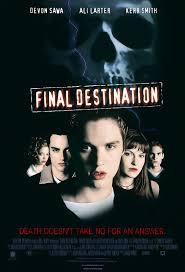
Final Stop (Film, 2000)
Original Name(s) | Final Destination | ||||||||
|---|---|---|---|---|---|---|---|---|---|
Director(s) | James Wong | ||||||||
Screenplay(s) | James Wong Jeffrey Reddick Glen Morgan | ||||||||
Producer(s) | Warren Zide, Craig Perry | ||||||||
Genre | Horror Supernatural Thriller | ||||||||
Distributor | New Line Cinema | ||||||||
Release Date(s) | 17 March 2000 (USA) | ||||||||
Duration | 98 minutes | ||||||||
Language(s) | English | ||||||||
Budget(s) | 23 million USD | ||||||||
Box Office Revenue | 112 million USD (Worldwide) | ||||||||
Lead Actors | Devon Sawa, Ali Larter, Kerr Smith, Tony Todd | ||||||||
IMDb Rating | 6.7 / 10 | ||||||||
Final Destination is a 2000 American horror-thriller film directed by James Wong, with a screenplay written by Wong, Glen Morgan, and Jeffrey Reddick. The producers are Craig Perry and Warren Zide, and the film was distributed by New Line Cinema.
The main cast includes Devon Sawa as Alex Browning, Ali Larter as Clear Rivers, Kerr Smith as Carter Horton, Seann William Scott as Billy Hitchcock, Chad Donella as Tod Waggner, and Tony Todd as William Bludworth. The film features a narrative in which death is portrayed as a force that operates according to a specific order.
The film begins with high school student Alex Browning experiencing a premonition of a disaster while boarding a plane with his classmates for a school trip to Paris. Alex foresees the plane exploding and, due to this vision, causes a panic that leads him and several others to leave the aircraft before takeoff. Shortly afterward, the plane indeed explodes in midair, confirming his vision.
As the survivors begin to die one by one in unexpected and extraordinary accidents, the idea emerges that death is targeting them in sequence to restore its disrupted order. The film explores their desperate attempts to escape death and death’s relentless efforts to reestablish its predetermined sequence.
Final Destination (2000) Trailer (Unseen Trailers)
The film originated from a screenplay draft developed by Jeffrey Reddick initially intended as an episode for a television series. This draft was later expanded by New Line Cinema into a feature-length film. Reddick’s concept transformed into an original horror narrative in which death is depicted as an invisible yet calculated force. Principal photography took place primarily in Vancouver, British Columbia, Canada, with additional scenes filmed in San Francisco and its surroundings. Filming was completed in early 2000.
Devon Sawa portrays Alex Browning, the protagonist who foresees the plane crash and inadvertently saves the lives of others. Ali Larter plays Clear Rivers, Kerr Smith portrays Carter Horton, and Seann William Scott plays Billy Hitchcock. Chad Donella portrays Tod Waggner, while Kristen Cloke plays teacher Valerie Lewton. Tony Todd appears as funeral director William Bludworth, the only character who provides the survivors with cryptic information about death and explains the events on a symbolic level.
In the film, death is not presented as a physical entity but as an abstract, deliberate, and inevitable order. It is represented not as an invisible being but as a force that operates through chains of cause and effect, manipulating events. The sequence of death follows the same order as the passengers’ boarding of the plane. When this order is disrupted, death strives to restore it. Although the film does not directly address concepts such as fate, coincidence, inevitability, and control, it uses these themes as background elements within its dramatic structure. This approach treats death not as a force that challenges individual agency but as a fixed and ongoing law.
The film’s score was composed by Shirley Walker. The music is designed to intensify moments of tension and to subtly signal the approach of death. Visual effects and camera angles are combined with meticulous choreography to create accidents based on chain reactions. This technical approach highlights the “domino effect” aesthetic, aligning with the film’s narrative structure.
The film was released in the United States on March 17, 2000. It earned approximately $10 million during its opening weekend. Over the course of its theatrical run, it achieved a worldwide gross of approximately $112.9 million. Given its production budget of $23 million, the film was considered a commercial success.
The film received mixed reviews from critics. While some praised the innovative portrayal of death as an invisible yet systematic force, others found this approach artificial or mechanical. On review aggregation platforms such as Rotten Tomatoes, the film received a critic score of around 40%. However, audience reception was significantly more favorable.
Following its commercial success, four sequels were produced: Final Destination 2 (2003), Final Destination 3 (2006), Final Destination 4 (2009), and Final Destination 5 (2011). Each film centers on a different group of characters, yet the core theme—that death follows a specific order and is inevitable—is maintained throughout the series. The films explore how characters attempt to escape death after an initial large-scale disaster, followed by a series of escalating events. Each installment is structured around original death scenarios and interconnected chains of cause and effect. In the 2020s, it was announced that a new entry in the franchise, titled Final Destination: Bloodlines, is in development, with the intention of expanding the series’ existing narrative universe.
Final Destination is regarded as an example of a subgenre within horror cinema that incorporates supernatural elements. It constructs tension without relying on a physical killer, distinguishing itself from the traditional slasher genre. Death is portrayed as an invisible force operating within a fixed order, an approach that influenced subsequent films with similar structures. The film gained attention for its depiction of death through sequential cause-and-effect relationships, contributing to the broader adoption of such narrative techniques in cinema. In this context, Final Destination is considered not only a commercial success but also a landmark in horror cinema for its innovative narrative structure.
"Final Destination (2000) - Box Office Mojo." Box Office Mojo. Accessed May 26, 2025. https://www.boxofficemojo.com/title/tt0195714/
"Final Destination." Rotten Tomatoes. Accessed May 26, 2025. https://www.rottentomatoes.com/m/final_destination
Unseen Trailers. "Final Destination (2000) ORIGINAL TRAILER [HD]." YouTube video, 2:13. December 17, 2022. Accessed May 26, 2025. https://www.youtube.com/watch?v=bIf5pgKcu9s

Final Stop (Film, 2000)
Original Name(s) | Final Destination | ||||||||
|---|---|---|---|---|---|---|---|---|---|
Director(s) | James Wong | ||||||||
Screenplay(s) | James Wong Jeffrey Reddick Glen Morgan | ||||||||
Producer(s) | Warren Zide, Craig Perry | ||||||||
Genre | Horror Supernatural Thriller | ||||||||
Distributor | New Line Cinema | ||||||||
Release Date(s) | 17 March 2000 (USA) | ||||||||
Duration | 98 minutes | ||||||||
Language(s) | English | ||||||||
Budget(s) | 23 million USD | ||||||||
Box Office Revenue | 112 million USD (Worldwide) | ||||||||
Lead Actors | Devon Sawa, Ali Larter, Kerr Smith, Tony Todd | ||||||||
IMDb Rating | 6.7 / 10 | ||||||||
No Discussion Added Yet
Start discussion for "Final Stop (Film, 2000)" article
Plot
Production
Cast and Characters
Thematic Structure
Music and Technical Elements
Release and Box Office Performance
Critical Reception
Sequels and Franchise
Cultural Impact and Positioning