


This article was automatically translated from the original Turkish version.
+1 More
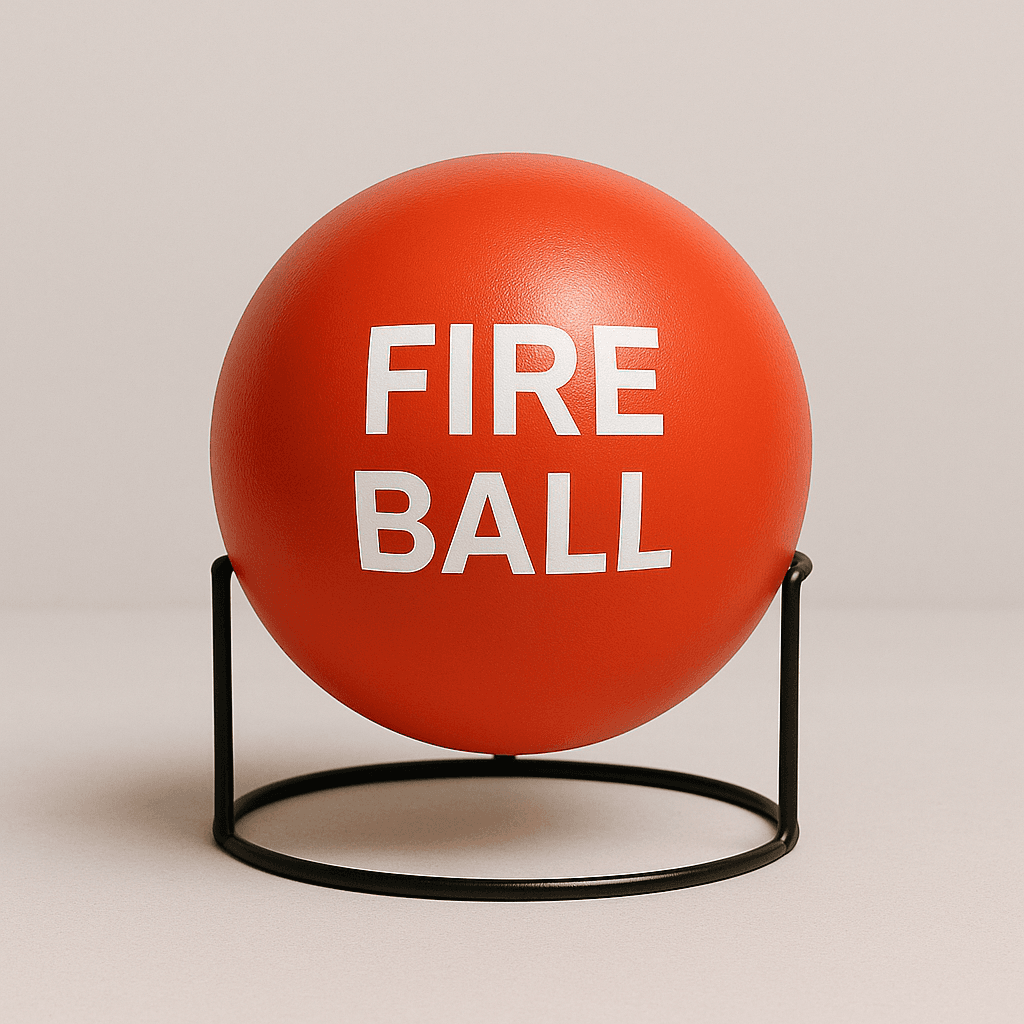
Fire Extinguishing Ball (Fire Ball)
Application Area(s) | Home Warehouse Hospital School Industrial facilities Electrical panels Vehicle Office | ||||||||
|---|---|---|---|---|---|---|---|---|---|
Shelf Life | Average of 5 years | ||||||||
Scope(s) | Approximately 3–5 m² | ||||||||
Content | Dry chemical powder (monoammonium phosphate) | ||||||||
Format | Spherical (ball-shaped) | ||||||||
Type(s) | Fire safety device | ||||||||
The fire extinguishing ball is a passive fire-fighting device that automatically ruptures upon being thrown onto flames or coming into direct contact with fire, releasing its contained fire-suppressing agent into the surrounding area. This product was developed to enable rapid and safe intervention in fires, with its earliest examples appearing in 19th-century Europe in the form of glass spheres.
Following the initial glass models of the 19th century, German engineer Malay Modak advanced fire suppression technology by filling Plexiglas balls with compressed carbon dioxide and nitrogen gas. Modern versions today typically contain powdered fire-suppressing agents and dispensing mechanisms powered by gunpowder. Some innovative developments have begun integrating modern systems such as unmanned aerial vehicles (drones) capable of carrying fire extinguishing balls.
Fire extinguishing balls stand out as a low-cost and user-friendly fire-fighting tool, particularly for individual spaces. However, they have limited effectiveness in large-scale fire scenarios such as widespread forest fires. Ongoing research continues to develop more advanced fire suppression systems and munitions to overcome these limitations.

Representative Image of a Fire Ball (Generated by Artificial Intelligence)
Modern fire extinguishing balls generally feature an outer shell made of PVC-coated expanded polystyrene foam. Inside, approximately one kilogram of monoammonium phosphate-based suppressant is contained, which is dispersed by a small amount of gunpowder within the ball. The total weight of the device typically does not exceed 1.5 kilograms. Upon contact with fire, the ball ruptures and releases the suppressant, thereby preventing the fire from spreading or extinguishing it entirely.
Fire extinguishing balls are most suitable for use against fires in their initial stages. They can be permanently mounted in individual spaces such as homes, offices, or vehicles, where they activate automatically upon exposure to flames. They can also be manually thrown into the fire zone. Thanks to this passive system, users are not required to approach the fire directly.
The use of fire extinguishing balls for aerial intervention has been considered, but technical limitations have restricted this application. For instance, the device must impact the ground to function properly, which reduces its effectiveness in obstructed environments such as wooded areas. Additionally, in forest fires, flames typically spread at the treetops, while these balls are designed to act primarily on ground-level fires, making them insufficient in such scenarios.

Fire Bombing UAV (
ElektrikPort. "Yangın Söndürmede Yeni Alternatif: Yangın Söndürme Topları." Accessed May 14, 2025. https://www.elektrikport.com/makale-detay/yangin-sondurmede-yeni-alternatif-yangin-sondurme-toplari/17116
Toptaş, Murat, and Yılmaz, Mehmet. “Yangın Söndürme İçin Alternatif Bir Tasarım: Akıllı Yangın Söndürme Bombası.” *Mühendis ve Makina* 62, no. 705 (2021): 806–829. https://dergipark.org.tr/tr/download/article-file/1727892

Fire Extinguishing Ball (Fire Ball)
Application Area(s) | Home Warehouse Hospital School Industrial facilities Electrical panels Vehicle Office | ||||||||
|---|---|---|---|---|---|---|---|---|---|
Shelf Life | Average of 5 years | ||||||||
Scope(s) | Approximately 3–5 m² | ||||||||
Content | Dry chemical powder (monoammonium phosphate) | ||||||||
Format | Spherical (ball-shaped) | ||||||||
Type(s) | Fire safety device | ||||||||
No Discussion Added Yet
Start discussion for "Fire Extinguishing Ball" article
Historical Development and Innovative Applications
Structure and Operating Principle of Modern Fire Extinguishing Balls
Aerial Intervention Applications and Design Challenges