


This article was automatically translated from the original Turkish version.
Primum non nocere! Secundum cavere! Tertium sanare!
First, do no harm! Then, protect! Then, heal!
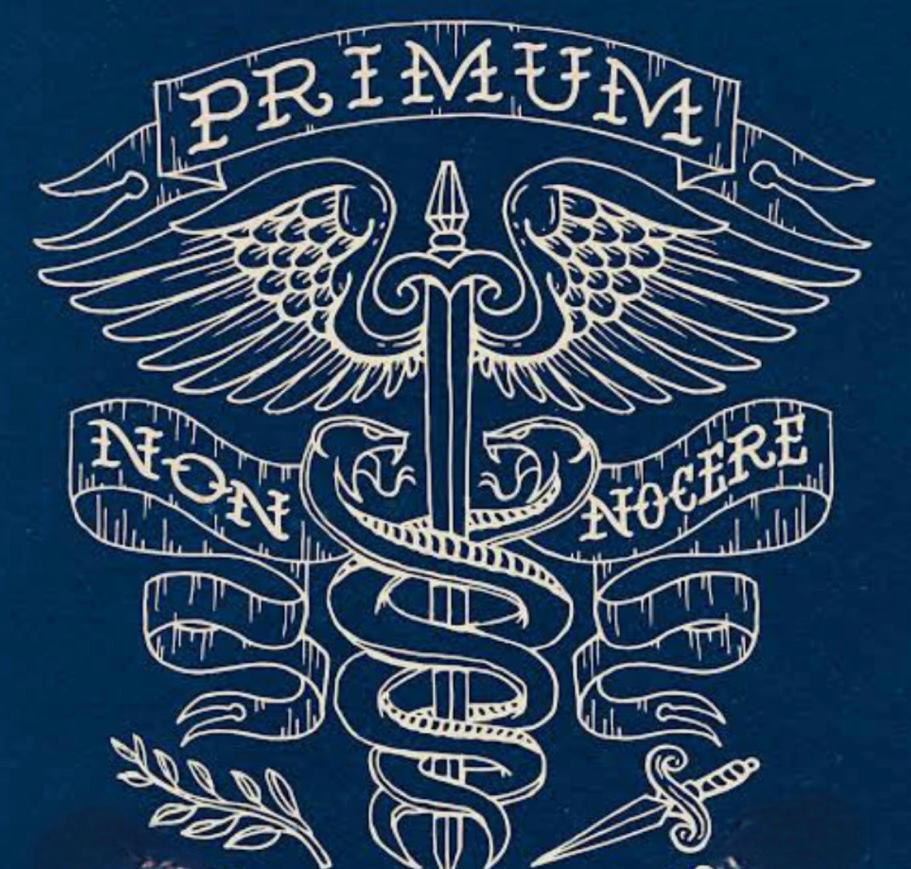
The phrase Primum Non Nocere inscribed above the caduceus, symbol of medicine (The New Yorker)
Primum non nocere is a Latin phrase meaning "First, do no harm!" It has also been recorded as primum nihil nocere. It has been translated into German as zuerst einmal nicht schaden, into French as D'abord, ne pas nuire, and into English as first, do not harm.
This brief but powerful expression, traditionally attributed to the ancient Greek physician Hippocrates, serves as an ethical guide for physicians and is regarded almost as a law. Primum non nocere is directly linked to the principle of non-maleficence, one of the four fundamental ethical principles in modern medicine.
As one of the foundational pillars of medical education, this phrase is taught to students in medical schools and often appears symbolically at graduation ceremonies. It reminds physicians to always consider the potential harm that any medical intervention may cause. This principle becomes especially prominent in situations where there is a clear risk of harm and the benefits are limited or uncertain, helping to guide ethical decision-making within the framework of medical ethics.
Although this phrase is one of the most fundamental and frequently cited in medical science and is commonly attributed to Hippocrates, its exact origin remains uncertain. Contrary to popular belief, it does not appear in the Hippocratic Oath. Although associated with Hippocrates, there is no definitive evidence that the phrase appears verbatim in any of his original texts. However, it is known that the phrase began to be used in Anglo-Saxon literature from the 19th century onward and has since been linked to texts mistakenly assumed to be part of the Corpus Hippocraticum.
JAMA, “Primum Non Nocere,” *Journal of the American Medical Association* 238, no. 7 (1977): 589–590, https://jamanetwork.com/journals/jama/article-abstract/354858.
What is the saying regarded as the first principle of medicine, and why is it so important?
