


This article was automatically translated from the original Turkish version.
Flameless Combustion in Gas Turbines
Type(s) | Thermal energy production method / Combustion technology | ||||||||
|---|---|---|---|---|---|---|---|---|---|
Basic Principle(s) | Flameless combustion with low oxygen concentration by mixing fuel and oxidizer above their autoignition temperature | ||||||||
Area(s) of Use | High-temperature processes Petrochemical plants Industrial furnaces Gas turbines | ||||||||
Advantage(s) | Longer equipment lifespan Reduced thermal stress Homogeneous temperature distribution Low NOₓ and CO emissions | ||||||||
Combustion Characteristics | Temperature gradients are low Reaction spreads throughout the volume No flame core forms | ||||||||
Technical Requirements | Good turbulence and mixing quality Low O₂ concentration (typically around 10%) High preheating (>600°C for methane) | ||||||||
Modeling | ANSYS Fluent) Analysis with CFD software (e.g. | ||||||||
In high-temperature systems, particularly gas turbines and industrial furnaces, improving energy efficiency and reducing emissions is of great importance importance. Conventional combustion methods can lead to both thermal stresses and high NOₓ emissions due to the formation of high-temperature pockets and flame kernels. At this point, flameless combustion emerges as an innovative approach that combines the advantages of high efficiency and low emissions.
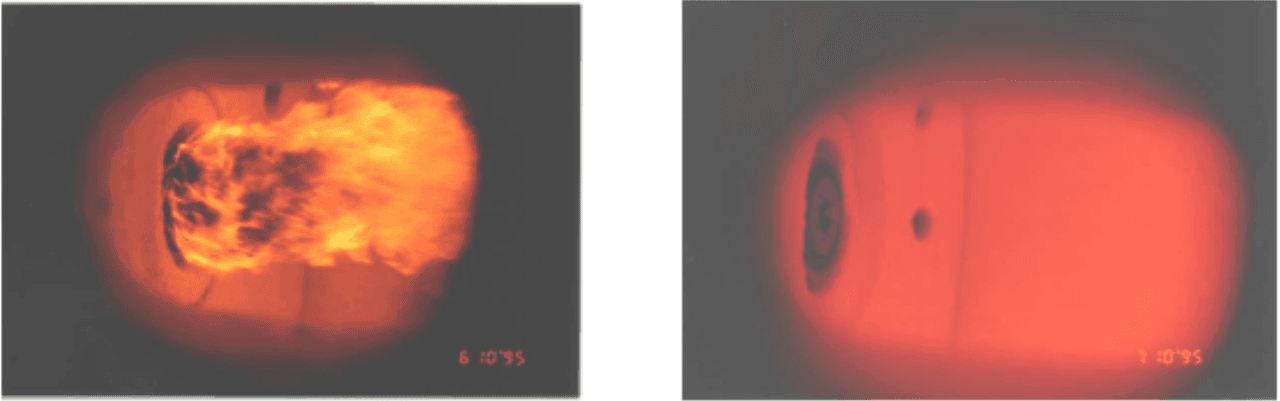
Flameless combustion is a combustion method in which fuel (methane) and oxidizer (air) are mixed at high temperature and low oxygen concentration, resulting in combustion without the formation of a distinct flame kernel. It is called “flameless” because the combustion reaction is distributed over a large volume rather than concentrated at a single point, eliminating the visible bright flame. This results in lower peak temperatures.
Conventional Combustion:
Flameless Combustion:

Flame and Flameless Combustion
As shown in the figure above, the left image displays a distinct flame kernel, while the right image shows no such visible kernel. Combustion occurs homogeneously throughout the chamber.
To achieve flameless combustion, the following steps are typically followed:
1. Preheating the fuel and air above the autoignition temperature.
2. Reducing the O₂ concentration in the air—for example, by diluting air with exhaust gases to lower the oxygen level.
3. Increasing the recirculation of hot combustion products within the combustion chamber.
4. Using burner and combustion chamber designs that enhance mixing and turbulence.
In a comparative study, two analyses were performed using the ANSYS Fluent software to simulate both flame and flameless combustion in a gas turbine combustor. To enable flameless combustion, the methane fuel and air were preheated above the autoignition temperature of approximately 600°C. Additionally, the oxygen concentration in the air was reduced from 23% to 10%.
Analysis results revealed that in conventional flame combustion, high-temperature peaks and a distinct flame front were observed. In flameless combustion, the temperature distribution was significantly more uniform, with markedly lower peak temperatures. The following images present the simulation results obtained using ANSYS Fluent.

Flame and flameless combustion analysis results
ANSYS, Inc. Ansys Fluent Workbench Tutorial Guide. Release 2024 R1, January 2024. Canonsburg, PA: ANSYS, Inc.
Enagi, Ibrahim I., K. A. Al-Attab, and Z. A. Zainal. “Combustion Chamber Design and Performance for Micro Gas Turbine Application.” *Fuel Processing Technology* 166 (2017): 258–268. https://doi.org/10.1016/j.fuproc.2017.05.025.
International Flame Research Foundation. “What Is Flameless Combustion?” Accessed March 28, 2025. https://ifrf.net/research/handbook/what-is-flameless-combustion/.

Flameless Combustion in Gas Turbines
Type(s) | Thermal energy production method / Combustion technology | ||||||||
|---|---|---|---|---|---|---|---|---|---|
Basic Principle(s) | Flameless combustion with low oxygen concentration by mixing fuel and oxidizer above their autoignition temperature | ||||||||
Area(s) of Use | High-temperature processes Petrochemical plants Industrial furnaces Gas turbines | ||||||||
Advantage(s) | Longer equipment lifespan Reduced thermal stress Homogeneous temperature distribution Low NOₓ and CO emissions | ||||||||
Combustion Characteristics | Temperature gradients are low Reaction spreads throughout the volume No flame core forms | ||||||||
Technical Requirements | Good turbulence and mixing quality Low O₂ concentration (typically around 10%) High preheating (>600°C for methane) | ||||||||
Modeling | ANSYS Fluent) Analysis with CFD software (e.g. | ||||||||
No Discussion Added Yet
Start discussion for "Flameless Combustion in Gas Turbines" article
Flameless Combustion
Comparison with Conventional (Flame) Combustion
Process of Achieving Flameless Combustion
Example Analysis and Results