


This article was automatically translated from the original Turkish version.
+1 More

Modern instruction are newly designated teaching methods that are primarily activity-based and aim to actively involve the student’s mind in the learning process through complete. In modern teaching, the student is the primary focus in instruction and planning. Individual differences among students are taken into account. Numerous factors influence the Information acquisition process, including (society, family, emotions, past, prior assumptions, ability, skills, intelligence, social environment...). The combinations formed by these factors lead to variations in learning pathways and adaptation to knowledge, resulting in each individual exhibiting a subjective learning style. These individual differences have driven research into learning styles.
According to the Turkish Language Association (Türk Dil Kurumu), style is the unique manner in which a person expresses themselves in thought, feeling, and understanding. Learning style can be defined as the individual’s distinctive way of comprehending and internalizing acquired knowledge. Learning styles are personal; that is, they are a form of individual difference. Learning style models, on the other hand, aim to establish a general framework for understanding learning styles. Many learning style models exist. The fourteen most well-known learning style models are presented in Figure 1. Among these, the Fleming & Mill learning style model is described in this text.
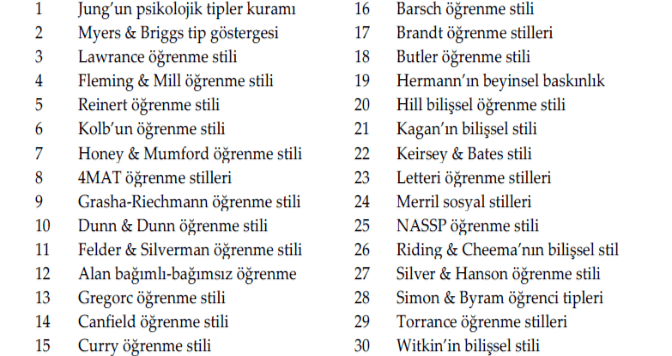
Source: Learning Style Models: A Comprehensive Review in the Context of Theoretical Foundations – Etem Yeşilyurt
Developed by Neil Fleming in 1987, it is also known as the VARK or VAK model. The acronym VARK or VAK stands for the following in English:
(Note: Some sources do not treat read-write as a separate learning style.)
General characteristics are as follows:
This style involves the use of visible and observable elements. Learners with this style acquire information best when it is presented visually or in written form. In a classroom setting, they learn effectively from instructors who use visual aids such as chalkboards, presentation tools, and diagrams related to the topic. Textbooks and notes are essential for their learning. These learners prefer to study alone in quiet environments. They use visualization (mental imagery) to recall learned information. Some personality traits of visual learners include:
Learners with this style understand information through self-talk and listening. They learn best when information is presented verbally. In class, they achieve effective learning by listening to lectures, participating in active group discussions, and, if available, reviewing audio recordings. They reinforce their learning by repeating information aloud. Some personality traits of auditory learners include:
According to the Turkish Language Association (Türk Dil Kurumu), kinesthetic refers to the predominant use of the sense of touch in meaning-making or comprehension. Kinesthetic learning involves physical experiences such as touching, feeling, active participation, and hands-on application. Learners with this style learn best through physical activities and direct experiences. In the classroom, they acquire knowledge by using materials and experimenting through trial and error. Effective learning requires classroom activities in which the student actively participates and experiences. Some personality traits of kinesthetic learners include:

Source: Adapted and tabulated from http://vark-learn.com/home-turkish.
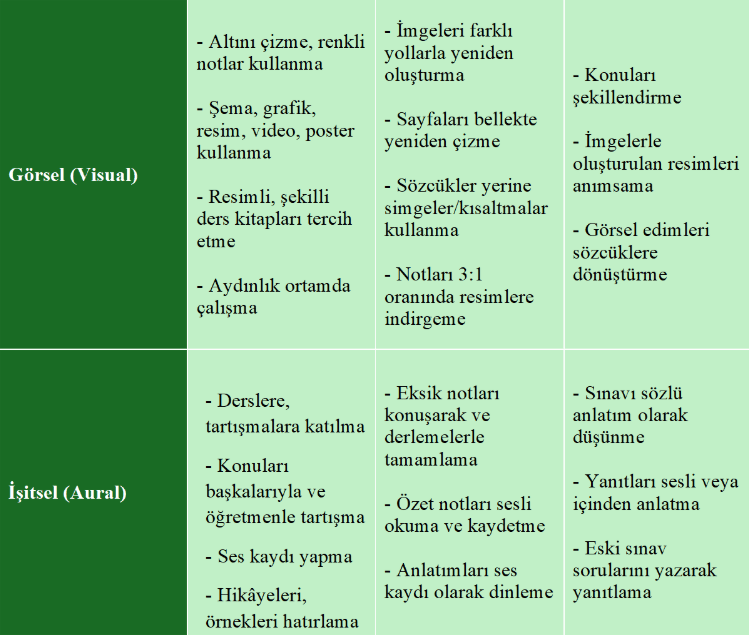
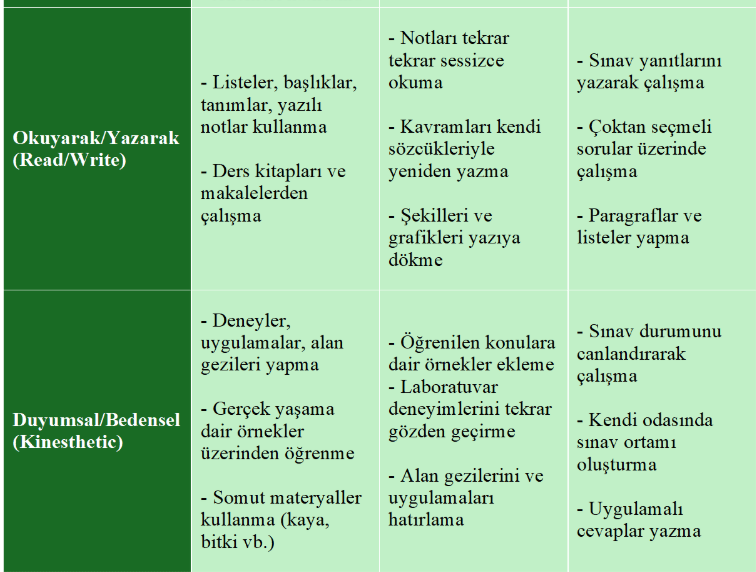
If your learning preferences are multimodal, you are in the majority (50–70%). This means you can effectively combine two (V-A, R-K), three (V-A-R, A-R-K), or all four (V-A-R-K) learning styles.
Thanks to their flexibility, multimodal learners can easily adapt to different environments, but they may need to combine multiple strategies to achieve effective learning.

No Discussion Added Yet
Start discussion for "Fleming and Mill Learning Style Model (VARK)" article
Fleming & Mill Learning Style Model (VARK)
Visual Learning Style
Auditory Learning Style
Kinesthetic Learning Style
MULTIMODAL LEARNING STRATEGIES