


This article was automatically translated from the original Turkish version.
Floating solar power plants are electricity generation systems in which photovoltaic panels are mounted on floating support structures on water surfaces. This approach reduces the land requirement of terrestrial solar plants while converting water surfaces such as reservoirs, dams, irrigation ponds, canals, floodplain lakes, and certain marine areas into energy production infrastructure. The technology is regarded as a viable option for enhancing the spatial deployment of solar energy, particularly in regions with high land pressure.
The first applications emerged in the late 2000s and have since experienced rapid growth in both installed capacity and design diversity. By the end of 2023, global installed capacity had reached several gigawatts, with deployments concentrated largely in protected inland waters and Asia dominating as the leading region. 【1】
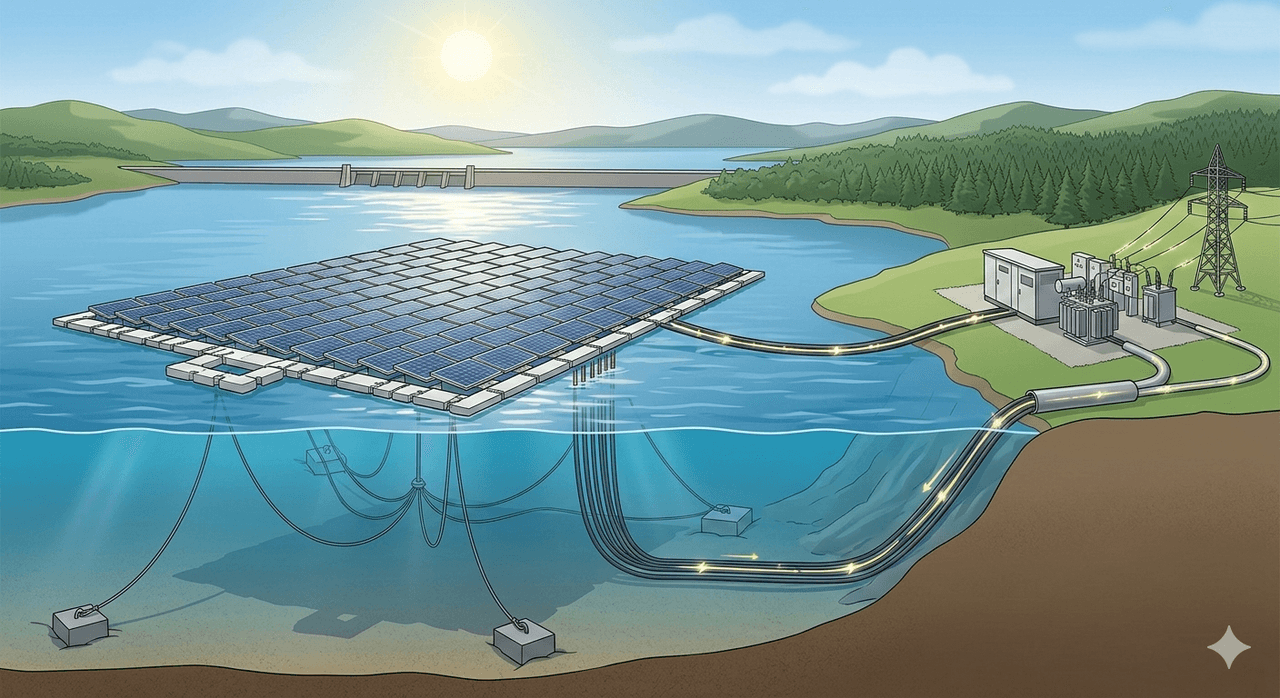
Floating Solar Power Plants (Generated by Artificial Intelligence)
The evolution of these plants can be understood as a response to two key pressures in the solar energy sector. The first is the increasing difficulty of finding suitable land for large-scale terrestrial solar plants. The second is the limitations of photovoltaic modules in terms of temperature, soiling, and surface use efficiency. Floating systems alleviate land-use conflicts by utilizing the spatial potential of water surfaces while altering module operating conditions through the microclimate created by the water body.
Early applications were primarily implemented in calm water bodies such as lakes and reservoirs. Subsequently, significant research efforts have focused on near-coastal and open-sea solutions exposed to higher wave and wind loads. This expansion demonstrates that the technology has evolved into a multidisciplinary engineering field integrating hydrodynamics, materials science, environmental monitoring, and maintenance logistics—not merely as an energy generation device.【2】
A floating solar plant is not merely an array of panels. Its core consists of a floating platform or pontoon structure that supports the modules, cables, connection equipment, and in some designs, electrical components such as inverters. Mooring and anchoring systems maintain the platform’s position, enabling the array to operate without drifting or rotating under the influence of wind, currents, water level fluctuations, and wave action. Electricity is generated as direct current in the modules and then converted to alternating current via inverters before being transmitted to the onshore grid through a transformer.
Numerous studies indicate that floating structures are predominantly manufactured from lightweight, corrosion-resistant, and relatively UV-resistant materials such as high-density polyethylene. However, some systems employ hybrid solutions using metal or fiber-reinforced plastic carriers. In near-coastal and marine applications, protection against lightning, cable insulation, connector security, and marine-grade connection details become more critical.【3】
Floating systems are not uniform. The literature distinguishes three main categories: pure floating designs where modules sit directly on pontoon-like floats; hybrid platforms supported by metal or fiber-reinforced carriers; and thin-film or membrane-based surface solutions. This distinction is not merely visual or structural. Each design produces a distinct performance regime in terms of heat transfer, wind cooling, wave response, maintenance access, and mechanical fatigue behavior. Applications in inland waters, operating under calmer hydrodynamic conditions, currently constitute the most commercially prevalent class.
Near-coastal and open-sea solutions, however, remain in a more experimental and selective development phase due to harsher environmental loads. Consequently, technological maturity varies significantly depending on the application environment. Commercialization and standardization are more advanced in protected reservoirs or lakes, whereas in marine areas with higher wave heights, wind loads, and salinity, design validation, prototyping, and long-term field trials are more decisive.
The most frequently cited technical advantage of floating solar plants is their impact on module temperature. Photovoltaic modules experience reduced electrical efficiency as they heat up. Installation near water surfaces can alter air movement and heat exchange around the modules, potentially achieving lower operating temperatures under certain conditions. However, research shows this benefit does not occur automatically across all systems. Cooling gains depend on platform geometry, module positioning relative to the water, degree of rear-side ventilation, wind direction, relative humidity, water temperature, and local climate. In other words, simply being “on water” does not guarantee higher efficiency.
Nevertheless, numerous field and meta-studies demonstrate that well-designed floating systems can achieve higher energy production than their terrestrial counterparts, largely due to more favorable thermal conditions. In particular, some membrane-based solutions with stronger thermal contact with water exhibit fundamentally altered heat dissipation mechanisms, rendering conventional terrestrial temperature models inadequate. Therefore, energy yield calculations must incorporate parameters specific to floating systems rather than directly applying standard terrestrial software.
The growing importance of this technology is driven not only by production efficiency but also by system-level benefits. Floating installations reduce pressure for additional land allocation for solar power. This is especially significant in countries where competition for land use is high between agriculture, settlements, transportation infrastructure, and natural areas. Additionally, the panel cover can reduce evaporation from the water surface, a feature of particular relevance for reservoirs used for irrigation, drinking water, or hydropower.
The literature emphasizes that floating photovoltaics integrated with hydropower reservoirs can share transmission infrastructure, complement generation profiles, and be designed as hybrid energy systems when considered alongside reservoir management. Thus, floating solar plants are increasingly viewed not merely as independent generation facilities but as components of integrated water-energy infrastructure systems.【4】
The environmental dimension of floating solar power plants is one of the most contested and least standardized areas of the technology. The shading created by the floating structure reduces light transmission, potentially affecting water temperature, algal growth, dissolved oxygen, thermal stratification, mixing regimes, and aquatic life. Some studies report that the cover can reduce evaporation and suppress excessive algal blooms, yielding positive outcomes for water quality in certain cases. However, the impacts vary significantly depending on the water body’s depth, volume, trophic structure, local climate, coverage ratio, and design configuration.
Therefore, generalizations about environmental outcomes are difficult. A measurement and modeling study in a German lake showed that the panel cover significantly reduced solar radiation reaching the water surface and near-surface wind, influencing summer stratification. This finding reveals that the environmental effects of floating systems extend beyond shading to include alterations in lake-atmosphere interactions. The current body of research indicates a sensitive field requiring balanced assessment of benefits and risks.【5】
Reliability in floating solar plants involves a more complex framework than in terrestrial systems. The primary reason is that conventional photovoltaic components operate in a more humid, dynamic, and sometimes corrosive environment. Junction boxes, cables, connectors, floating body components, mechanical fasteners, and anchoring parts are subjected to additional stresses due to proximity to or direct contact with water. Literature reports field examples of mechanical abrasion damage, torsion at connection points, wave-induced loads, biological fouling, corrosion, edge sealing failure, and junction box issues.
In particular, the combined effects of moisture, salinity, continuous motion, and UV exposure reveal that traditional terrestrial durability assumptions are insufficient. However, long-term field data remain limited. Consequently, many reviews emphasize that reliability assessment remains an emerging field, requiring clearer correlation between accelerated aging tests and real-world stress profiles. While existing studies on performance degradation rates suggest some floating systems may exhibit similar long-term decline to rooftop or terrestrial systems, it is still too early to draw definitive conclusions about emerging failure modes.【6】
Operation and maintenance of floating solar plants require a broader framework than routine practices for terrestrial plants. In addition to monitoring electrical performance, the integrity of the platform, floats, mooring and anchoring lines, cable routing, insulation condition, corrosion, biological fouling, and water quality indicators must also be included in monitoring. Consequently, meteorological sensors are complemented by measurements of water temperature, current, wave height, relative humidity, and in some applications, water quality parameters. Due to accessibility challenges, the use of unmanned aerial vehicles, remote sensing, and水上及水下机器人平台正变得越来越重要。
Key maintenance priorities include regular inspection of mooring and anchoring systems, verification of float watertightness and structural integrity, visual and thermal inspection of module arrays, mitigation of hot-spot risks from bird droppings and organic contamination, prevention of unwanted water contact with cables and connectors, and verification of lightning protection and grounding continuity. This landscape demonstrates that maintenance of floating systems involves not merely more tasks but also requires specialized personnel and more advanced monitoring infrastructure.【7】
As the technology advances, attention has shifted from inland waters to near-coastal and open-sea solutions. The primary driver is the vast spatial potential of oceans and their capacity to further reduce terrestrial land pressure. However, the marine environment also introduces greater wave loads, high winds, saline atmosphere, biological fouling, and complex mooring challenges. Consequently, marine floating photovoltaics demand more stringent engineering requirements than inland applications.
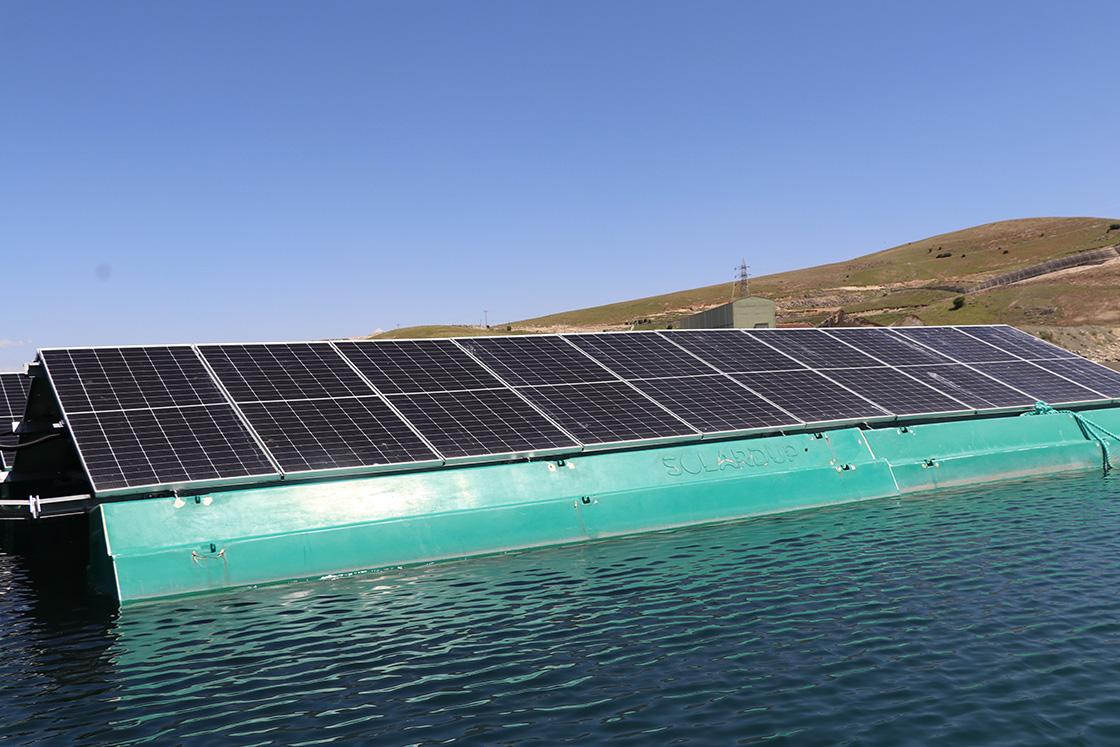
Keban Dam Lake Floating Solar Power Plant (Anadolu Ajansı)
In recent years, various prototypes and pilot projects have been tested under different wave and wind conditions, with developments in rigid platforms, flexible membranes, and modular island-like designs. Nevertheless, significant uncertainties remain regarding scalable economic models, long-term durability, standardization, and energy yield validation for marine solutions. This indicates that offshore floating solar power plants are technically feasible but remain an immature field.【8】
Floating solar power plants represent more than just an extension of photovoltaic technology onto water surfaces; they constitute an integrated infrastructure category that unites energy production, water management, environmental monitoring, and structural engineering. The core appeal of the technology lies in its ability to alleviate land pressure, enhance generation through lower module temperatures under certain conditions, and offer additional benefits such as reduced evaporation and infrastructure integration on water surfaces. However, significant knowledge gaps persist in environmental impacts, reliability, standardization, modeling accuracy, and maintenance costs.
Therefore, floating solar plants can be defined as an energy technology that has rapidly expanded but has not yet matured across all dimensions. The consensus in current literature is that the future of this technology will be shaped not merely by increased deployment but by improved environmental assessments, more detailed field data, robust design standards, and more systematic maintenance approaches.【9】
Anadolu Ajansı. “Türkiye’nin İlk Yüzer Güneş Enerjisi Santrali Elektrik Üretimine Haziranda Başlıyor.” Accessed March 10, 2026. https://www.aa.com.tr/tr/ekonomi/turkiyenin-ilk-yuzer-gunes-enerjisi-santrali-elektrik-uretimine-haziranda-basliyor/3232756
Bossi, Silvia, Luciano Blasi, Giacomo Cupertino, Ramiro dell’Erba, Angelo Cipollini, Saverio De Vito, Marco Santoro, Girolamo Di Francia, and Giuseppe Marco Tina. “Floating Photovoltaic Plant Monitoring: A Review of Requirements and Feasible Technologies.” *Sustainability* 16, no. 19 (2024): 8367. Accessed March 10, 2026. https://doi.org/10.3390/su16198367
Bugeja, Ryan, Luciano Mule’ Stagno, Cyprien Godin, Wenping Luo, and Xiantao Zhang. “Advancements and Challenges in Floating Photovoltaic Installations Focusing on Technologies, Opportunities, and Future Directions.” *Energies* 18, no. 22 (2025): 5908. Accessed March 10, 2026. https://doi.org/10.3390/en18225908
Essak, Laura, and Aritra Ghosh. “Floating Photovoltaics: A Review.” *Clean Technologies* 4, no. 3 (2022): 752–769. Accessed March 10, 2026. https://doi.org/10.3390/cleantechnol4030046
Ilgen, K., D. Schindler, S. Wieland, and others. “The Impact of Floating Photovoltaic Power Plants on Lake Water Temperature and Stratification.” *Scientific Reports* 13 (2023): 7932. Accessed March 10, 2026. https://doi.org/10.1038/s41598-023-34751-2
International Energy Agency Photovoltaic Power Systems Programme (IEA-PVPS). *Floating Photovoltaic Power Plants: A Review of Energy Yield, Reliability, and Maintenance.* Report IEA-PVPS T13-31:2025. 2025. Accessed March 10, 2026. https://iea-pvps.org/wp-content/uploads/2025/04/IEA-PVPS-T13-31-2025-REPORT-Floating-PV-Plants.pdf
Lawale, Oreoluwa, Simon P. Philbin, and Sahand Hosouli. “Modelling, Simulation and Performance Analysis of Floating Photovoltaic Systems—A Systematic Review and Meta-Analysis.” *Energies* 18, no. 19 (2025): 5273. Accessed March 10, 2026. https://doi.org/10.3390/en18195273
Leal, A. B., H. N. de Souza Filho, L. Gabriel Zanon, T. F. A. C. Sigahi, I. Simon Rampasso, and R. Anholon. “Selection of Photovoltaic Panels for Floating Systems: An Analysis Based on Entropy, CRITIC and TOPSIS.” *International Journal of Sustainable Engineering* 17, no. 1 (2024): 1173–1185. Accessed March 10, 2026. https://doi.org/10.1080/19397038.2024.2438671
Liu, Gang, Jiamin Guo, Huanghua Peng, Huan Ping, and Qiang Ma. “Review of Recent Offshore Floating Photovoltaic Systems.” *Journal of Marine Science and Engineering* 12, no. 11 (2024): 1942. Accessed March 10, 2026. https://doi.org/10.3390/jmse12111942
Ramanan, C. J., King Hann Lim, Jundika Candra Kurnia, Sukanta Roy, Bhaskor Jyoti Bora, and Bhaskar Jyoti Medhi. “Towards Sustainable Power Generation: Recent Advancements in Floating Photovoltaic Technologies.” *Renewable and Sustainable Energy Reviews* 194 (2024): 114322. Accessed March 10, 2026. https://doi.org/10.1016/j.rser.2024.114322
Rebelo, Ricardo, Luís Fialho, and Maria Helena Novais. “Floating Photovoltaic Systems: Photovoltaic Cable Submersion and Impacts Analysis.” arXiv (2021). Accessed March 10, 2026. https://arxiv.org/abs/2103.16246
Vasuki, Sathya Shanka, Jack Levell, Rudi Santbergen, and Olindo Isabella. “A Technical Review on the Energy Yield Estimation of Offshore Floating Photovoltaic Systems.” *Renewable and Sustainable Energy Reviews* 216 (2025): 115596. Accessed March 10, 2026. https://doi.org/10.1016/j.rser.2025.115596
Wei, Yujia, Danial Khojasteh, Christian Windt, and Luofeng Huang. “An Interdisciplinary Literature Review of Floating Solar Power Plants.” *Renewable and Sustainable Energy Reviews* 209 (2025): 115094. Accessed March 10, 2026. https://doi.org/10.1016/j.rser.2024.115094
[1]
International Energy Agency Photovoltaic Power Systems Programme (IEA-PVPS). Floating Photovoltaic Power Plants: A Review of Energy Yield, Reliability, and Maintenance. Report IEA-PVPS T13-31:2025. 2025. 12. Access date 10 March 2026. https://iea-pvps.org/wp-content/uploads/2025/04/IEA-PVPS-T13-31-2025-REPORT-Floating-PV-Plants.pdf
[2]
Bossi, Silvia, Luciano Blasi, Giacomo Cupertino, Ramiro dell’Erba, Angelo Cipollini, Saverio De Vito, Marco Santoro, Girolamo Di Francia ve Giuseppe Marco Tina. “Floating Photovoltaic Plant Monitoring: A Review of Requirements and Feasible Technologies.” Sustainability 16, no. 19 (2024): 8367. Access date 10 March 2026. https://doi.org/10.3390/su16198367
[3]
International Energy Agency Photovoltaic Power Systems Programme (IEA-PVPS). Floating Photovoltaic Power Plants: A Review of Energy Yield, Reliability, and Maintenance. Report IEA-PVPS T13-31:2025. 2025. 16-35. Access date 10 March 2026. https://iea-pvps.org/wp-content/uploads/2025/04/IEA-PVPS-T13-31-2025-REPORT-Floating-PV-Plants.pdf
[4]
Essak, Laura ve Aritra Ghosh. “Floating Photovoltaics: A Review.” Clean Technologies 4, no. 3 (2022): 752–769. Access date 10 March 2026. https://doi.org/10.3390/cleantechnol4030046
[5]
Ilgen, K., D. Schindler, S. Wieland ve diğerleri. “The Impact of Floating Photovoltaic Power Plants on Lake Water Temperature and Stratification.” Scientific Reports 13 (2023): 7932. Access date 10 March 2026. https://doi.org/10.1038/s41598-023-34751-2
[6]
International Energy Agency Photovoltaic Power Systems Programme (IEA-PVPS). Floating Photovoltaic Power Plants: A Review of Energy Yield, Reliability, and Maintenance. Report IEA-PVPS T13-31:2025. 2025. 37-49. Access date 10 March 2026. https://iea-pvps.org/wp-content/uploads/2025/04/IEA-PVPS-T13-31-2025-REPORT-Floating-PV-Plants.pdf
[7]
International Energy Agency Photovoltaic Power Systems Programme (IEA-PVPS). Floating Photovoltaic Power Plants: A Review of Energy Yield, Reliability, and Maintenance. Report IEA-PVPS T13-31:2025. 2025. 49-58. Access date 10 March 2026. https://iea-pvps.org/wp-content/uploads/2025/04/IEA-PVPS-T13-31-2025-REPORT-Floating-PV-Plants.pdf
[8]
Liu, Gang, Jiamin Guo, Huanghua Peng, Huan Ping ve Qiang Ma. “Review of Recent Offshore Floating Photovoltaic Systems.” Journal of Marine Science and Engineering 12, no. 11 (2024): 1942. Access date 10 March 2026. https://doi.org/10.3390/jmse12111942
[9]
International Energy Agency Photovoltaic Power Systems Programme (IEA-PVPS). Floating Photovoltaic Power Plants: A Review of Energy Yield, Reliability, and Maintenance. Report IEA-PVPS T13-31:2025. 2025. 60-61. Access date 10 March 2026. https://iea-pvps.org/wp-content/uploads/2025/04/IEA-PVPS-T13-31-2025-REPORT-Floating-PV-Plants.pdf

No Discussion Added Yet
Start discussion for "Floating Solar Power Plants" article
Core Concepts and Development Trajectory
System Structure and Key Components
Design Types and Application Environments
Energy Yield and Thermal Behavior
Land, Water, and Integration Advantages
Environmental Impacts and Ecosystem Dimensions
Reliability, Wear Mechanisms, and Failure Risks
Monitoring, Operation, and Maintenance Requirements
Expansion to Marine Environments and New Engineering Challenges