


This article was automatically translated from the original Turkish version.
Foam fire extinguishers are portable fire-fighting devices that operate by pressurizing and spraying a mixture of water and foam concentrate, and are particularly effective against Class A and B fires. They suppress fires through both cooling and smothering mechanisms. These systems prevent oxygen contact and inhibit evaporation by forming a film over liquid surfaces.
The history of foam fire suppression systems dates back to the early 20th century. The first chemical foam-based suppression system was developed in 1902 by Russian scientist Aleksandr Loran, marking a significant advancement in combating fuel fires. During the mid-20th century, as fire risks increased in industrial facilities and oil refineries, foam suppression systems became widely adopted.
In Türkiye, foam fire extinguishers became mandatory in both public and private sectors starting in the 2000s, as required by the “Regulation on Protection of Buildings from Fire” and related fire department directives. Today, foam systems are used both as manual portable units and as fixed installation systems.
Foam fire suppression systems have long been integrated into fire safety practices within industrial facilities and hazardous material storage areas. In Türkiye, the use of these systems in buildings and installations has been systematically regulated by the “Regulation on Protection of Buildings from Fire.” First published in 2002, this regulation has been updated over time to include detailed provisions on the use of foam systems. Specific conditions requiring foam-based systems in facilities have been defined, along with requirements for periodic testing, refilling standards, and installation criteria.
Foam extinguishers are effective against the following fire types:
Their use is not recommended for electrical fires, as the conductivity of foam may pose a risk in such situations.
Foam fire extinguishers suppress fires by covering the flame with their foam chemical agent, thereby cutting off oxygen contact and providing a cooling effect. This dual mechanism halts fire spread and rapidly extinguishes existing flames. Because foam has the ability to spread across liquid surfaces, it is particularly preferred for fires involving flammable liquids.
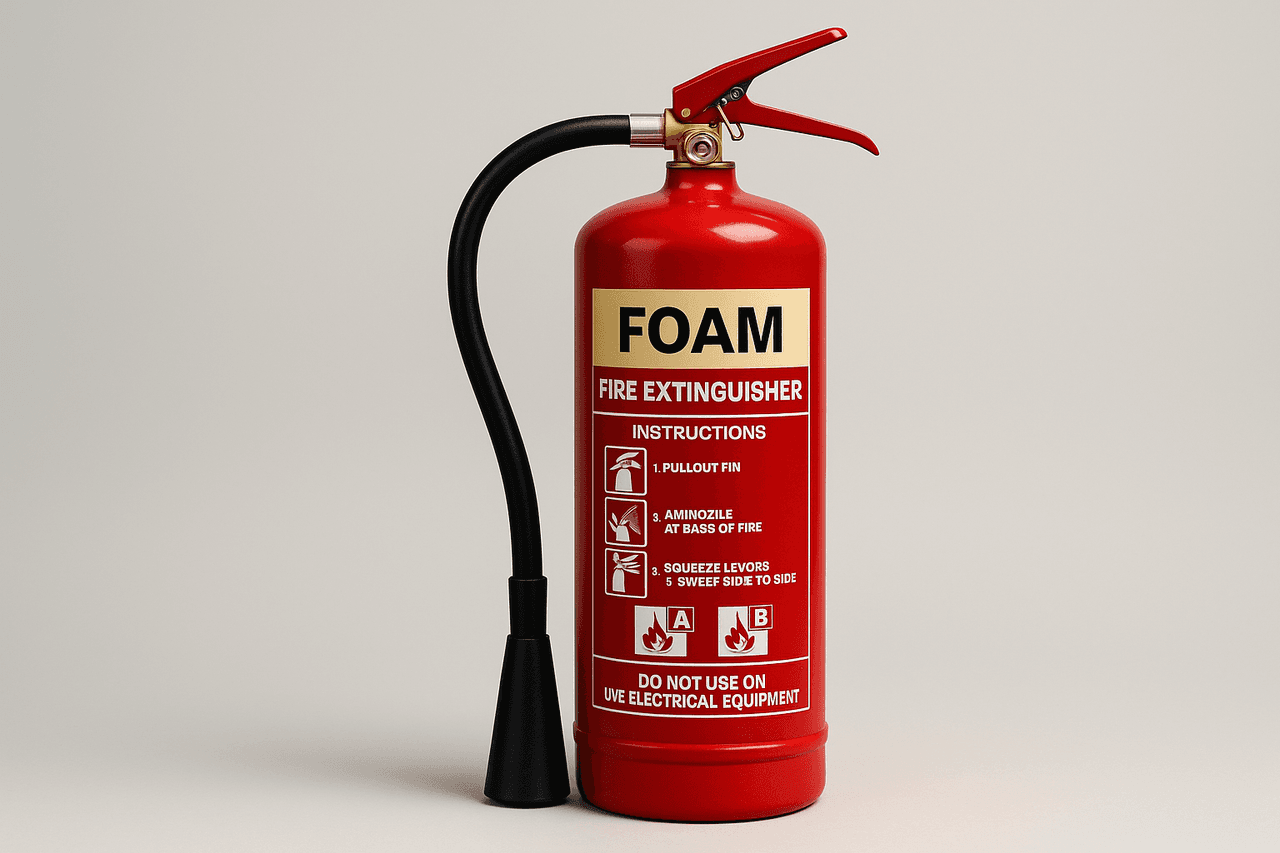
Foam Fire Extinguisher (Generated by Artificial Intelligence)
Foam extinguishers typically consist of two main components: a water-foam mixture and a propellant gas (usually nitrogen or CO₂). After activation, the mixture is directed through a specialized nozzle to transform into foam and target the fire. Common portable models range from 6 to 9 liters in capacity, while larger industrial systems are also available.
Foam fire extinguishers must be inspected at least once annually. Additionally, the foam concentrate must be tested at regular intervals, and chemical mixtures past their shelf life must be replaced. Regulations require that the last refill date, inspection date, and technical label information be clearly displayed on the extinguisher.
TMMOB reports emphasize that foam fire extinguishers should be positioned near liquid chemical storage areas in apartment buildings, office complexes, industrial sites, and shopping malls. Their placement is regulated based on criteria such as user accessibility and visibility. Common application areas include fuel stations, automotive service centers and garages, chemical industry facilities, food production zones, storage areas, and office environments.
Foam fire extinguishers are systems preferred in areas with high exposure to flammable liquids due to their high effectiveness against Class A and B fires. In Türkiye, their use is comprehensively regulated by both legislation and technical guidelines. When properly operated by trained personnel, they serve as an effective fire-fighting tool.
Erzurum İtfaiyesi Department. "Yangın Söndürme Tüpleri." Erzurum Büyükşehir Belediyesi İtfaiye Daire Başkanlığı. Accessed May 30, 2025. https://itfaiye.erzurum.bel.tr/tedbir/5/yangin-sondurme-tupleri.html
Kırtaş, Hacı Ahmet, and Hüseyin Altundağ. “Taşınabilir Yangın Söndürme Cihazlarının Üretimi Dolumu ve Bakımı.” *Uluslararası Yakıtlar Yanma ve Yangın Dergisi* 11, no. 1 (December 2023): 91–103. https://doi.org/10.52702/fce.1402423.
Ministry of Environment, Urbanization and Climate Change. *Guide to the Regulation on Protection of Buildings from Fire*. Ministry of Environment, Urbanization and Climate Change. Accessed May 30, 2025. https://webdosya.csb.gov.tr/db/meslekihizmetler/haberler/r2-b-nalarin-yangin-korunmasi-hakkinda-yonetmel-k-kilavuzu-etk-les-ml--20241221082232.pdf
Ministry of Health of the Republic of Turkey, General Directorate of Health for Borders and Coasts. *Fire Prevention and Suppression Directive*. Ministry of Health of the Republic of Turkey. Accessed May 30, 2025. https://www.hssgm.gov.tr/content/documents/yonergeler_genelgeler/Yang%C4%B1n%20%C3%96nleme%20ve%20S%C3%B6nd%C3%BCrme.pdf

No Discussion Added Yet
Start discussion for "Foam Fire Extinguisher Cylinders" article
History
Implementation Process in Türkiye
Fire Classes and Applicable Areas
Extinguishing Principle
Design and Structural Features
Periodic Maintenance and Inspection Requirements
Regulatory Scope and Application Examples