


This article was automatically translated from the original Turkish version.
+2 More
Fractal art is an artistic movement that expresses the irregular and complex structures found in nature through a mathematical approach, using self-repeating patterns. This art form is based on the concept of fractal geometry, which, unlike traditional Euclidean geometry, allows for the depiction of natural forms and chaos. Fundamentally, it emerges from the transformation of visual outputs derived from mathematical fractal equations and iterative algorithms into artistic expressions. Fractal art is a subgenre of digital art and new media art.
The development of fractal art is linked to shifts in scientific theories since the late 19th century. The decline of a mechanistic and quantitative worldview, replaced by approaches such as quantum physics and chaos theory, sparked a quest to understand the nonlinear nature of nature and life. This scientific paradigm proposed that seemingly irregular phenomena actually contain an underlying order.
The scientific foundation of fractal art was laid by mathematician Benoît B. Mandelbrot in the 1970s with the introduction of the concept of "fractal geometry". Mandelbrot used this concept to describe irregular and fragmented structures present in nature but unexplainable by Euclidean geometry. The core idea stems from the observation that the length of Britain’s coastline varies depending on the scale of measurement and is in fact infinite. According to this view, nature itself possesses fractal properties.
The transformation of fractal geometry into an artistic movement became possible from the 1980s onward, with the advancement and widespread adoption of computer technology. Complex fractal equations could only be visualized thanks to the computational power of computers. This technological progress enabled artists to explore mathematical structures such as the Mandelbrot Set and Julia Set, allowing fractal visuals to become part of digital art. Thus, fractal artists began using algorithms and computers as tools to produce visual works within a framework of mathematical order.
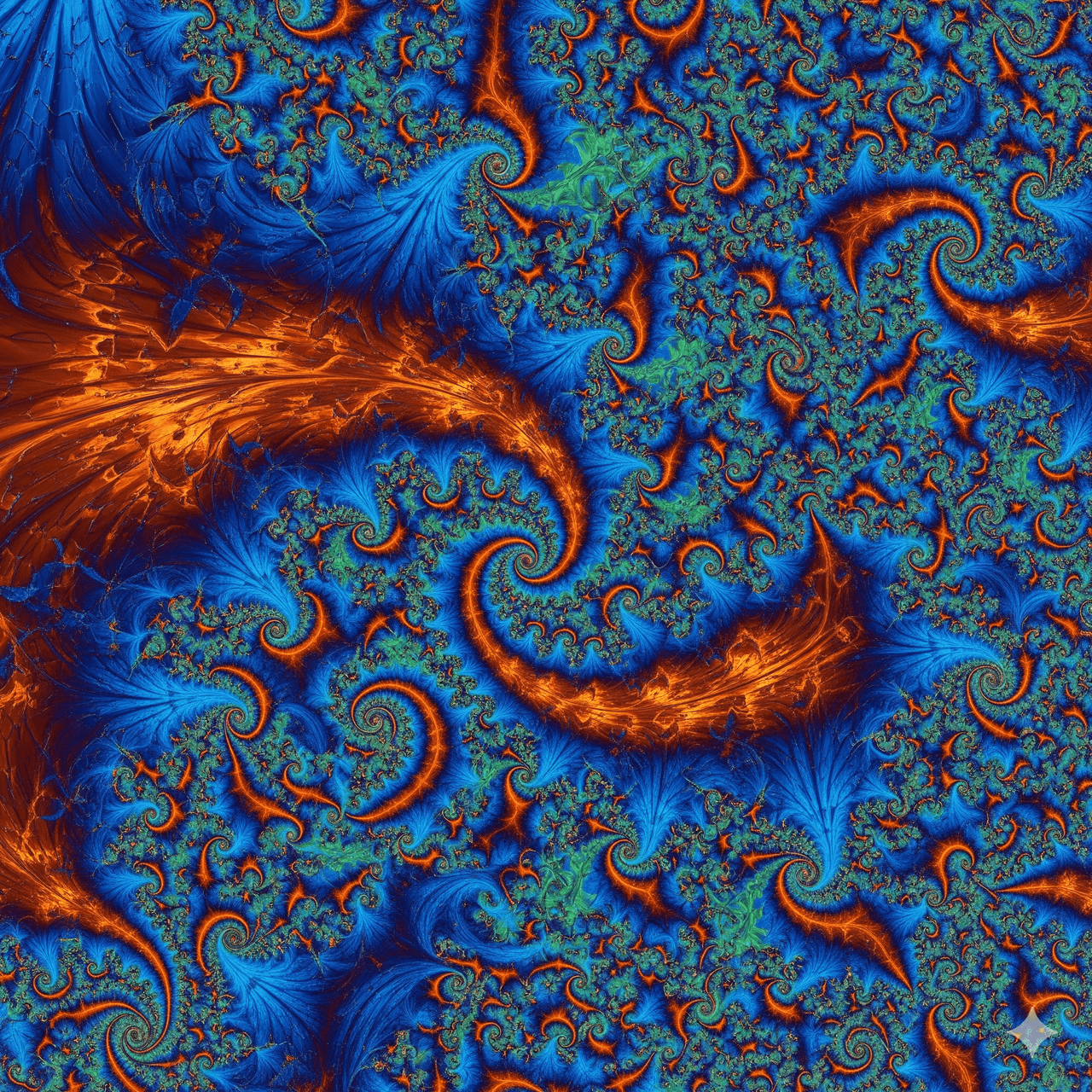
Example of Fractal Art. (Generated by Artificial Intelligence)
The main methods and techniques used in this artistic movement are as follows:
Fractal artists can be broadly categorized into two groups based on their approach:
The defining feature of fractal art is the principle of infinite repetition and self-similarity. This principle states that a fractal structure contains scaled copies of itself at different levels. When you zoom into any portion of a fractal artwork, you encounter details that resemble the overall pattern.
Fractal art is a fusion of mathematical order and creative expression. Artists construct structures by applying specific mathematical equations and algorithms.
Fractal works represent structures that appear random but are in fact determined by precise mathematical rules. Indeed, fractals are forms that emerge under dynamic conditions and contain both order and disorder within themselves.
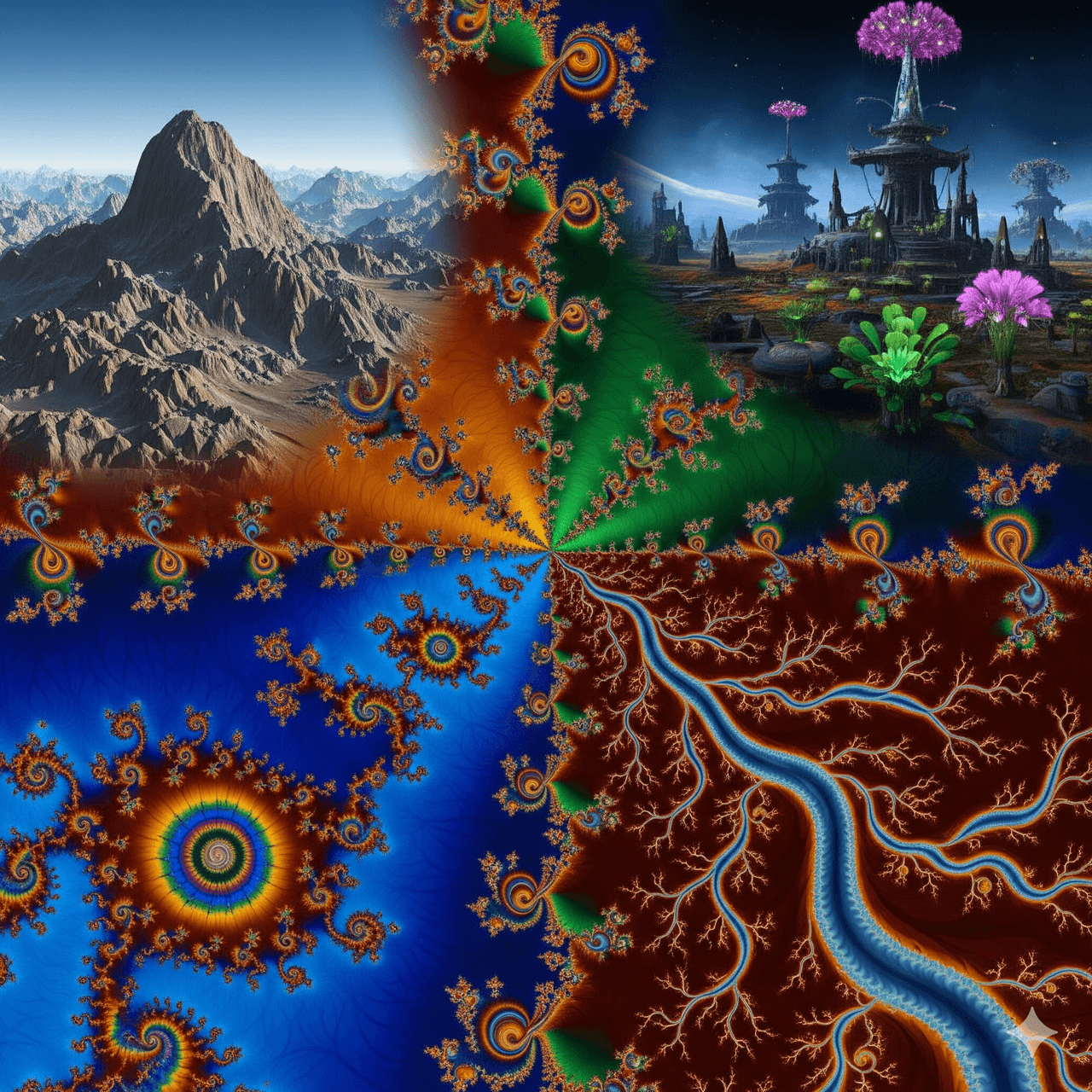
A Visual Representing Different Applications of Fractal Art. (Generated by Artificial Intelligence)
Fractal artworks were first exhibited in digital art exhibitions. Artists use fractal algorithms to create both abstract and figurative works, offering viewers an experience beyond traditional art forms. These works can be displayed on digital platforms and virtual galleries as a form of artistic expression.
Fractal art is also used in scientific visualization, beyond aesthetic purposes. Modeling natural structures—such as tree branching, cloud formations, or river networks—using fractal principles helps scientists better understand these phenomena.
The capabilities of self-similarity and infinite detail provided by fractal art are highly useful in fields such as computer graphics, animation, and video games. Fractal algorithms are particularly employed in generating natural landscapes, mountains, and fantastical universes.
Boyacı, Melis. "Fractal Art and Its Non-Mentioned Artists." Dergipark. Accessed September 29, 2025. https://dergipark.org.tr/tr/download/article-file/1656733
Cengiz, Özgür, Deniz Uluışık, and Fevzi Nuri Kara. "Çağdaş Sanat Yapıtlarında Fraktal Geometri Etkileri Üzerine Bir Değerlendirme [An Evaluation of the Effects of Fractal Geometry on Contemporary Artworks]." Kafkas Üniversitesi Sosyal Bilimler Enstitüsü Dergisi. Accessed September 29, 2025. https://www.kafkas.edu.tr/dosyalar/sobedergi/file/26/10%20%C3%87a%C4%9Fda%C5%9F%20Sanat%20Yap%C4%B1tlar%C4%B1nda%20Fraktal%20Geometri%20Etkileri%20%C3%9Czerine%20Bir%20De%C4%9Ferlendirme.pdf
Solak, Ömer. "Digital Arts – Digital Literatures." *Söylem – Journal of Philology*, Volume 7, no. 2 (2022): 357-389. Accessed September 29, 2025. https://dergipark.org.tr/en/pub/soylemdergi/article/1134421
Historical Origins of Fractal Art
Artistic Production and Techniques
Characteristics of Fractal Art
Infinite Repetition and Self-Similarity
Integration of Mathematical Order and Aesthetic Creativity
Balancing Randomness and Determinism
Applications of Fractal Art
Digital Art Exhibitions and Artistic Expressions
Scientific Visualization
Computer Graphics, Animation, and Video Games