


This article was automatically translated from the original Turkish version.
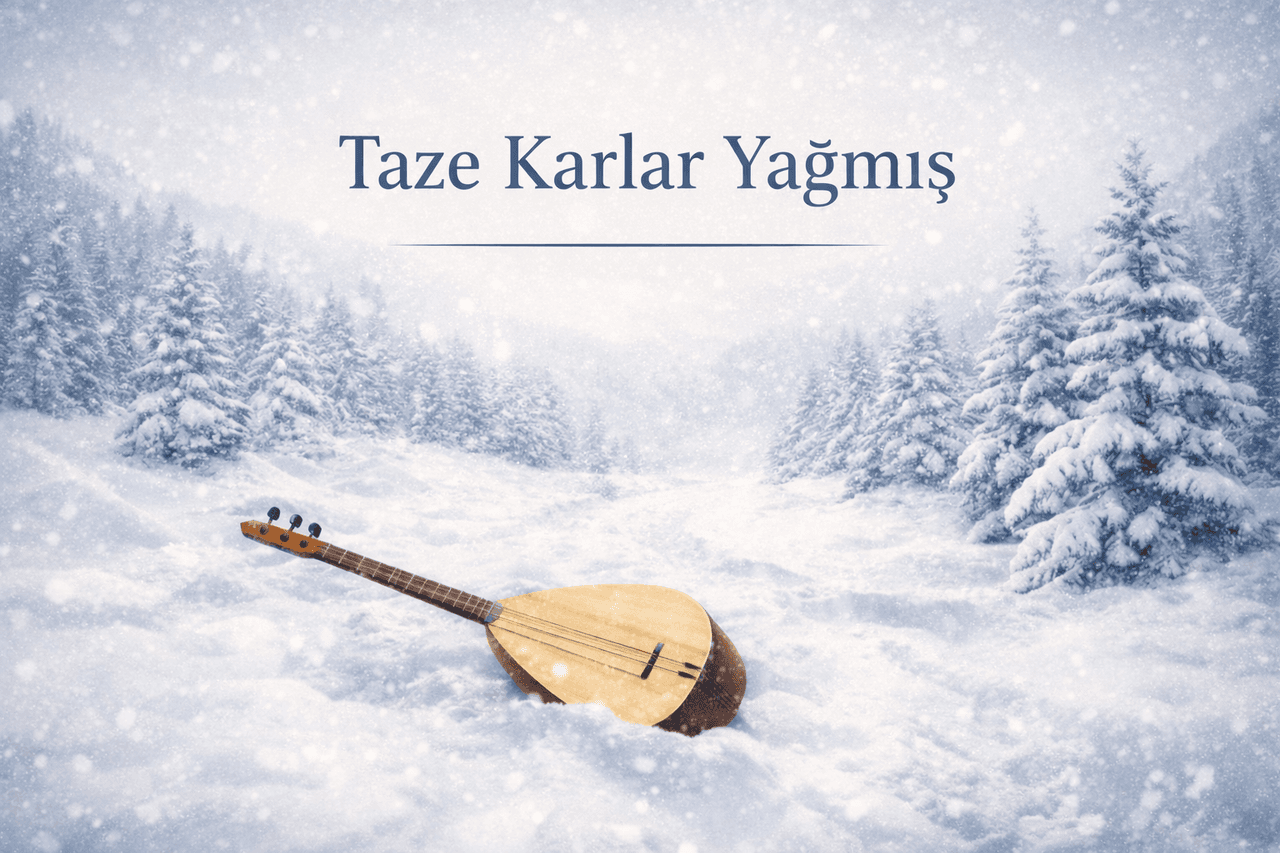
(Image generated by artificial intelligence.)
Fresh Snow Has Fallen (Folk Song)
Type(s) | Turkish folk ballad | ||||||||
|---|---|---|---|---|---|---|---|---|---|
Region(s) | Sivas - Yıldızeli | ||||||||
Theme(s) | Separation Longing and Existential Inquiry | ||||||||
Collector | Âşık Ali Sultan (Ali Tozkoparan) | ||||||||
Taze Karlar Yağmış is a lyrical Turkish folk music song transmitted within the oral culture tradition of Anatolia. The song draws attention through its lyrical structure centered on themes of separation, exile, and individual fate. The piece, interpreted by various performers, is associated with both its lyrics and melody with the âşık tradition.
Ali Sultan - Taze Karlar Yağmış (ARDA Müzik)
The origin of the song “Taze Karlar Yağmış” is linked to the âşık tradition, one of the primary channels of oral culture in Anatolia. The song gained popularity not through written composition but through oral transmission, reaching the present day in various performance styles and variants. The natural imagery in the lyrics, particularly the image of snow, has become a powerful element that reinforces the themes of separation and inner turmoil.【1】
Although information regarding the song’s origin cannot be directly traced to a historical document, it has been shaped through oral narratives and collections attributed to Ali Sultan (Ali Tozkoparan). In this context, the song underwent a process of anonymization but has been associated with Ali Sultan in specific sources.【2】 The song is currently represented in academic studies and digital platforms through sheet music, lyrics, and performance recordings.【3】
Fresh snow has fallen upon the snow
The nightingale sings upon the rose
They say the beloved has taken her hands
There is no remedy beyond this
She goes to the field with a sickle in hand
Her field lies dry and far away
Seeing her, I am filled with longing
I have not seen my beloved beyond this
Autumn has returned and the air has grown cold
My beloved’s absence has multiplied my sorrow
I have no other love to cherish
I have loved no other beyond this

Âşık Ali Sultan (Generated by Artificial Intelligence.)
Born as Ali Tozkoparan, Âşık Ali Sultan was born in 1947 in Yusufoğlu village, part of the Yıldızeli district of Sivas, although his birth date is recorded as 1944 in official documents. His father’s name is Muharrem and his mother’s name is Fatma. Ali Sultan attended primary school in his village and moved to Sivas for secondary education, first enrolling at Selçuk Middle School and later continuing his studies at Atatürk Middle School. While still a student in the second grade, he left school to fulfill his national military service. During his service as an infantry soldier in Manisa, he performed regularly on stage with his saz in the military barracks. In 1967, he fell in love with a girl named Satı from Çay village, a Circassian settlement in the Turhal district of Tokat, and eloped with her. As a result, both were sentenced to five months and twenty-nine days in prison. Ali Sultan and Satı had two children, Mesut and Canan.【4】
Âşık Ali Sultan briefly worked as a laborer for the Sivas State Railways, but left after several years. He then moved to Istanbul to record his first album, recording four songs at Grafson Studio. However, when sales did not meet expectations, the record company declined to produce a second album. Ali Sultan later signed with another label, and this second album achieved significantly higher sales, bringing his name to national prominence across Türkiye. In 1986, he moved abroad and lived in Vienna for eleven years, performing concerts internationally. He also performed music with Neşet Ertaş in Germany. Ali Sultan is still alive and resides in Istanbul.【5】
Eager to play the saz since childhood, Âşık Ali Sultan began secretly playing his older brother Hüseyin’s instrument during primary school. Influenced by Hamit Şeker during these years, he took lessons from Mehmet Tek at the Sivas Community Education Center and from Yusuf Bey of Amasya while in middle school. He first performed publicly while still a student at Selçuk Middle School. Encouraged by his music teacher Nezahat Arseven, he participated in an inter-school music competition and won first prize by singing three songs before a jury that included Zaralı Halil. The prize covered his school expenses for one year. Ali Sultan met Âşık Veysel at a young age and was deeply influenced by him. He traveled with Âşık Veysel and Âşık Ali İzzet Özkan to various regions of Anatolia, giving concerts. He participated in the Second Sivas Âşıklar Festival held on 30 October 1964 by Sivas Garrison Commander Fuat Doğu Paşa. Ali Sultan has recorded over fifty albums; his first cassette was recorded in Germany in 1974.【6】
Alevi–Bektaşi in faith, Âşık Ali Sultan focuses more on humanistic themes than on specifically Alevi-Bektaşi religious subjects in his poetry. He composes his poems in hece meter. His works primarily explore themes of love, longing, exile, separation, nature, death, and old age. Using the pen name “Sultan,” the poet has participated in only one poetic duel (atışma), which took place in Divriği with Şeref Taşlıova. He arranged the lyrics and music for the majority of the works he recorded on his cassettes. He also arranged musical settings for traditional folk verses and poems. Âşık Ali Sultan has participated in numerous concerts, festivals, âşık events, and TV and radio programs; as of 2004, he had produced fifty-four cassettes. He has contributed more than forty works to the archives of the Turkish Radio and Television Corporation, some with only lyrics, others with both lyrics and music, and some with music alone.【7】
The works attributed to Ali Sultan have not survived as a written corpus but have reached the present through collections, biographical studies, and digital archives. This situation necessitates evaluating his position within the poetic and folk song tradition within the context of oral transmission. His name is particularly remembered in Turkish folk music literature through the song Taze Karlar Yağmış, which is widely regarded as one of the most well-known pieces associated with him.

Sheet Music for the Song “Taze Karlar Yağmış” (Bağlamacı)
The lyrics of the song combine natural elements with personal inner turmoil and the theme of separation. The image of snow serves both as a physical setting and as a metaphor for emotional state. In this way, the song reflects the symbolic narrative tradition common in Anatolian folk poetry. The song exhibits a simple linguistic structure and repetitive lines, making it well-suited for oral performance.
Akın, Bülent. “Ali Sultan (Ali Tozkoparan).” *Türk Edebiyatı İsimler Sözlüğü* (TEİS). Ahmet Yesevi Üniversitesi. Date Published: July 16, 2019; Updated: December 5, 2020. Accessed February 1, 2026. https://teis.yesevi.edu.tr/madde-detay/ali-sultan-ali-tozkoparan
Ali Sultan. "Ali Sultan - Taze Karlar Yağmış." YouTube video, 3:45. January 21, 2016. Accessed February 1, 2026. https://youtu.be/_9ecA04gJvA?si=yCt87_No0N0RyxmQ
Bağlamacı. "Taze Karlar Yağmış Karın Üstüne." *Bağlamacı - Notalar*. Eser No. 5392. Accessed February 1, 2026. https://www.baglamaci.com/notalar/eser5392/taze-karlar-yagmis-karin-ustune?pdf=taze_karlar_yagmis_karin_ustune.pdf&id=5392
Bozalioğlu, Yakup Kadri. “Aşık Ali Sultan, Halk Aşığı, Yıldızeli.” *Şehrî-Sivas.* Accessed February 1, 2026. https://www.sehrisivas.com/asiklar_ozanlar/asik-ali-sultan-halk-asigi-yildizeli_1229.html
Kaya, Doğan. "Âşık Ali Sultan." Sivas: Çukurova Üniversitesi Türkoloji Araştırmaları Merkezi. PDF file, 6 pp. Accessed February 1, 2026. https://turkoloji.cu.edu.tr/HALK%20EDEBIYATI/dogan_kaya_asik_ali_sultan.pdf
İlgen, Ebru, Salman, Melike, and Çalışkan, Eneshan. “Varoluşsal Perspektifte Bir Türkü Çözümlemesi: ‘Taze Karlar Yağmış Karın Üstüne’.” *Journal of OKUFED* 1, no. 2 (2020): 14–23. Accessed February 1, 2026. https://dergipark.org.tr/tr/download/article-file/1153777
[1]
İlgen, Ebru, Salman, Melike and Çalışkan, Eneshan “A Folk Song Analysis from an Existential Perspective: ‘Taze Karlar Yağmış Karın Üstüne.’” Journal of OKUFED 1, no. 2 (2020). Pages: 14–23. Access date: 1 February 2026. https://dergipark.org.tr/tr/download/article-file/1153777
[2]
Akın, Bülent. “Ali Sultan (Ali Tozkoparan).” Türk Edebiyatı İsimler Sözlüğü (TEİS). Ahmet Yesevi Üniversitesi. Publication date: 16 July 2019; update date: 5 December 2020. Access date: 1 February 2026. https://teis.yesevi.edu.tr/madde-detay/ali-sultan-ali-tozkoparan
[3]
Bağlamacı. “Taze Karlar Yağmış Karın Üstüne.” Bağlamacı - Notalar. Work No. 5392. Access date: 1 February 2026. https://www.baglamaci.com/notalar/eser5392/taze-karlar-yagmis-karin-ustune?pdf=taze_karlar_yagmis_karin_ustune.pdf&id=5392
[4]
Akın, Bülent. “Ali Sultan (Ali Tozkoparan).” Türk Edebiyatı İsimler Sözlüğü (TEİS). Ahmet Yesevi Üniversitesi. Publication date: 16 July 2019; update date: 5 December 2020. Access date: 1 February 2026. https://teis.yesevi.edu.tr/madde-detay/ali-sultan-ali-tozkoparan
[5]
Akın, Bülent. “Ali Sultan (Ali Tozkoparan).” Türk Edebiyatı İsimler Sözlüğü (TEİS). Ahmet Yesevi Üniversitesi. Publication date: 16 July 2019; update date: 5 December 2020. Access date: 1 February 2026. https://teis.yesevi.edu.tr/madde-detay/ali-sultan-ali-tozkoparan
[6]
Akın, Bülent. “Ali Sultan (Ali Tozkoparan).” Türk Edebiyatı İsimler Sözlüğü (TEİS). Ahmet Yesevi Üniversitesi. Publication date: 16 July 2019; update date: 5 December 2020. Access date: 1 February 2026. https://teis.yesevi.edu.tr/madde-detay/ali-sultan-ali-tozkoparan
[7]
Akın, Bülent. “Ali Sultan (Ali Tozkoparan).” Türk Edebiyatı İsimler Sözlüğü (TEİS). Ahmet Yesevi Üniversitesi. Publication date: 16 July 2019; update date: 5 December 2020. Access date: 1 February 2026. https://teis.yesevi.edu.tr/madde-detay/ali-sultan-ali-tozkoparan

(Image generated by artificial intelligence.)
Fresh Snow Has Fallen (Folk Song)
Type(s) | Turkish folk ballad | ||||||||
|---|---|---|---|---|---|---|---|---|---|
Region(s) | Sivas - Yıldızeli | ||||||||
Theme(s) | Separation Longing and Existential Inquiry | ||||||||
Collector | Âşık Ali Sultan (Ali Tozkoparan) | ||||||||
No Discussion Added Yet
Start discussion for "Fresh Snow Has Fallen (Folk Song)" article
Origin of the Song
Lyrics of the Song
Who is Âşık Ali Sultan (Ali Tozkoparan)?
Thematic and Formal Characteristics of the Song