

This article was automatically translated from the original Turkish version.
Latin Name | Musculus frontalis | ||||||||
|---|---|---|---|---|---|---|---|---|---|
Neural Nutrition | Nervus facialis (Seventh cranial nerve) | ||||||||
Blood Circulation | Arteria supraorbitalis, Arteria supratrochlearis | ||||||||
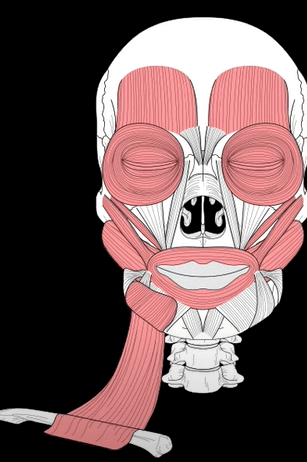
Frontalis muscle is a skeletal muscle located in the forehead region of the human body and plays a role in facial expression formation. Its Latin name is musculus frontalis, and it is situated on the anterior part of the skull, immediately beneath the skin of the forehead. Structurally, it forms the anterior portion of a broader muscle system known as musculus occipitofrontalis, together with the occipitalis muscle. According to Terminologia Anatomica, the frontalis muscle is not classified as a separate muscle but as part of a single structure together with the occipitalis muscle. In human anatomy, the frontalis muscle is classified among the mimetic muscles and contributes exclusively to the formation of facial expressions. Its neural and vascular supply is provided by the facial nerve (nervus facialis), while its blood supply is delivered through the supraorbital and supratrochlear arteries.
The frontalis muscle is a thin, quadrilateral muscle located on the anterior part of the head. Its fibers are long, pale, and loose, and are firmly connected to the superficial fascia. It has a larger surface area compared to the occipitalis muscle. This muscle does not attach directly to bone; instead, it merges with surrounding facial muscles and connects superficially to the skin. The upward-extending fibers of the muscle unite with the galea aponeurotica (epicranial aponeurosis) at the vertex of the head. This connective tissue also fills the space between the occipital and frontalis muscles.
The frontalis muscle originates embryologically from the second pharyngeal arch and is classified among the mimetic muscles. Although structurally a skeletal muscle, it does not attach directly to bone; rather, it functions in association with the skin to produce facial expressions. Among superficial muscles, it is considered part of the epicranial muscle group and is regarded together with the occipitalis muscle as a single muscular complex (epicranial muscles). The galea aponeurotica between them serves as the common connective tissue that ensures their functional unity.
The frontalis muscle is innervated by the temporal branch of the facial nerve. This nerve is a branch of the seventh cranial nerve, nervus facialis, which controls the motor function of the facial muscles. The vascular supply of the muscle is typically provided by branches of the superficial temporal artery and the ophthalmic artery. These vessels play a significant role in nourishing the forehead and scalp skin.
The frontalis muscle plays an active role in the formation of facial expressions. It particularly contributes to the nonverbal expression of emotions such as attention, surprise, and curiosity by elevating the eyebrows. It acts as a counterbalance to the orbicularis oculi muscle around the eyes, supporting mimetic movements in this region. When light is insufficient or when focusing on a distant object, the muscle contracts to stretch the forehead, resulting in horizontal wrinkles. Chronic and excessive use of this muscle can lead to prominent forehead wrinkles and aesthetic concerns. Additionally, lesions of the frontal nerve may result in dysfunction of this muscle, potentially causing facial asymmetry.
Anatomy, Head and Neck, Frontalis Muscle. StatPearls Publishing. Date Published January 2024. Accessed July 3, 2025.
Human Frontalis Muscle Innervation and Morphology. Plastic and Reconstructive Surgery Welter, Laura, Silvia Bramke, and Christian Albrecht May. 2022. Global Open 10 (3): e4200.

Latin Name | Musculus frontalis | ||||||||
|---|---|---|---|---|---|---|---|---|---|
Neural Nutrition | Nervus facialis (Seventh cranial nerve) | ||||||||
Blood Circulation | Arteria supraorbitalis, Arteria supratrochlearis | ||||||||
Anatomical Structure
Embryological Origin and Classification
Innervation and Vascular Supply
Function and Clinical Relevance