



George Washington
Doğum tarihi | 1732-02-22 | ||||||||
|---|---|---|---|---|---|---|---|---|---|
Ölüm tarihi | 1799-12-14 | ||||||||
Military Rank | General of the Armies | ||||||||
Presidency Start Date | 30 April 1789 | ||||||||
Presidency End Date | 4 March 1797 | ||||||||
George Washington became a prominent figure in the colonies at a young age due to his experiences in the French and Indian War (1754–1763). He assumed his first major military command at the Battle of Fort Necessity (1754). His courage and leadership during the Braddock Expedition (1755) elevated him to hero status in colonial public opinion. During this period, Washington gained deep experience in military strategy and leadership and developed a clear understanding that the colonies needed to defend themselves against British rule.
After the French and Indian War, Washington retired from military service and returned to his plantation at Mount Vernon. As a planter, he grew wealthy. He served in the Virginia House of Burgesses. His social standing earned him respect both within Virginia’s aristocracy and across the broader colonial society. This period allowed Washington to gain political experience and closely follow the colonies’ grievances.
In the 1770s, Britain’s heavy taxation of the colonies—the Stamp Act, the Townshend Acts, and the Tea Act—and trade restrictions influenced Washington. He argued that the power to tax should reside solely with elected assemblies. He supported economic boycotts against Britain. Although Washington did not openly advocate for independence during this time, he became an active voice in defending colonial rights.
Washington attended the First Continental Congress in 1774 as a delegate from Virginia. There, he advocated for greater cooperation among the colonies and a unified stance against Britain. While supporting peaceful resolution, he signaled his willingness to back military resistance if necessary. This stance laid the groundwork for his eventual selection as a military leader.
When the Battles of Lexington and Concord erupted in April 1775, tensions between Britain and the colonies had turned into armed conflict. On June 15, 1775, the Second Continental Congress elected George Washington as Commander-in-Chief of the Continental Army. Key factors in his selection included:
- His origin from Virginia, ensuring balance between northern and southern colonies,
- His military experience,
- His reputation for reliability and impartiality.
Washington demonstrated his commitment to public service and popular leadership by offering to serve without salary.
As commander-in-chief, Washington led the war effort for eight years. He maintained the army under harsh conditions and secured victories at Trenton, Princeton, and Yorktown. He played a crucial role in securing the French alliance. During this period, Washington became not only a military leader but also the political and moral symbol of the American Revolution.
After the war, Washington relinquished his military authority to the Continental Congress in Annapolis in 1783, demonstrating his respect for civilian authority. He retired to Mount Vernon and began a quiet life as a farmer. Yet, in the eyes of the public and political leaders, he became a national hero and the ideal leader. This act of voluntary power relinquishment was seen as unprecedented in world history and positioned Washington as the strongest candidate for the presidency.
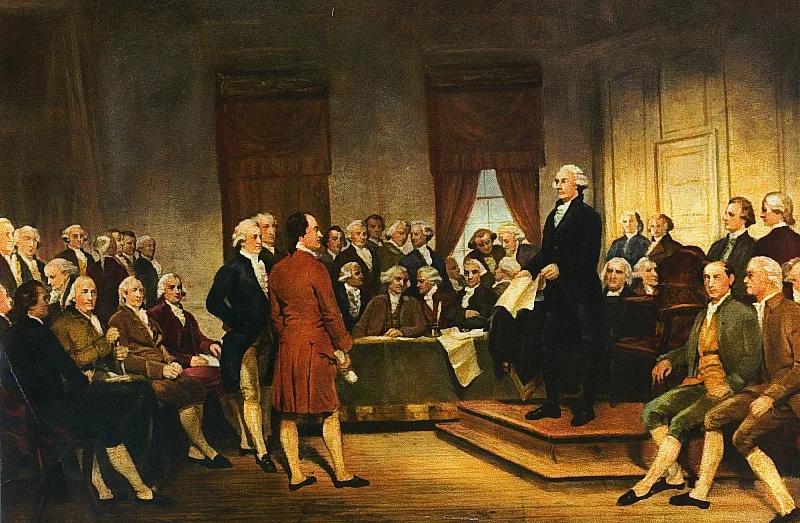
In 1787, Washington presided over the Constitutional Convention in Philadelphia. His impartial and trustworthy character ensured the convention’s proceedings proceeded smoothly. He played an active role in the adoption of the Constitution. This process solidified Washington’s status as the natural choice of the people and delegates to lead the new government as its first president.

George Washington surveying land-
George Washington’s first serious military experience occurred during the French and Indian War.
Commissioned by the Governor of Virginia, Washington was sent to observe French activities in the Ohio Valley and to persuade them to withdraw from the region.
Washington was besieged by French forces and their Native American allies. He signed his first and only surrender document here. This event ignited the French and Indian War—and indirectly, the Seven Years’ War.
Serving as an aide to General Edward Braddock during the campaign along the Monongahela River, Washington drew attention for his courage and leadership despite the expedition’s disastrous outcome.
Significance: He developed his military leadership skills and gained firsthand experience in how wars should be organized and the importance of defending the colonies.
Washington served as Commander-in-Chief of the Continental Army from the beginning to the end of the Revolutionary War.
Washington forced the British to evacuate Boston. This was his first major strategic victory.
Although initially suffering defeats—especially at the Battle of Long Island—Washington restored morale with victories at Trenton and Princeton.
Washington crossed the Delaware River and launched a surprise attack, defeating British Hessian mercenaries.
Immediately following the Trenton victory, Washington defeated British forces again. These victories halted the Continental Army’s downward spiral.
Efforts to defend Philadelphia failed. However, the army maintained its resistance.
Washington kept the army intact under extremely harsh conditions. During this time, Baron von Steuben’s training transformed the army into a disciplined force.
A long and grueling battle. The Continental Army proved itself as a trained and effective fighting force.
With French allies, Washington secured the surrender of General Cornwallis. This victory effectively ended the American Revolutionary War.
Significance: Through military and strategic leadership, Washington won the people’s trust and sustained the revolutionary ideal. He also achieved diplomatic successes, notably securing French support.
Defensive Strategy: During periods of weakness, he avoided direct battles and focused on preserving his army through strategic retreats.
Surprise Attacks: He secured morale advantages through surprise assaults, as at Trenton and Princeton.
Seeking Foreign Support: He conducted diplomacy to secure French alliance, notably through the support of Lafayette and Rochambeau.
War of Attrition Strategy: He aimed to increase Britain’s war costs and pressure its public opinion into seeking peace.

George Washington-world history
In 1789, Washington was unanimously elected the first president. He took the oath of office on April 30, 1789, at Federal Hall in New York. His impartiality and charisma contributed significantly to the political stability of the young nation.
To ensure effective governance, Washington established a cabinet of advisors:
Thomas Jefferson (Secretary of State),
Alexander Hamilton (Secretary of the Treasury),
Henry Knox (Secretary of War),
Edmund Randolph (Attorney General).
This structure formed the foundation of the modern American government system.
During his presidency, ten amendments guaranteeing individual rights—the Bill of Rights—were added to the Constitution.
Washington declared the United States neutral in the war between Britain and France. This proclamation became one of the foundational pillars of later American foreign policy.
A tax protest erupted among whiskey producers in Pennsylvania. Washington suppressed the rebellion with a federal militia force of 13,000 men. This event demonstrated the federal government’s ability to enforce its authority effectively.
A treaty with Britain to resolve trade and boundary disputes. Although controversial domestically, it preserved American economic stability and peaceful relations with Britain.
This agreement with Spain resolved navigation rights on the Mississippi River and boundary issues.
At the end of his second term, Washington chose not to seek re-election and delivered his Farewell Address to the nation.
In it, he warned against:
- Avoiding political parties,
- Steering clear of foreign alliances,
- Preserving national unity.
George Washington (1732–1799) was not only the hero of the American Revolutionary War but also a statesman who played a pivotal role in shaping the political, social, and cultural foundations of the United States. His leadership left enduring effects on the establishment of American institutions, the formation of political culture, and the preservation of national unity.
Washington was the central figure in shaping the nation’s post-independence governance. During his presidency:
- He established the supremacy of civilian authority; his decision to relinquish military power to civilian institutions set a powerful example for republican values.
- He set the precedent of serving only two terms and declining a third, establishing the principle that power is limited in duration and transferable. This practice later became the 22nd Amendment to the U.S. Constitution.
Washington was the architect of the transition from a weak confederation to a strong federal state:
- He presided over the Constitutional Convention (1787) and advocated for a strong central government.
- His creation of the first cabinet system (State, Treasury, Justice, and War Departments) enhanced the functionality of the executive branch.
- By effectively asserting federal authority during the Whiskey Rebellion (1794), he demonstrated the strength of constitutional order.
Washington served as a unifying figure who protected the young nation from fragmentation:
- He warned against partisan politics threatening national cohesion and championed national unity.
- As a leader representing all Americans, he maintained balance between northern and southern states.
Washington’s foreign policy approach defined the United States’ international posture:
- The 1793 Neutrality Proclamation established a policy of non-intervention in European wars.
- The Jay Treaty (1794) normalized economic and diplomatic relations with Britain, securing American foreign trade.
This policy became a precursor to later American doctrines such as the Monroe Doctrine (1823).
Washington’s governing philosophy:
- Implemented the separation of powers among the legislative, executive, and judicial branches.
- Used executive authority without overreach, establishing a model of strong yet balanced governance within constitutional limits.
This approach became one of the foundational practices of American democracy.
Washington’s character shaped American political culture:
- He defined public service as an act of sacrifice and moral responsibility.
- He bequeathed to future leaders the model of subordinating personal ambition to the public good.
This approach became a source of inspiration for later leaders such as Lincoln.
He indirectly supported economic reforms such as the creation of the first national bank (1791). He played a leading role in establishing the physical foundations of the federal system, including the designation of Washington, D.C., as the capital and the creation of federal territory.

George Washington in a scene from the war-world history
George Washington laid the foundations of the United States’ political structure, foreign policy, and social values, defining the leadership and governance principles of an independent nation. He was not merely the first president but also the embodiment of its founding ideals.
The traditions and principles established by Washington remain central to American political and cultural life today. After retiring to Mount Vernon, Washington died in 1799 from a throat infection. In his will, he stipulated the emancipation of his personal enslaved people, taking a meaningful step within the moral framework of his time.
BBC. "George Washington." BBC History. Accessed 2025. https://www.bbc.co.uk/history/historic_figures/washington_george.shtml.
Mount Vernon. "Ten Facts About Washington’s Presidency." Mount Vernon. Accessed 2025. https://www.mountvernon.org/george-washington/the-first-president/ten-facts-about-washingtons-presidency.
The Washington Papers. "Biography of George Washington." *The Washington Papers*. Accessed 2025. https://washingtonpapers.org/resources/biography-of-george-washington/.
The White House Archives. "George Washington." The White House. Accessed 2025. https://georgewbush-whitehouse.archives.gov/history/presidents/gw1.html.
White House Historical Association. "George Washington." *White House History*. Accessed 2025. https://www.whitehousehistory.org/bios/george-washington.
World History Encyclopedia. "Washington Rallying His Troops at the Battle of Monmouth." World History Encyclopedia. Accessed 2025. https://www.worldhistory.org/image/18465/washington-rallying-his-troops-at-the-battle-of-mo/.

George Washington
Doğum tarihi | 1732-02-22 | ||||||||
|---|---|---|---|---|---|---|---|---|---|
Ölüm tarihi | 1799-12-14 | ||||||||
Military Rank | General of the Armies | ||||||||
Presidency Start Date | 30 April 1789 | ||||||||
Presidency End Date | 4 March 1797 | ||||||||
George Washington’s Path to Election as President of the United States
1. Early Military Experience and Recognition in the Colonies (1754–1763)
2. Return to Civil Life and Social Engagement (1760s–1770s)
3. Growing Resistance to Britain and Political Activism
4. Leadership Position Before the American Revolution
5. Election as Commander-in-Chief of the Continental Army (1775)
6. Military Leadership During the American Revolutionary War (1775–1783)
7. Return to Civil Life and Reputation
8. Constitutional Convention and National Demand for Leadership (1787)
Wars in Which George Washington Participated
1. French and Indian War (1754–1763)
Major Conflicts and Roles:
Service in the Ohio Valley (1753–1754):
Battle of Fort Necessity (July 3, 1754):
Braddock Expedition (1755):
2. American Revolutionary War (1775–1783)
Key Battles and Campaigns:
Siege of Boston (1775–1776):
New York and New Jersey Campaigns (1776–1777):
Battle of Trenton (December 26, 1776):
Battle of Princeton (January 3, 1777):
Battles of Brandywine and Germantown (1777):
Winter at Valley Forge (1777–1778):
Battle of Monmouth (1778):
Siege of Yorktown (1781):
Tactics and Strategies Adopted by Washington in Warfare
Election as First President of the United States (1789)
1. Establishment of the Cabinet System
2. Ratification of the Bill of Rights (1791)
3. Neutrality Proclamation of 1793
4. Whiskey Rebellion (1794)
5. Jay Treaty (1794)
6. Pinckney Treaty (1795)
7. Washington’s Farewell Address (1796)
George Washington’s Impact on the United States
1. Establishment of the Republican Governance Tradition
2. Strengthening of the Federal State
3. National Unity and Identity Formation
4. Principle of Neutrality and Foreign Policy
5. Rule of Law and Separation of Powers
6. Political Culture and Public Service Ethic
7. Contributions to Economic and Institutional Infrastructure