badge icon

This article was automatically translated from the original Turkish version.

Article

Ghost Nebula (IC 63)

Constellation
Cassiopeia
Distance
Approximately 550 light years
Dimensions
It covers an area of approximately 1x1 arcminute

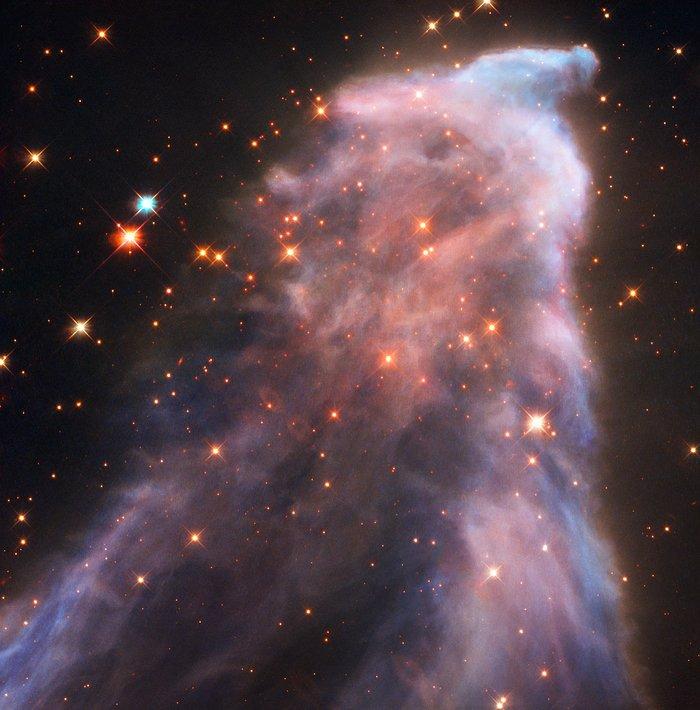
IC 63 is a small-scale nebula located in the direction of the constellation Cassiopeia, exhibiting both reflection and emission characteristics. In astronomical literature, it is commonly known as the "Phantom Nebula," a name derived from its hazy, ghost-like visual appearance. IC 63 is an important subject of study due to its surface brightness, ionization structure, and interactions with nearby stars.


Phantom Nebula. (NASA)

Location and Observability

  • Constellation: Cassiopeia
  • Equatorial Coordinates (J2000): Approximately RA 00h 59m, DEC +60° 53'
  • Distance: Approximately 550 light years
  • Apparent Magnitude: IC 63 is too faint to be seen with the naked eye; it is observable with a telescope under medium-dark sky conditions.
  • Angular Size: Covers an area of approximately 1x1 arcminute.

Physical Characteristics

IC 63 is a diffuse nebula displaying characteristics of both a reflection nebula and an emission nebula. The nebula is ionized due to its proximity to the hot star Gamma Cassiopeiae (γ Cas).

Stellar Interaction

  • Gamma Cassiopeiae is a B0.5 IVe class giant star with a temperature of approximately 34,000 Kelvin.
  • The high-energy ultraviolet radiation emitted by this star ionizes the gaseous components of IC 63.
  • The ionization front at the nebula’s leading edge has developed a distinct structure due to the intense photon flux.

Gas and Dust Structure

  • The nebula contains hydrogen gas (H I and H II), small amounts of helium, dust grains, and some ionized heavy elements.
  • The dust content reflects starlight, producing a blueish glow (reflection nebula characteristic).
  • The gas, when excited by Gamma Cassiopeiae’s ultraviolet radiation, emits a reddish light at the H-alpha line (656.28 nm).

Ionization and Radiation Process

  • The emission observed in IC 63 arises from recombination processes. Hydrogen ionized by stellar radiation later captures electrons and emits photons.
  • The radiation front can be spectroscopically analyzed in specific emission lines such as Hα, [S II], and [O III].

Morphological Features

  • IC 63 has a diffuse central region and a gas-wave structure extending outward from it.
  • It is regarded as a photo-eroded remnant of a molecular cloud.
  • Together with the neighboring nebula IC 59, IC 63 serves as a model system for studying star-interstellar medium interactions around Gamma Cassiopeiae.

Use in Research and Scientific Significance

IC 63 is studied in research on interstellar light interactions, ionization fronts, dust scattering properties, and the evolution of molecular clouds.

It is particularly valuable in the following areas:


  • How high-energy stellar radiation shapes gas clouds
  • Observable consequences of photodissociation and photochemical processes
  • Simultaneous observation of reflection and emission characteristics

Observational Data and Instruments

  • The Hubble Space Telescope (HST) has obtained high-resolution images of IC 63.
  • The Spitzer Space Telescope and ground-based optical telescopes have provided data in both infrared and optical bands.
  • Spectroscopic observations typically focus on emission lines such as H-alpha, [O III], and [S II].


IC 63 (Phantom Nebula) is a low-mass, irregularly shaped reflection-emission nebula exposed to the radiation of the bright star Gamma Cassiopeiae. Ionized by nearby ultraviolet radiation, it becomes visually distinct. Astronomical observations and modeling play a fundamental role in understanding how such nebulae interact with the interstellar medium.

Author Information

Avatar
AuthorOsman ÖzbayDecember 2, 2025 at 8:08 AM

Tags

Discussions

No Discussion Added Yet

Start discussion for "Ghost Nebula (IC 63)" article

View Discussions

Contents

  • Location and Observability

  • Physical Characteristics

  • Stellar Interaction

  • Gas and Dust Structure

  • Ionization and Radiation Process

  • Morphological Features

  • Use in Research and Scientific Significance

  • Observational Data and Instruments

Ask to Küre