

This article was automatically translated from the original Turkish version.
+1 More
Protection Status | UNESCO World Heritage Site | ||||||||
|---|---|---|---|---|---|---|---|---|---|
Structure Type(s) | Columnar Basalt | ||||||||
Type(s) | Coastal Geomorphological Area | ||||||||
Process | Crack Formation Thermal Contraction | ||||||||
Location | Northern Ireland | ||||||||
Building Orientation | Vertical Columns | ||||||||
Column Shape | Primarily Hexagonal | ||||||||
Rock Type | Basalt | ||||||||
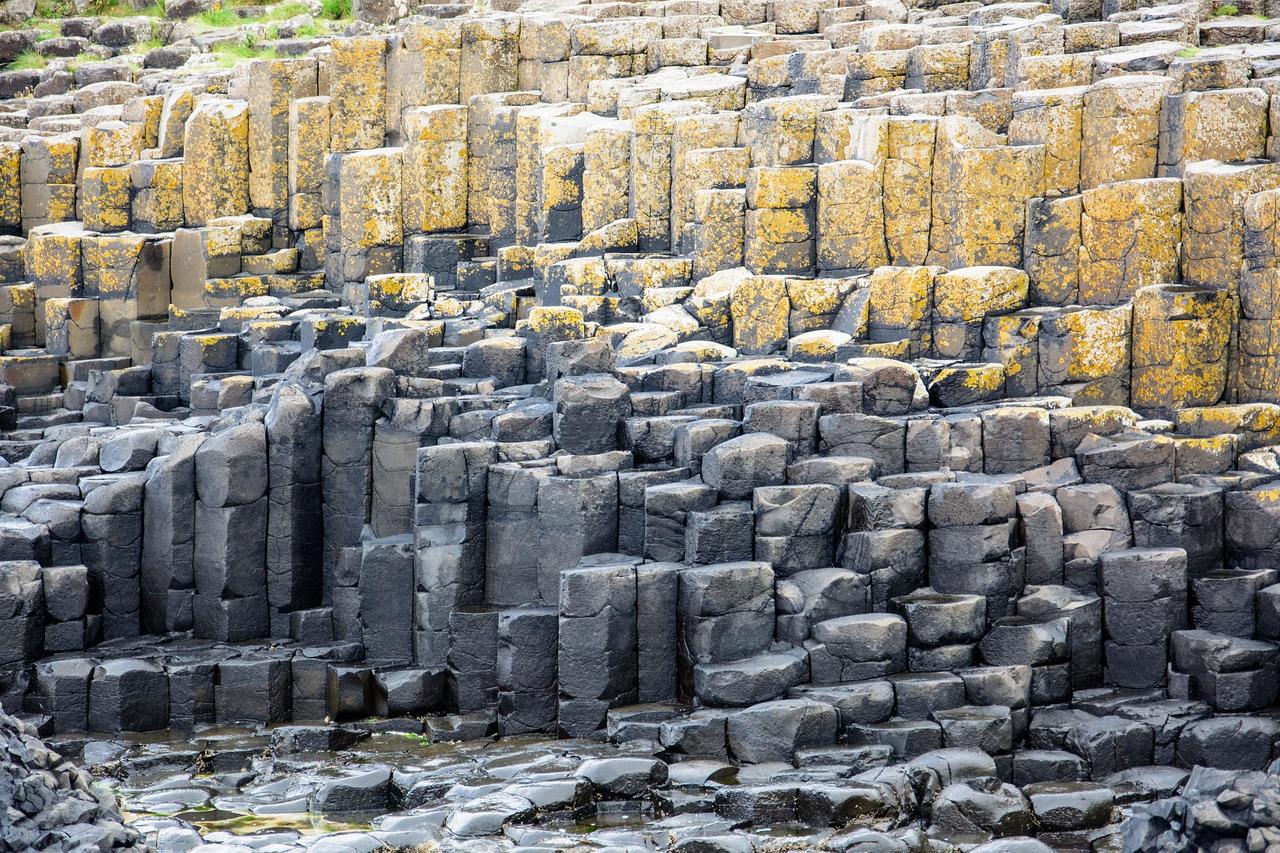
Giant’s Causeway (Giant’s Causeway), located on the Antrim coast of Northern Ireland, is a coastal geomorphological area defined by columnar rock structures formed by the cooling of Paleogene basaltic lava flows. The region contains a regular assembly of basalt columns, predominantly with hexagonal cross-sections and vertical orientations. These structures are linked to the solidification dynamics of lava that occurred approximately 60 million years ago during volcanic activity.【1】 The site holds international protection status due to its geological integrity and representative character.
Giant’s Causeway is situated in Northern Ireland, part of the United Kingdom, on the coast of County Antrim, northeast of the settlement of Bushmills. The site lies along the Causeway Coast facing the North Atlantic and is characterized by rocky sea platforms extending along the cliff-lined shoreline. The coastline includes wave-exposed cliffs, natural rock steps, and irregular block accumulations.

Giant’s Causeway (Pixabay)
The site consists of basalt outcrops rising from sea level and rocky terraces running parallel to the coast. This morphology exposes lava flow surfaces at different elevations along the shoreline. Together with the surrounding Dunseverick area, it forms a cohesive geological landscape and represents a coastal environment shaped by the interaction of terrestrial and marine processes.
Giant’s Causeway is a volcanic stack area located along the northeast coast of Northern Ireland, where thick basalt layers are exposed at the surface. The region’s fundamental geological structure consists of volcanic debris layers of varying thicknesses and morphological characteristics. These layers can be studied through the cliffs and rocky platforms exposed along the coastline and reflect successive accumulation processes. Additionally, the columnar structures formed by the contraction of solidified magma reveal the natural fracture systems developed after volcanic activity.
The rock cover also includes local tuff and volcanic debris layers. This variability resulted from differing weathering and cooling conditions during intermittent lava flows. The stratigraphic structure of the area is determined by the interaction of tectonic processes and volcanic accumulations, and Giant’s Causeway preserves evidence of geological developments both before and after the Paleogene period in terms of layered systems and morphological features.
The basaltic lava accumulations at Giant’s Causeway are the result of magmatic activity associated with the opening of the North Atlantic during the Paleogene period. During this time, mantle-derived magma rose along extensional fractures in the crust and formed extensive, fluid lava flows. Successive and multiple eruptions accumulated into thick lava layers, creating a broad basalt plateau along the northern coast. This process enabled the deposition of lava in varying thicknesses and the development of morphological diversity. Vertical cliffs, columnar structures, and stacked lava sequences represent direct surface expressions of Paleogene volcanism. Thus, the volcanic accumulation at the site is a tangible record of prolonged and successive magmatic activity occurring concurrently with tectonic rifting.
The columnar structures observed at Giant’s Causeway are the result of thermal stress and contraction mechanisms during the cooling of magmatic flows. Upon reaching the surface, the lava rapidly came into contact with ambient temperatures, triggering volumetric contraction. Contraction led to the formation of vertical fracture systems that shaped the characteristic hexagonal geometries of the magmatic columns. The cooling process is directly related to lava thickness and mineral composition; thicker layers cooled more slowly internally, while rapid surface cooling determined the initiation points of fractures. Thus, Giant’s Causeway functions as a natural laboratory clearly demonstrating the thermal and mechanical cooling dynamics of lava.
The dominant rock type at Giant’s Causeway consists of Paleogene basaltic lavas. These basalts are typically dark gray and fine-grained, containing minerals crystallized due to rapid cooling of lava flows. Interbedded layers of tuff, lapilli, and volcanic debris are observed locally between volcanic rock strata. These intermediate layers reflect brief pauses between lava flows and the transient effects of volcanic eruptions. Mineralogically, the lavas are rich in plagioclase feldspar, pyroxene, and olivine, which determine the mechanical strength and resistance to erosion of the layers.

Giant’s Causeway (Pixabay)
Stratigraphically, Giant’s Causeway is defined as a layered system composed of multiple successive magmatic flows. The thickness of basaltic layers varies, forming a multi-layered stack. The weathering and fracturing characteristics of the basalts shape the surface morphology of the stratigraphic structure. Columnar basalt structures reveal mechanically distinct cooling dynamics in both vertical and horizontal directions. Thus, the site provides a detailed record of Paleogene volcanic processes in terms of both rock composition and stratigraphic organization.
The settlement environment of Giant’s Causeway is a coastal plateau shaped by volcanic and tectonic processes during the Paleogene period. The vertical and horizontal variability of the geological structure has influenced drainage, soil formation, and natural erosion processes, thereby defining the region’s physical environment and ecological potential. The settlement environment also interacts with tectonic movements and sea level changes, resulting in plateaus, cliffs, and rocky areas at varying elevations and slopes along the coast.
Mechanical weaknesses developed in the basaltic layers after cooling and solidification initiated the subsidence process at Giant’s Causeway. Internal stresses generated during the stacking of magmatic flows combined with contraction fractures over time, leading to block displacement and the formation of subsidence areas at the surface. This process was particularly pronounced in regions with variable layer thicknesses, where small collapses and fracture systems emerged along steep cliffs and plateau margins. Subsidence was accelerated by erosion and rainfall, contributing to the morphological diversity of the area through the weathering and fragmentation of lava layers.
The morphology of the Giant’s Causeway coastline has been shaped by the interaction of lava layer stacking and subsidence processes. Basalt blocks exposed along cliffs and plateaus have been eroded over time by wave and current action, forming natural terraces and steep rocky structures along the shore. These coastal features produce a variable erosion profile due to differing resistance levels among lava layers. Additionally, marine action has widened and fragmented interlayer voids, continuously reshaping the coastline. Thus, the Giant’s Causeway coast has acquired its current form and structure through the combined influence of the stratigraphic arrangement of lava layers and erosion mechanisms driven by the sea.

Giant’s Causeway (Pixabay)
Giant’s Causeway is recognized as an area requiring national and international protection due to its geological, morphological, and paleontological value. The site makes significant contributions to scientific research by preserving stratigraphic records of Paleogene volcanic layers and their morphological outcomes. The columnar basalt structures and stacked lava flows observable along the coast constitute a rare and well-preserved example of great importance to geology. Due to these features, the site holds high value for scientific investigations, educational fieldwork, and geotourism.
Moreover, the protection of Giant’s Causeway is vital to prevent degradation caused by natural erosion processes and human impacts. Its status has been established to ensure the sustainable management of natural heritage and to safeguard scientific data for future generations. Conservation practices are supported by regulations concerning site management, visitor guidance, and observation permits. Within this framework, Giant’s Causeway functions as a safe and accessible area for geological research, education, and tourism activities.
Barbieri, Alessandra. “Devler İrlanda Doğa görseli.” Pixabay. Accessed February 22, 2026. https://pixabay.com/tr/photos/devler-irlanda-do%c4%9fa-kayalar-5067573/
Barbieri, Alessandra. “İz Devler İrlanda görseli.” Pixabay. Accessed February 22, 2026. https://pixabay.com/tr/photos/iz-devler-irlanda-do%c4%9fa-manzara-5067571/
British Geological Survey. “The Giant’s Causeway and Causeway Coast.” British Geological Survey. Accessed February 22, 2026. https://www.bgs.ac.uk/discovering-geology/maps-and-resources/office-geology/the-giants-causeway-and-causeway-coast/
Department of Agriculture, Environment and Rural Affairs. “Giant’s Causeway World Heritage Site.” Department of Agriculture, Environment and Rural Affairs (Northern Ireland). Accessed February 22, 2026. https://www.daera-ni.gov.uk/articles/giants-causeway-world-heritage-site
Department of Agriculture, Environment and Rural Affairs. “Giant’s Causeway and Dunseverick ASSI.” Department of Agriculture, Environment and Rural Affairs (Northern Ireland). Accessed February 22, 2026. https://www.daera-ni.gov.uk/protected-areas/giants-causeway-and-dunseverick-assi
Hhach. “Kuzey İrlanda Devlerin Geçiş Yolu Bazalt görseli.” Pixabay. Accessed February 22, 2026. https://pixabay.com/tr/photos/kuzey-irlanda-devlerin-ge%c3%a7i%c5%9f-yolu-3801174/
Maltese-Foods. "Devler Causeway Antrim Sahil Ziyaret Kuzey İrlanda, Dönüm noktası görseli." Pixabay. Accessed February 22, 2026. https://pixabay.com/tr/photos/devler-causeway-antrim-sahil-ziyaret-218450/
Simms, Michael J. “Subsidence, Not Erosion: Revisiting the Emplacement Environment of the Giant’s Causeway, Northern Ireland.” *Proceedings of the Geologists’ Association* 132, no. 3 (2021): 537–548. Accessed February 22, 2026. https://www.researchgate.net/publication/354072108_Subsidence_not_erosion_Revisiting_the_emplacement_environment_of_the_Giant%27s_Causeway_Northern_Ireland
UNESCO Dünya Heritage Centre. "Giant’s Causeway and Causeway Coast." UNESCO World Heritage Centre. Accessed February 22, 2026. https://whc.unesco.org/en/list/369/
UNESCO İngiltere Kingdom National Commission. "Giant’s Causeway and Causeway Coast." UNESCO United Kingdom National Commission, December 2024. Accessed February 22, 2026. https://unesco.org.uk/site/assets/files/5168/ukncfswhs15v1_1_giants_causeway.pdf
Volpin, Monica. “Devlerin Geçiş Yolu Bazalt Sütunlar Volkan görseli.” Pixabay. Accessed February 22, 2026. https://pixabay.com/tr/photos/devlerin-ge%c3%a7i%c5%9f-yolu-bazalt-s%c3%bctunlar-7227161/
[1]
UNESCO World Heritage Centre, “Giant’s Causeway and Causeway Coast,” UNESCO World Heritage Centre, Last Access: 22 February 2026, https://whc.unesco.org/en/list/369/


Protection Status | UNESCO World Heritage Site | ||||||||
|---|---|---|---|---|---|---|---|---|---|
Structure Type(s) | Columnar Basalt | ||||||||
Type(s) | Coastal Geomorphological Area | ||||||||
Process | Crack Formation Thermal Contraction | ||||||||
Location | Northern Ireland | ||||||||
Building Orientation | Vertical Columns | ||||||||
Column Shape | Primarily Hexagonal | ||||||||
Rock Type | Basalt | ||||||||
Location and Physical Environment
Geological Formation
Paleogene Volcanism
Cooling Dynamics
Rock Structure and Stratigraphy
Settlement Environment
Subsidence Process
Coastal Development
Protection Status and Significance