


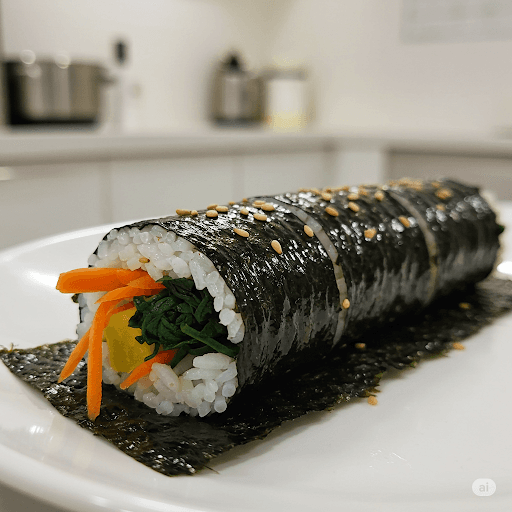
Country of Origin | Country of Origin | ||||||||
|---|---|---|---|---|---|---|---|---|---|
Main Ingredients | Various fillings Seaweed (gim) Rice (bap) | ||||||||
Preparation Method | Rolling the ingredients in seaweed and slicing into rolls | ||||||||
Serving Style | usually cold or at room temperature Sliced | ||||||||
Consumption Areas | Restaurants Street food Travels Picnics Home meals | ||||||||
Gimbap is one of the characteristic dishes of South Korean cuisine. In some regions, it is also called "Kimbap." At its core, it consists of steamed short-grain rice (bap) rolled together with various ingredients in a sheet of dried seaweed (gim). Gimbap holds a significant place in Korean society as both a homemade meal and a convenient dish commonly consumed outside the home.
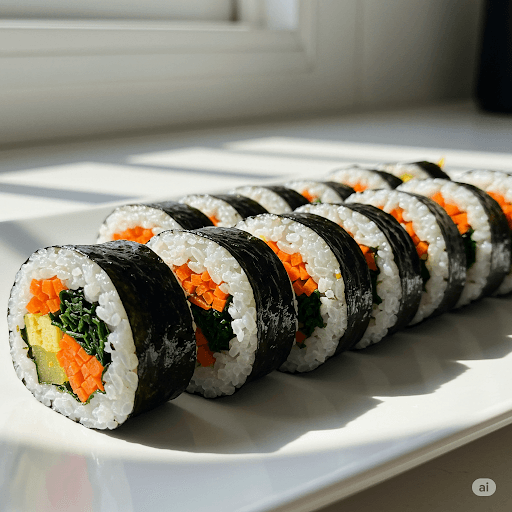
Gimbap. (Generated by Artificial Intelligence.)
There are differing views regarding the origin of gimbap. According to one perspective, gimbap emerged under the influence of Japanese cuisine during Japan’s occupation of Korea (1910–1945). During this period, the Japanese dish makizushi—rice rolls wrapped in seaweed—was introduced to Korean cuisine and was gradually adapted to suit Korean tastes. As part of this adaptation, Koreans replaced the vinegar-seasoned rice used in Japanese versions with rice flavored with sesame oil.
An alternative view suggests that gimbap is a traditional Korean dish that dates back to the Joseon Dynasty (1392–1897). Proponents of this view argue that Koreans have long consumed rice and side dishes wrapped in seaweed. This practice is documented in the 1819 work Yeoryang Sesigi by Kim Mae-sun, where it is referred to as bokssam.
Both perspectives offer different insights into the historical origins of gimbap. Regardless of its origin, gimbap is now widely regarded as an authentic and integral part of Korean cuisine.
The basic components of gimbap include steamed short-grain rice, dried seaweed (gim), and a variety of fillings. The rice is typically seasoned with sesame oil and salt to enhance its flavor. The fillings vary widely and can be customized according to personal preference. Commonly used ingredients include:
During preparation, a sheet of seaweed is placed on a bamboo mat. A layer of rice is spread evenly over the seaweed, and the chosen fillings are arranged in the center. The mat is then used to roll the contents tightly into a cylinder. The roll is cut into slices approximately 2 cm thick and served.
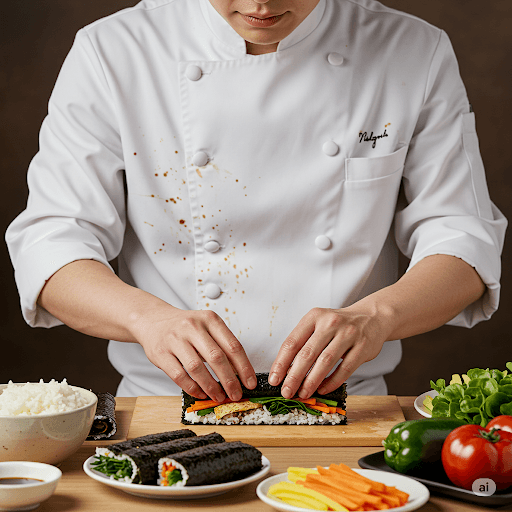
A chef preparing gimbap (AI-generated)
Gimbap holds a prominent place in Korean culture, being widely consumed both in everyday life and on special occasions. It is especially favored for its convenience during picnics, school field trips, and travel. Additionally, it is a popular choice among Korean street foods.
There are several variations of gimbap. One notable example is Chungmu-gimbap, which consists solely of rice wrapped in seaweed and is served with spicy octopus salad and pickled radish on the side. This particular variation is especially associated with the Tongyeong region.
Over time, gimbap has transcended Korea’s borders and gained recognition internationally. As a representative dish of Korean cuisine, it is now available in Korean restaurants around the world and even pre-packaged in some international supermarkets.
Chung, Hye-Jeong, and Young-Sook Lee. “The Effects on the Quality of Gimbap by Different Types Cultivars of Rice.” Korean Journal of Food and Cookery Science 30, no. 3 (2014): 271–277. https://www.koreascience.or.kr/article/JAKO201420249946377.page Accessed : 13 May 2025.
Kwon, Dae Young. Soon-Hee, Kim. Chung, Kyung Rhan. W. Daily, James. & Park, Sunmin. “Science and Philosophy of Korea Traditional Foods (K-Food).” Journal of Ethnic Foods 10, no. 1 (2023): 1–12. https://journalofethnicfoods.biomedcentral.com/articles/10.1186/s42779-023-00194-3 Accessed : 13 May 2025.

Country of Origin | Country of Origin | ||||||||
|---|---|---|---|---|---|---|---|---|---|
Main Ingredients | Various fillings Seaweed (gim) Rice (bap) | ||||||||
Preparation Method | Rolling the ingredients in seaweed and slicing into rolls | ||||||||
Serving Style | usually cold or at room temperature Sliced | ||||||||
Consumption Areas | Restaurants Street food Travels Picnics Home meals | ||||||||
Historical Background and Debates on Origin
Preparation and Ingredient Diversity
Cultural Significance and Modes of Consumption
This article was created with the support of artificial intelligence.