


This article was automatically translated from the original Turkish version.
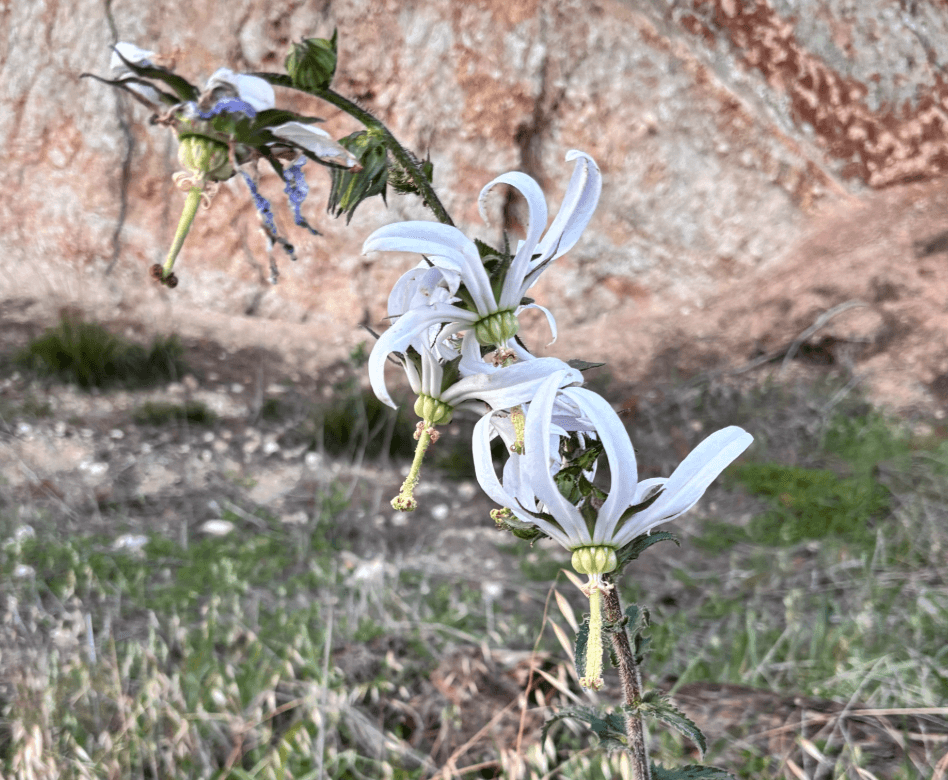
Michauxia campanuloides (Goat's Bell)
Distribution Area | It is distributed along the eastern edge of the Eastern Mediterranean. It occurs naturally in southern Türkiye, Syria, Lebanon and Israel. | ||||||||
|---|---|---|---|---|---|---|---|---|---|
Habitat and Climate | It inhabits stony slopes, dry open areas and semi-steppe habitats. It adapts well to arid and hot climates with permeable and mineral-poor soils. | ||||||||
Flowering Period | It typically flowers between late May and mid-July. This period is triggered by rising temperatures and the melting of snow cover. | ||||||||
Family | Campanulaceae | ||||||||
Height(s) | It is usually between 50 and 200 cm tall. | ||||||||
Growth Form | Its thick and rigid stem rises upward, with basal rosettes of lobed leaves and narrower, sessile leaves higher up. | ||||||||
Michauxia campanuloides (Michauxia campanuloides L’Hérit. ex Aiton) is a biennial or short-lived perennial herb native to the Eastern Mediterranean region, particularly in southern Türkiye, Syria, Lebanon, and Israel. It thrives in rocky slopes and dry open habitats. This species is distinguished by its deeply lobed flowers, which range from white to purplish tones, and its strongly reflexed corolla lobes, making it one of the most conspicuous members of the Campanulaceae (bellflower) family.
Traditionally used for nutritional and medicinal purposes, this plant is regarded as a model species in pharmacognostic research and phytochemical studies aimed at developing antioxidants and anticancer agents, due to its sensitivity to oxidative stress, cytotoxicity, and its rich phenolic compound content.

Michauxia campanuloides (Keçi Biciği) Plant (Gaye Durmuş, 1 June 2025)
Michauxia campanuloides typically grows between 50 and 200 cm in height. Its thick, rigid stem rises upright, bearing pinnate leaves forming a basal rosette, while upper leaves are narrower and sessile. The flowers are large, adorned with white to purplish hues, deeply lobed, and characterized by strongly reflexed corolla lobes. This showy floral structure enhances pollinator attraction and provides a morphological advantage for reproductive success under windy and dry habitat conditions.
The root system is taproot-forming, enabling deep penetration into rocky, hard substrates, thereby securing physical anchorage and improving water access. Seed dispersal occurs during the summer months following flowering and is directly linked to the timing of snowmelt. The flowering period generally spans from late May to July, varying with temperature and moisture conditions. This phenological adaptation plays a decisive role in synchronizing pollination events with brief periods of moisture availability.
Michauxia campanuloides is a highly adapted species to the arid and rocky habitats of the Eastern Mediterranean, distinguished by its tolerance mechanisms against environmental stressors. It is commonly found on rocky slopes, open areas with loose substrates, and semisteppe habitats, thriving in both natural and disturbed ecological environments. Particularly, it acts as an early colonizer on soils exposed by human disturbance or erosion, fulfilling a biological role as a filler of ecological gaps during habitat restoration processes.
Due to its sensitivity to soil properties—especially moisture content, ionic composition, and organic matter levels—M. campanuloides functions as an indicator species reflecting the physical and chemical conditions of its microhabitat. Its rich profile of anthocyanins and phenolic compounds helps mitigate oxidative damage under environmental stress while simultaneously conferring physiological advantages in competitive environments.
In areas where M. campanuloides establishes, its interactions with soil microorganisms—mediated through phenolic secretions and the rhizosphere microbiome—can influence mineral nutrient cycling. This contributes to increased soil biochemistry diversity and aids in maintaining moisture balance in habitats with low water retention capacity. The plant’s non-dense growth form does not inhibit surrounding plant diversity; thus, M. campanuloides is considered a species that facilitates habitat restructuring during early successional stages in Mediterranean transition zones.
Michauxia campanuloides is adapted to both abiotic and biotic pollination vectors through its floral morphology and phenology. Its showy, deeply lobed flowers, ranging from white to purplish tones, enhance pollinator attraction, while the upward orientation and wide aperture of the flowers support the activity of diurnal pollinators such as bees and butterflies. The observed secondary pollen presentation—where pollen is delivered not directly from the anthers but via another surface such as the style—represents a unique adaptation that optimizes pollination success.
From a reproductive biology perspective, M. campanuloides can reproduce both generatively (via seeds) and to a limited extent vegetatively. However, ecological conditions favor generative reproduction as the dominant strategy. The flowering period typically lasts from late May to mid-July and is directly correlated with rising temperatures and snowmelt in its region. This timing enhances synchronization with pollinator activity, increasing the likelihood of successful pollination.
Seeds tend to disperse over short distances via wind and gravity. In habitats with loose, rocky substrates, seeds readily adhere to microtopographic niches, a key factor enhancing germination potential. Additionally, seeds may be passively transported between microhabitats by spring meltwater or surface runoff, enabling the species to establish colonies even in arid and disturbed areas. These traits play a crucial role in maintaining both habitat continuity and intraspecific genetic diversity.

Michauxia campanuloides Plant (Gaye Durmuş, 1 June 2025)
The natural distribution areas of Michauxia campanuloides consist predominantly of permeable, rocky, and low-organic-matter soils with semi-arid characteristics. Although not a direct aquatic species, it indirectly influences surface water movement and subsurface soil moisture cycles within its ecosystems. Particularly, the high concentration of phenolics and flavonoids in its root zone can alter the composition of soil solutions through interactions with microbial communities. This process facilitates the microbial transformation of dissolved organic matter, thereby indirectly modulating the chemical profile of percolating water.
Moreover, due to its non-dense growth form and minimal soil shading, M. campanuloides can act as a physical barrier that directs surface water flow and helps preserve soil moisture retention capacity. This feature, especially on sloped and erosion-prone terrain, slows rapid water runoff and limits soil particle displacement. Consequently, the plant contributes indirectly to reduced sediment transport and mineral loss.
Although M. campanuloides is not a classical water filtration plant, its phenolic compounds—including chlorogenic acid, caffeic acid, and astragalin—can influence ion balance and organic residue transformation in soil solutions through microbial biochemical processes. In this regard, the plant may assume a limited but unique biogeochemical regulatory role in shaping water quality within its microhabitat.
Michauxia campanuloides functions as a native perennial species contributing to multiple ecosystem services within its Eastern Mediterranean distribution range. Particularly as an early colonizer in rocky, semisteppe, and disturbed habitats, it supports soil stabilization and assumes a biological pioneer role in slowing land erosion and initiating habitat restoration.
The plant’s high content of phenolics and flavonoids—especially astragalin, isoquercitrin, and chlorogenic acid—shapes its interactions with surrounding microorganisms and holds potential to enrich soil microbial diversity. This is particularly significant in low-organic-matter soils, where it supports the continuity of biogeochemical cycles and enhances microscale habitat complexity. Additionally, its phytochemical secretions may contribute to suppressing certain soil-borne pathogens.
The conspicuous floral structure and strong pollinator attraction make it an important resource for bees, butterflies, and other pollinators. Its short but intense flowering period provides a temporary yet critical source of pollen and nectar during specific seasons. This supports regional ecological balance by sustaining pollinator diversity and cyclic biological interactions.
Furthermore, the traditional use of M. campanuloides by some local communities for food and medicinal purposes demonstrates its contribution to cultural ecosystem services. Thus, the species holds value not only in terms of natural system sustainability but also within the context of human-nature interactions.
Dural, Hayri, and Mecit Vural. “Michauxia L’Hér. (Campanulaceae) Cinsinin Türkiye’deki Türleri Üzerinde Morfolojik, Anatomik ve Karyolojik Araştırmalar.” *Gazi University Journal of Science*, 2024. Accessed June 3, 2025. https://dergipark.org.tr/en/download/article-file/4928583.
Durmuş, Gaye. Michauxia campanuloides (Keçi Biciği) Flower, in Natural Habitat. My own photograph. Osmaniye, Türkiye, June 1, 2025.
Durmuş, Gaye. Michauxia campanuloides General View (Plant Form). My own photograph. Osmaniye, Türkiye, June 1, 2025.
Durmuş, Gaye. Michauxia campanuloides Leaf Structure (Close-up). My own photograph. Osmaniye, Türkiye, June 1, 2025.
Lack, Hans Walter. “The Discovery, Naming, and Typification of Michauxia campanuloides (Campanulaceae), with Notes on Its Distribution and Ecology.” Willdenowia 51, no. 2 (2021): 199–209. Accessed June 3, 2025. https://doi.org/10.3372/wi.51.51203

Michauxia campanuloides (Goat's Bell)
Distribution Area | It is distributed along the eastern edge of the Eastern Mediterranean. It occurs naturally in southern Türkiye, Syria, Lebanon and Israel. | ||||||||
|---|---|---|---|---|---|---|---|---|---|
Habitat and Climate | It inhabits stony slopes, dry open areas and semi-steppe habitats. It adapts well to arid and hot climates with permeable and mineral-poor soils. | ||||||||
Flowering Period | It typically flowers between late May and mid-July. This period is triggered by rising temperatures and the melting of snow cover. | ||||||||
Family | Campanulaceae | ||||||||
Height(s) | It is usually between 50 and 200 cm tall. | ||||||||
Growth Form | Its thick and rigid stem rises upward, with basal rosettes of lobed leaves and narrower, sessile leaves higher up. | ||||||||
No Discussion Added Yet
Start discussion for "Goat's Bells (Michauxia campanuloides)" article
Botanical Structure and Morphological Characteristics
Habitat Adaptation and Ecosystem Role
Pollination and Reproductive Mechanisms
Water Quality and Filtration Function
Ecosystem Services and Biodiversity Contribution