

This article was automatically translated from the original Turkish version.
+1 More
Taxonomy | Falco Peregrinus | ||||||||
|---|---|---|---|---|---|---|---|---|---|
Habitat | Rocky areas cities | ||||||||
Migration Status | Migrant | ||||||||
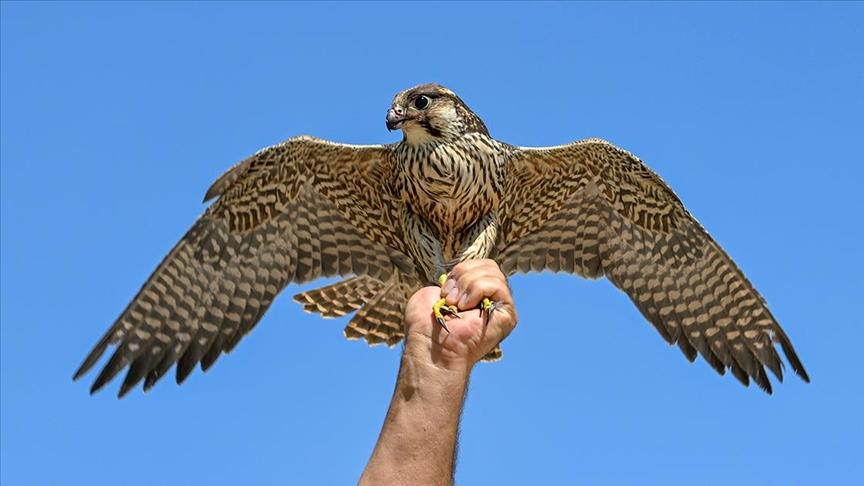
The Peregrine Falcon (Falco peregrinus) is a species distinguished by its speed among raptors, particularly renowned for the record-breaking velocity it achieves during vertical dives. These diurnal hunters occupy the top tier of predators in natural ecosystems and are notable for their advanced flight capabilities and robust anatomical structure.
Peregrine Falcons have a back covered in bluish-gray tones. The underparts are whitish or cream-colored and marked with dark streaks. These streaks are absent from the throat region. The top of the head is black, with a dark pattern surrounding the eyes. Females are on average 30 to 35 percent larger than males. Their talons are powerful and sharply pointed, and their beaks are hooked, adapted for tearing apart prey.
This species can thrive in a variety of ecosystems across many regions of the world. It inhabits natural environments such as rocky mountain slopes, semi-arid steppes, and forested areas, and is also frequently observed near human settlements. In urban areas where pigeons and similar bird species are abundant, it exhibits hunting behavior.
The primary food sources are typically smaller bird species, although in some cases it preys on larger birds. While flying, it surveys the landscape from high altitudes by circling widely. Once prey is detected, it folds its wings tightly against its body and initiates a steep, high-speed dive. During this dive, it can reach instantaneous speeds of up to 385 kilometers per hour—the highest recorded speed in the animal kingdom. Approximately one in five of these dives results in a successful capture. After wounding larger prey, it consumes the prey once it has fallen to the ground.
Peregrine Falcons are migratory birds that travel along migration routes spanning thousands of kilometers. The movements of individuals fitted with tracking devices are scientifically analyzed to evaluate habitat use and behavioral patterns. During migration, individuals that become weak or suffer health issues receive support through various rehabilitation programs. Those restored to optimal health through appropriate nutrition and care are released back into their natural habitats.
As a predator within the ecosystem, it plays a significant role in regulating bird populations. Its flight and hunting behaviors can directly influence the behavioral patterns of other bird species. It is distinguished by exceptional visual acuity, rapid response capability, and agility. It holds an important position in maintaining the balance of natural ecosystems.
Gözcelioğlu, Bülent. “Gökdoğan.” *Bilim ve Teknik*, Volume 47, no. 550, January 2014, pp. 50–51. Accessed July 14, 2025. https://e-dergi.tubitak.gov.tr/edergi/yazi.pdf?dergiKodu=4&cilt=47&sayi=830&sayfa=52&yaziid=35686.
Gözcelioğlu, Bülent. “Gökdoğan.” *Bilim ve Teknik*, no. 550, January 2014, pp. 50–51. https://ansiklopedi.tubitak.gov.tr/kutup/ansiklopedi/gokdogan.
Varol, Mesut. “İsrail’de verici takılan gökdoğan kuşu, Van’daki tedavisinin ardından doğaya salındı.” Anadolu Ajansı, Accessed July 14, 2025. https://www.aa.com.tr/tr/yasam/israilde-verici-takilan-gokdogan-kusu-vandaki-tedavisinin-ardindan-dogaya-salindi/2984866

Taxonomy | Falco Peregrinus | ||||||||
|---|---|---|---|---|---|---|---|---|---|
Habitat | Rocky areas cities | ||||||||
Migration Status | Migrant | ||||||||
Morphological Characteristics
Habitat and Distribution
Diet and Hunting Behavior
Migration and Tracking Examples
Ecological Role and Behavioral Traits