


This article was automatically translated from the original Turkish version.
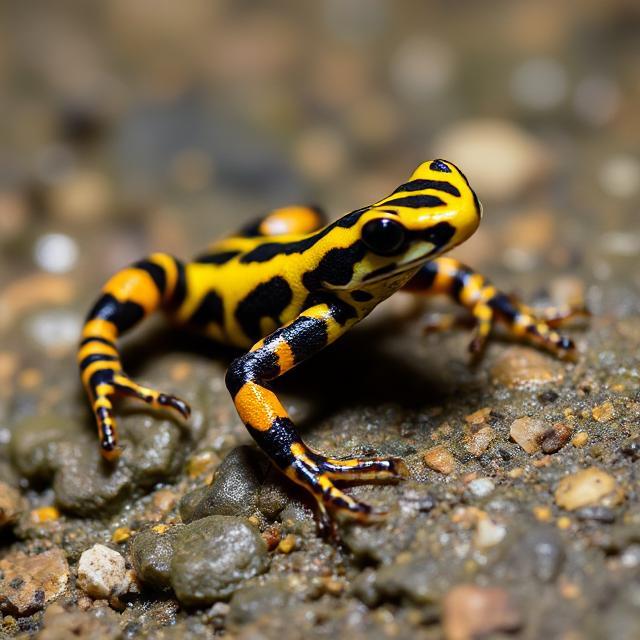
Golden Frog
Type(s) | Atelopus zeteki | ||||||||
|---|---|---|---|---|---|---|---|---|---|
Local Name | Panamanian golden frog | ||||||||
Conservation Status | Critically Endangered (IUCN) | ||||||||
Threats | Habitat loss, diseases | ||||||||
Habitat | Mountainous regions of Panama | ||||||||
Atelopus zeteki, commonly known as the "Golden Frog", is a frog species native to Central America. It inhabits the high-altitude tropical forests of Panama. This frog is distinguished by its bright yellow and orange coloration, which typically serves as a warning signal to potential predators. Atelopus zeteki generally reaches a length of 5 to 7 cm and is physically striking. However, the species’ beauty and vivid colors have also rendered it vulnerable to predators.
This species was once widespread, particularly during the 1980s, but experienced rapid population declines in the 1990s due to habitat loss, wildlife trade, and disease. The IUCN classifies Atelopus zeteki as "Critically Endangered". Global research has identified habitat destruction and infection by the fungus chytridiomycota as the primary causes of its sharp decline.
Atelopus zeteki is found in the high-altitude tropical forests of western Panama, particularly at elevations between 1000 and 2000 meters. These forests provide ideal living conditions with their moist, shaded environments. However, in recent years, deforestation has begun to threaten the frog’s habitat. Its high requirements for temperature and humidity restrict it to very specific environments. As a result, habitat loss has had a devastating impact on Atelopus zeteki populations.

Golden Frog (Generated by Artificial Intelligence)
Atelopus zeteki is a carnivorous species that primarily feeds on insects. Adults prey on worms, insects, and other small invertebrates. They are typically most active in the early morning and become more sedentary during the day. They are frequently observed in microhabitats within their environment, especially among leaf litter and near water edges.
This species is protected by toxic compounds secreted through its skin. Its bright coloration acts as an aposematic signal, warning potential predators of its toxicity. Additionally, because it lives near water, Atelopus zeteki depends on clean, still water for survival.
Atelopus zeteki is a critically endangered species with rapidly declining populations. Major factors contributing to this decline include habitat loss, deforestation, and climate change. However, one of the greatest threats is infection by the fungus chytridiomycota (Batrachochytrium dendrobatidis). This fungus has caused mass die-offs of amphibians worldwide and has severely impacted Atelopus zeteki. The fungus disrupts the frogs’ skin respiration, leading to death.
Conservation efforts aim to protect the species’ natural habitats. Some programs seek to breed the species in controlled environments to support wild populations. In addition, breeding initiatives in zoos and the preservation of isolated populations are helping to improve the chances of survival for Atelopus zeteki. Local protected areas have been established in Panama, and various monitoring projects are currently underway to track the species.
Efforts to conserve the Golden Frog have achieved only limited success so far. However, new conservation strategies and increased scientific research may enable the species to recover and reproduce successfully. Ensuring protection from disease and the restoration of viable populations in natural habitats require not only regional but also global conservation action. The Panamanian government and various international environmental organizations are actively involved in these efforts.
AmphibiaWeb. "Atelopus zeteki." AmphibiaWeb. Accessed May 5, 2025. https://amphibiaweb.org/cgi/amphib_query?account=mol&where-genus=Atelopus&where-species=zeteki.
The Revelator. “Species Spotlight: Will the Panamanian Golden Frog Survive?” The Revelator. Accessed May 5, 2025. https://therevelator.org/panamanian-golden-frog/.

Golden Frog
Type(s) | Atelopus zeteki | ||||||||
|---|---|---|---|---|---|---|---|---|---|
Local Name | Panamanian golden frog | ||||||||
Conservation Status | Critically Endangered (IUCN) | ||||||||
Threats | Habitat loss, diseases | ||||||||
Habitat | Mountainous regions of Panama | ||||||||
No Discussion Added Yet
Start discussion for "Golden Frog (Atelopus zeteki)" article
Habitat and Distribution
Diet and Behavior
Threats and Conservation Efforts
Conservation Status and Outcomes