
This article was automatically translated from the original Turkish version.
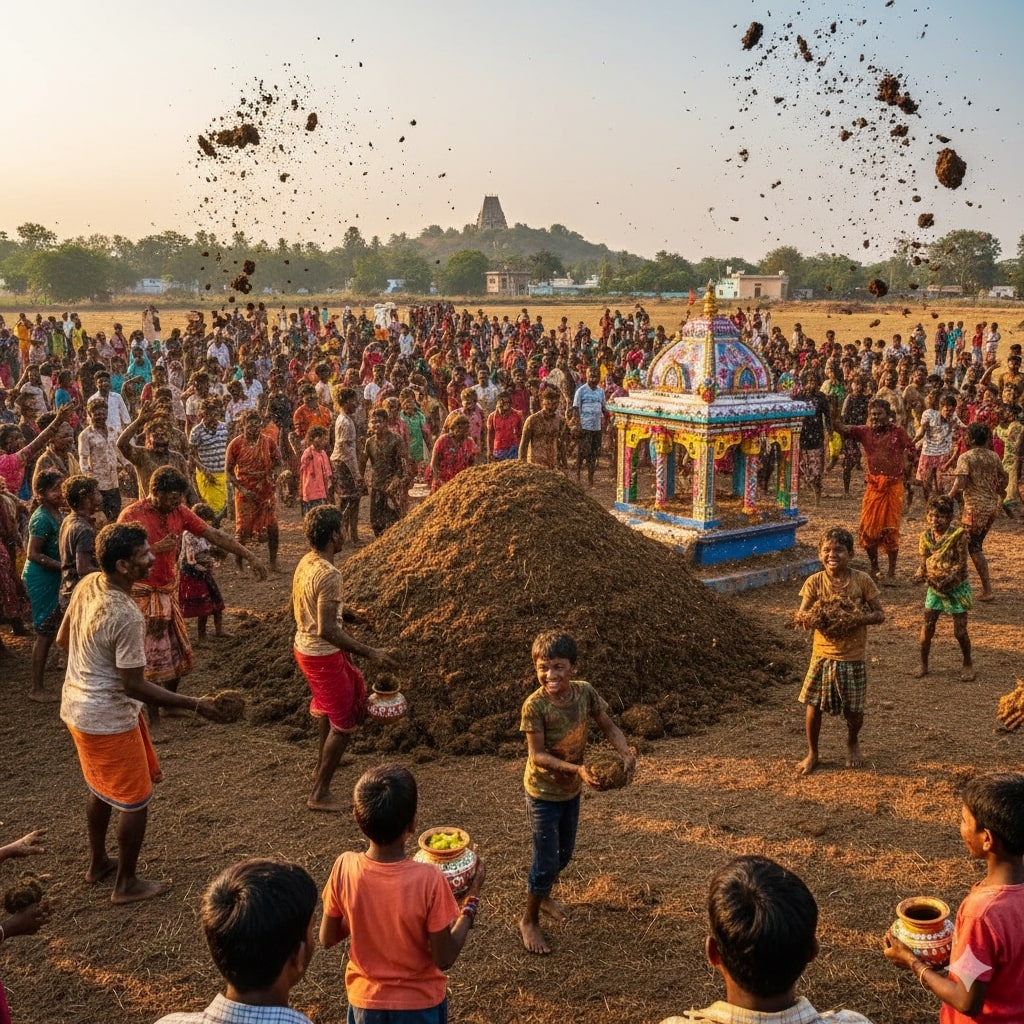
Gorehabba (Yapay Zeka ile Oluşturulmuştur.)
Gorehabba is a local festival and religious ceremony held in Gummatapura, a small village located on the border between the Indian states of Karnataka and Tamil Nadu. This festival marks the end of Diwali, one of India’s major Hindu festivals. Gorehabba is observed one day after Balipadyami, the fifth day of Diwali, which is believed to be the day when King Mahabali visits the earth.
The origins of the festival date back hundreds of years. According to tradition, the day after Balipadyami, a man named Devaragudda, who worked as a servant in the household of Kalegowda from the north, died. Upon his death, his bag and staff were thrown into a garbage pit. A few days later, a Linga was discovered in the same pit. When an ox cart passed over the Linga, it began to bleed. Subsequently, Lord Shiva appeared in a dream to the village chief and instructed him to build a temple at that very location. Since then, the day following Balipadyami has been celebrated as Gorehabba.
The central activity of the festival is a game in which participants throw cow dung at each other. This practice is often compared to Spain’s La Tomatina festival, except that instead of tomatoes, pieces of cow dung the size of tennis balls are used.
In Hinduism, cow dung is regarded as sacred and purifying, and holds great reverence. One of the longstanding beliefs behind this centuries-old tradition is that participating in the cow dung game can cure various illnesses.
About Gorehabba (India Today)
Before the main game involving cow dung, several rituals are performed. On the morning of the ceremony, men, women, and children from all parts of the village collect cow dung and pile it in an area behind the Beerappa temple. The collected dung is transported to the temple by tractors and consecrated by a Hindu priest. Afterwards, children go around the village collecting ghee and oil for the puja to be held at the temple. Once all necessary materials are gathered, a prayer ceremony is conducted at the Karappa temple.
After the puja, as the villagers return in procession, one person is designated as the Chadikora (hidden man). This individual is adorned with a beard and mustache made of grass and mounted on a donkey, then taken to the temple. Upon arrival, the Chadikora’s beard and mustache are cut off and buried in the pit where the pile of cow dung has accumulated. A prayer is then offered to the pile of dung. As soon as the prayer ends, the priest throws a handful of cow dung into the crowd, signaling the start of the game. Everyone in the village rushes into the pit and is completely covered in cow dung. After the game, a statue of the Chadikora is made and taken to the nearby Kondigekara Gudda to be burned. A chicken is also burned alongside the effigy. The villagers then cleanse themselves in a nearby lake, return to the village, and mock the Chadikora.
Gorehabba (Yapay Zeka ile Oluşturulmuştur.)
History of the Festival
Customs and Beliefs
Rituals