

This article was automatically translated from the original Turkish version.
Göreme Açık Hava Müzesi is a rock-cut settlement located 2 kilometres east of the town of Göreme in the province of Nevşehir, which served as a major center for monastic life from the 4th to the 13th century AD. 【1】 Carved into volcanic rock, this complex was a significant religious center where early Christian monks and hermits withdrew for contemplation and built monasteries, churches, and chapels. The region has been listed on the UNESCO World Heritage List since 6 December 1985 under both natural and cultural heritage status.
Cappadocia holds strategic and theological importance in the history of Christianity. Due to persecution and religious prohibitions during the Roman period, Christian communities began settling in the hidden valleys of the region from 67 AD onwards, finding refuge to practice their faith.【2】 Following Emperor Constantine I’s acceptance of Christianity in the 3rd century, the number of churches in the region rapidly increased and architectural development accelerated.
Göreme Open Air Museum was a center where the foundations of the monastic education system were laid in the 4th century under the leadership of important religious figures such as Saint Basil. Although settlement and monastic life in the region began in this early period, the majority of the churches visible to visitors today date from the Middle Byzantine period (11th century), known as the “Golden Age” of Byzantine art.【3】
Except for the Tokalı Kilise, which dates to the 10th century, the main churches including Elmalı, Karanlık, and Çarıklı were constructed during this period using the characteristic “Closed Greek Cross” floor plan. Thus, the museum represents the highest architectural and artistic achievement reached by the monastic tradition that began in the 4th century, centuries later.
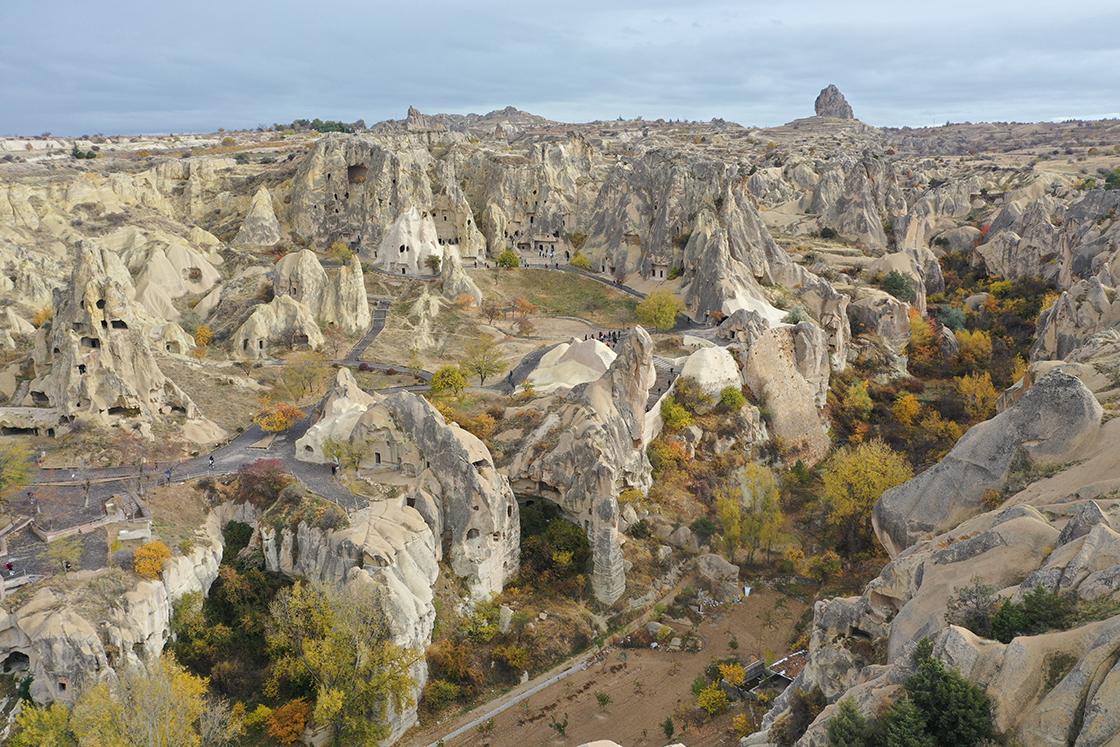
Aerial Photograph of Göreme Open Air Museum (Anadolu Ajansı)
The religious structures within the museum boundaries contain important examples of Byzantine art and Christian iconography. Two distinct painting techniques were primarily used in the interior decorations of the churches. In the first technique, the rock surface was smoothed and painted directly onto the stone. In the second, the surfaces were decorated using secco (tempera) and fresco techniques.
The wall paintings (frescoes) depict scenes primarily drawn from the Old and New Testaments and the life of Jesus Christ. These include depictions of the “Nativity,” “Baptism,” “Entry into Jerusalem,” “Journey to Bethany,” “Adoration of the Magi,” “Raising of Lazarus,” “Last Supper,” “Crucifixion,” and “Abraham’s Hospitality.” The majority of the frescoes date from the 10th to the 12th century and have preserved their originality to the present day.【4】
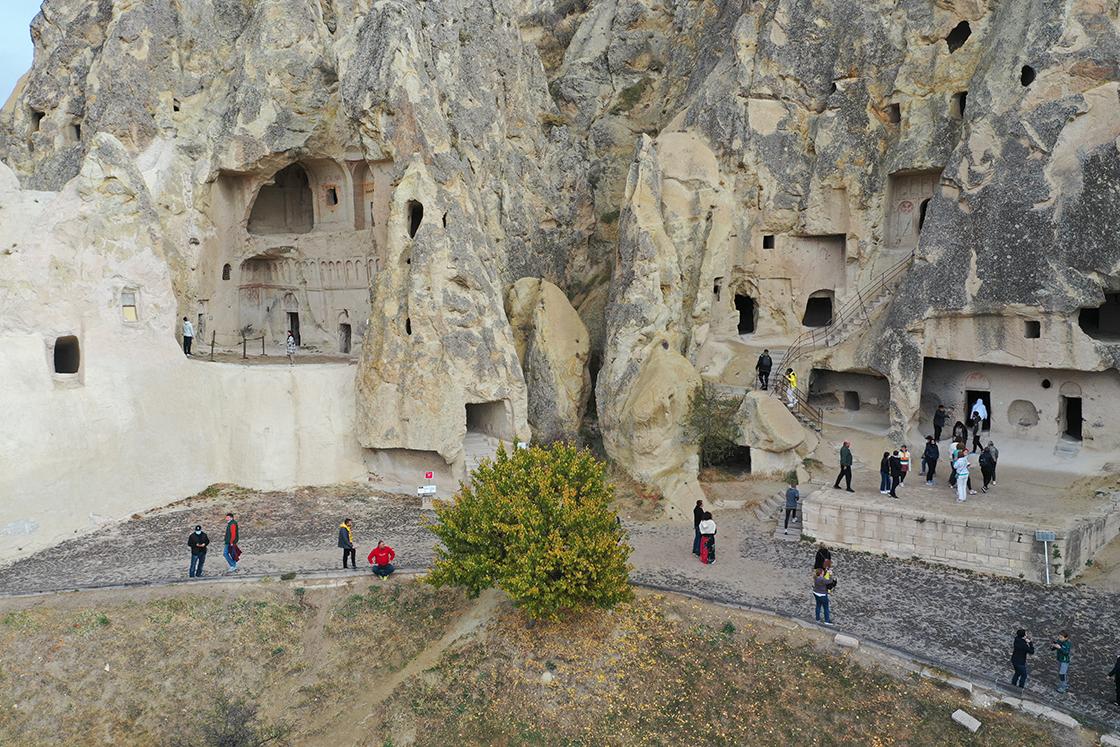
Göreme (Anadolu Ajansı)
A total of 17 chapels and churches have been identified within the Göreme Open Air Museum. The complex includes the Nuns’ and Men’s Monasteries, Saint Basil Church, Elmalı Church, Saint Barbara Church, Snake Church, Knights of Malta Church, Saint Catherine Church, Dark Church, Sandaled Church, and Tokalı Kilise.
The largest structure in the Göreme Open Air Museum, Tokalı Kilise dates to the 10th century and is the oldest known rock-cut church in the region. Unlike the domed churches with the “Closed Greek Cross” plan that became common in the 11th century, it features a rectangular plan with a barrel-vaulted ceiling. The building is a complex ensemble composed of spaces carved in different periods: the “Old Church” and the later-added “New Church.”
In the New Church section, frescoes depicting the chronological life of Jesus Christ make extensive use of lapis lazuli blue. The wall paintings provide detailed representations of the events from Christ’s birth to his crucifixion.
One of the best-preserved structures in the museum, the Dark Church was opened to tourism in later periods and underwent comprehensive cleaning and restoration. Its 11th-century frescoes have retained their original vibrancy due to minimal damage from external factors.
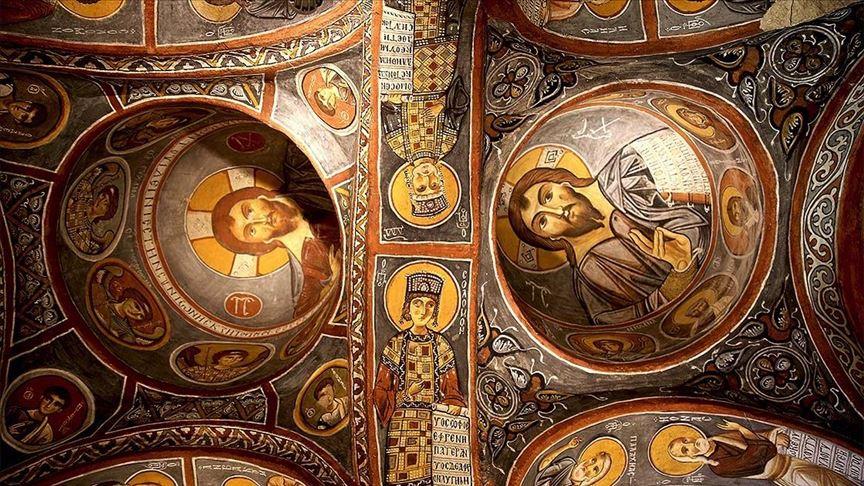
Frescoes of the Dark Church (Anadolu Ajansı)
Elmalı Church is a significant example of 11th-century architecture, featuring a nine-domed structure and a four-column Closed Greek Cross plan. Its decorative program highlights scenes from the life of Christ. The central dome contains a depiction of Christ Pantokrator (Christ Almighty). On the dome arches are figures of prophets holding scrolls inscribed with prayers; on the pendentives are scenes depicting the Evangelists and Abraham’s Hospitality.
Saint Barbara Church has a simpler design characterized by geometric patterns on its interior walls. Frescoes depicting Christian saints and biblical narratives adorn its surfaces. The Snake Church, named after the serpent motif on its walls, contains depictions of Saint George battling serpents and Saint Onuphrius. In Christian theology, the serpent in these scenes symbolizes evil.
Alkan, Behçet. "Göreme Açık Hava Müzesi kayadan oyma kiliseleri ve duvar resimleriyle turistleri çekiyor." *Anadolu Ajansı*, May 20, 2024. Accessed January 20, 2026.https://www.aa.com.tr/tr/kultur/goreme-acik-hava-muzesi-kayadan-oyma-kiliseleri-ve-duvar-resimleriyle-turistleri-cekiyor/3224588
Alkan, Behçet. "Göreme Açık Hava Müzesi'ndeki kilise ve şapeller ziyaretçilerini tarihi yolculuğa çıkarıyor." *Anadolu Ajansı*, November 6, 2021. Accessed January 20, 2026.https://www.aa.com.tr/tr/kultur-sanat/goreme-acik-hava-muzesindeki-kilise-ve-sapeller-ziyaretcilerini-tarihi-yolculuga-cikariyor/2413549
Alkan, Behçet. "Karanlık Kilise'nin freskleri ile bin yıl öncesine yolculuk." Anadolu Ajansı, August 3, 2020.https://www.aa.com.tr/tr/kultur-sanat/karanlik-kilisenin-freskleri-ile-bin-yil-oncesine-yolculuk/1930006.
KTO Karatay University Karsem Continuing Education Center Economic Enterprise. "Göreme Açık Air Museum: The Historical Monasteries of Cappadocia." Accessed January 20, 2026.https://karsem.karatay.edu.tr/goreme-acik-hava-muzesi-kapadokyanin-tarihi-manastirlari?srsltid=AfmBOopitU9Wk0NRgS9sQG6IWG0rQQlpvgGNa26wgzOBeJ_9H7zEf-Z1.
T.C. Ministry of Culture and Tourism. "Göreme Açık Museum-Nevşehir." Türkiye Kültür Portalı. Accessed January 20, 2026.https://www.kulturportali.gov.tr/turkiye/nevsehir/gezilecekyer/goreme-acik-hava-muzes
Özaydın Sipahi, Ayşe, and Firdevs Kulak Torun. "Göreme Açık Hava Müzesi’nde Yer Alan Bizans Kiliseleri." YDÜ Mimarlık Fakültesi Dergisi 5, no. 2 (2023): 21–41. Accessed January 20, 2025.https://dergipark.org.tr/tr/download/article-file/3348579
[1]
T.C. Kültür ve Turizm Bakanlığı, “Göreme Açık Hava Müzesi-Nevşehir,” Türkiye Kültür Portalı, erişim tarihi 20 Ocak 2026, https://www.kulturportali.gov.tr/turkiye/nevsehir/gezilecekyer/goreme-acik-hava-muzes
[2]
Behçet Alkan, “Göreme Açık Hava Müzesi'ndeki Kilise ve Şapeller Ziyaretçilerini Tarihi Yolculuğa Çıkarıyor,” Anadolu Ajansı, 6 Kasım 2021, erişim 20 Ocak 2026, https://www.aa.com.tr/tr/kultur-sanat/goreme-acik-hava-muzesindeki-kilise-ve-sapeller-ziyaretcilerini-tarihi-yolculuga-cikariyor/2413549.
[3]
Ayşe Özaydın Sipahi ve Firdevs Kulak Torun, “Göreme Açık Hava Müzesi’nde Yer Alan Bizans Kiliseleri,” YDÜ Mimarlık Fakültesi Dergisi 5, sy. 2 (2023): 21–41, erişim 20 Ocak 2026, https://dergipark.org.tr/tr/download/article-file/3348579.
[4]
Behçet Alkan, “Göreme Açık Hava Müzesi Kayadan Oyma Kiliseleri ve Duvar Resimleriyle Turistleri Çekiyor,” Anadolu Ajansı, 20 Mayıs 2024, erişim 20 Ocak 2026, https://www.aa.com.tr/tr/kultur/goreme-acik-hava-muzesi-kayadan-oyma-kiliseleri-ve-duvar-resimleriyle-turistleri-cekiyor/3224588.
Historical Development and Monastic System
Architectural Structure and Artistic Features
Major Structures Within the Museum
Tokalı Kilise
Dark Church
Elmalı Church
Saint Barbara and Snake Church