


This article was automatically translated from the original Turkish version.
Pull Model in International Economics
Original Name(s) | Gravity Model | ||||||||
|---|---|---|---|---|---|---|---|---|---|
Type(s) | International Trade Theory | ||||||||
Theorists | Anderson & van Wincoop (2003) James E. Anderson (1979) | ||||||||
First Practitioner | Jan Tinbergen (1962) | ||||||||
Basic Concept | Trade flows Geographic distance Economic size (GDP) | ||||||||
Theoretical Foundation | Newton's Law of Universal Gravitation | ||||||||
Application Area(s) | Trade predictions Foreign direct investment and migration modeling Regional integration analyses Free trade agreement effects | ||||||||
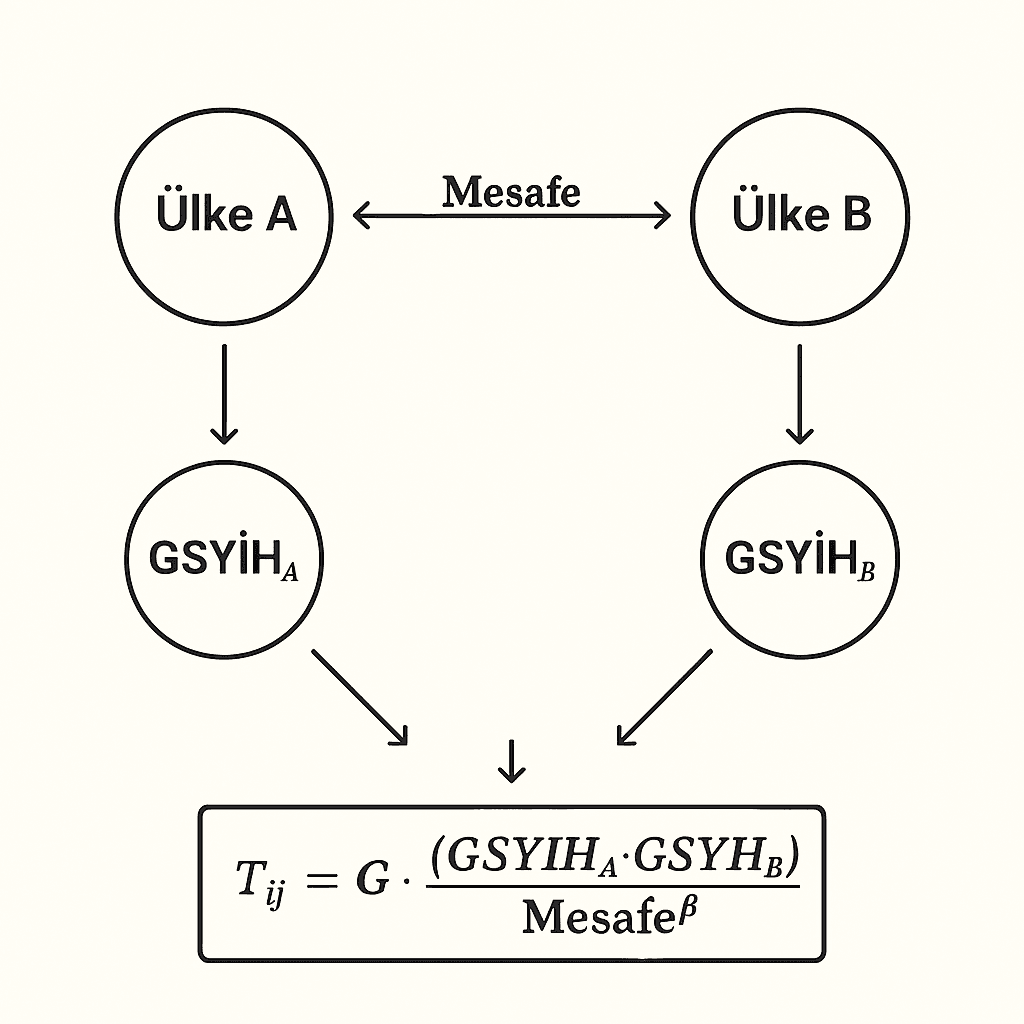
The Gravity Model is an empirically based approach developed to explain the volume of international trade trade. The model assumes that the magnitude of trade between two country countries is directly proportional to their economic sizes—typically measured by GDP—and inversely proportional to the geographic distance between them. Formulated with inspiration from Newton’s universal shooting law of gravitation, this model was initially developed as a statistical relationship and later strengthened by theoretical contributions grounded in microeconomic foundations and general balance equilibrium analysis.
Today, the Gravity Model is not only used to explain the direction and level of international only trade but also as a tool to analyze the effects of free trade agreements, trade barriers, and regional integration like processes. The basic formula of the model is as follows:
Anderson, James E. "A Theoretical Foundation for the Gravity Equation." The American Economic Review 69, no. 1 (1979): 106–116.
Anderson, James E., and Eric van Wincoop. "Gravity with Gravitas: A Solution to the Border Puzzle." The American Economic Review 93, no. 1 (2003): 170–192.
Bergstrand, Jeffrey H. "The Gravity Equation in International Trade: Some Microeconomic Foundations and Empirical Evidence." The Review of Economics and Statistics 67, no. 3 (1985): 474–481.
Frankel, Jeffrey A. Regional Trading Blocs in the World Economic System. Washington, DC: Peterson Institute for International Economics, 1997.
SamaEl. "Ethiopia’s Ascent to Global Trade: Navigating the Path to WTO Membership." Medium. December 28, 2023. https://medium.com/@sayele_39399/ethiopias-ascent-to-global-trade-navigating-the-path-to-wto-membership-f0f3acf5008d.
Tinbergen, Jan. Shaping the World Economy: Suggestions for an International Economic Policy. New York: Twentieth Century Fund, 1962.

Pull Model in International Economics
Original Name(s) | Gravity Model | ||||||||
|---|---|---|---|---|---|---|---|---|---|
Type(s) | International Trade Theory | ||||||||
Theorists | Anderson & van Wincoop (2003) James E. Anderson (1979) | ||||||||
First Practitioner | Jan Tinbergen (1962) | ||||||||
Basic Concept | Trade flows Geographic distance Economic size (GDP) | ||||||||
Theoretical Foundation | Newton's Law of Universal Gravitation | ||||||||
Application Area(s) | Trade predictions Foreign direct investment and migration modeling Regional integration analyses Free trade agreement effects | ||||||||
No Discussion Added Yet
Start discussion for "Gravity Model in International Economics" article