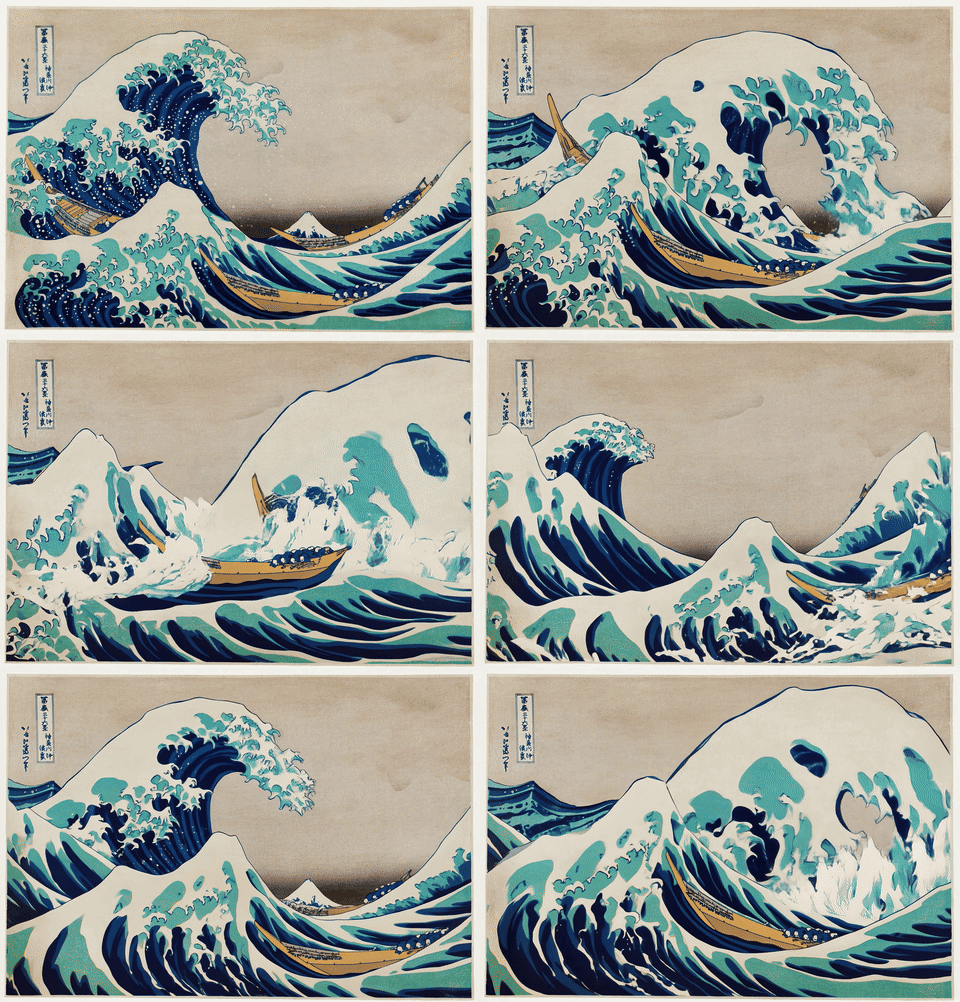


This article was automatically translated from the original Turkish version.
+2 More
Dimensions of the Work | 25.7 × 37.9 cm | ||||||||
|---|---|---|---|---|---|---|---|---|---|
Series to Which It Belongs | Thirty-six Views of Mount Fuji / Fugaku sanjūrokkei | ||||||||
Artistic Tradition | Ukiyo-e | ||||||||
Type of Work | Color woodblock print | ||||||||
Period to Which It Belongs | Edo Period | ||||||||
Date of Production | Approximately 1830–33 | ||||||||
Artist Who Created the Work | Katsushika Hokusai | ||||||||
Locations Where the Work Is Displayed | The Metropolitan Museum of Art The British Museum in London Library of Congress Art Institute of Chicago | ||||||||
The Great Wave off Kanagawa (Japanese: 神奈川沖浪裏; Kanagawa Oki Nami Ura, “Behind the Waves off Kanagawa”), widely known in English as The Great Wave, is a polychrome woodblock print created by the Japanese artist Katsushika Hokusai between 1830 and 1833. The work is part of his series Thirty-Six Views of Mount Fuji and was printed on paper using ink and color. The composition depicts a massive wave towering over three boats off the coast of Kanagawa, with Mount Fuji visible in the background.
Originally produced for commercial distribution and printed in large quantities, the print is among the best-known examples of Edo-period Ukiyo-e tradition. Over time, it became one of the most recognizable images of Japanese art and is internationally renowned for its preserved impressions in museum collections, its place in art historical literature, and its widespread use across various cultural domains.【1】
The original title is in Japanese: Kanagawa Oki Nami Ura (神奈川沖浪裏). In this title, “Kanagawa” refers to the coastal region depicted, “oki” means the open sea or offshore area, “nami” means wave, and “ura” indicates the back, behind, or rear. Consequently, translations into other languages vary in word choice, but all are understood to refer to the scene of waves off Kanagawa.【2】
In English, the work is commonly known as The Great Wave. However, this is not the original Japanese title. The Great Wave is a widely adopted name that emerged during its international circulation.【3】
The title appears within a rectangular cartouche in the upper left corner of the print, alongside the name of the series: Thirty-Six Views of Mount Fuji (Fugaku Sanjūrokkei). The artist’s signature is located nearby. As the work gained widespread recognition in later periods, The Great Wave became the most commonly used designation in museum catalogs, art historical publications, and popular culture, while the original title and other translations continued to be used as well.
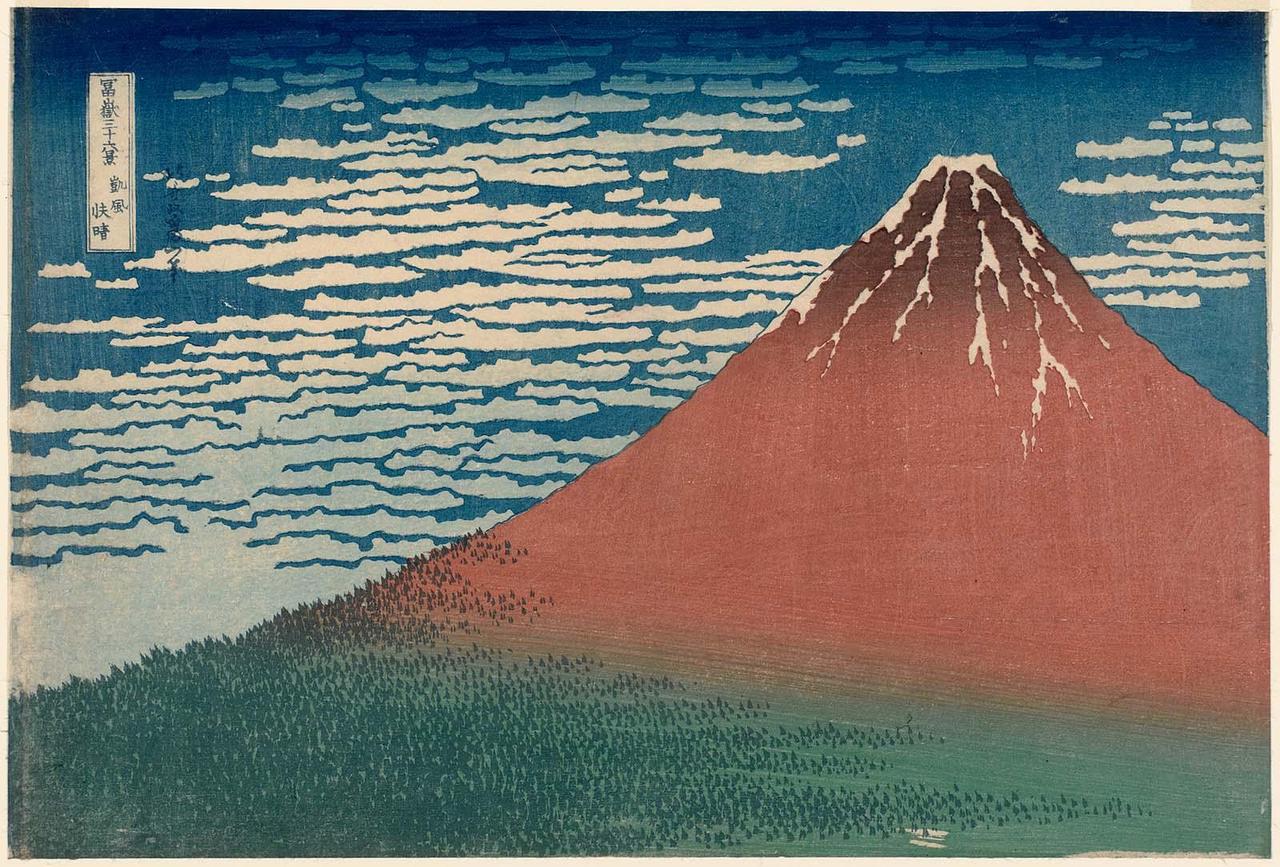
Thirty-six Views of Mount Fuji (Fugaku sanjūrokkei) (MFA)
The work was produced by the Japanese artist Katsushika Hokusai during the Edo period. Its creation is generally dated between 1830 and 1833, corresponding to the period during which Hokusai worked on his series Thirty-Six Views of Mount Fuji. The series was first introduced by the publisher Eijudo around the New Year of 1831.【4】 This provides one of the key pieces of evidence that the print entered circulation in the early 1830s. Following its initial publication and the series’ popularity, ten additional prints were added to the original set of thirty-six in subsequent years, expanding the series beyond its initial scope.【5】
The production of the print followed the standard division of labor in Edo-period Ukiyo-e publishing. The artist designed the composition, which was then transferred onto woodblocks by carvers, who prepared the printing plates, while printers applied ink and pressed the image onto paper. The publisher managed the entire production, distribution, and sales process. Thus, the work reflects not only Hokusai’s design but also a collaborative production model involving multiple skilled artisans.【6】
Hokusai was around seventy years old when he began working on this series. This phase of his life coincides with his increased focus on landscape subjects. In this context, Kanagawa Oki Nami Ura is regarded both as a product of Edo-period commercial print culture and as one of the most prominent examples of Hokusai’s late-period work.
Kanagawa Oki Nami Ura is a colored print on paper. The dimensions of the work are approximately 10 × 14 inches, or 25.7 × 37.9 cm. Variations in size among different impressions result from differences in trimming and margin widths.【7】
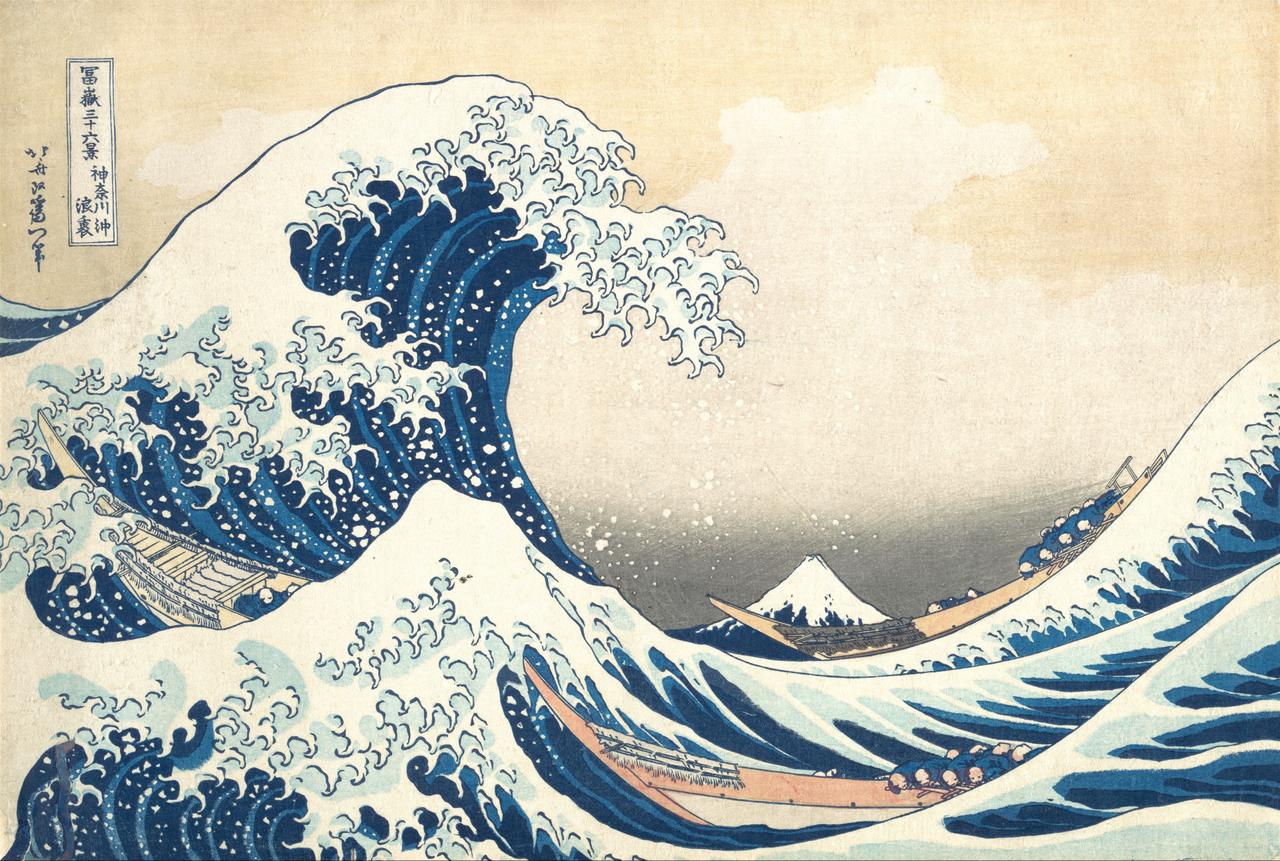
The Great Wave off Kanagawa (THE MET)
Separate woodblocks were used for each color in the printing process. The main outlines were first transferred to a primary block, followed by additional blocks for the sky, sea, boats, and other colored areas. Black outlines applied in the final stage created a linear structure that defined the forms and unified the composition. Thus, broad areas of color and fine details were harmoniously arranged on the same plane.
Blue tones play a decisive role in the technical structure of the work. Traditional indigo and Prussian blue were used together, enabling transitions between light, bright, and dark shades. Overlapping pigments in certain areas created denser surfaces, particularly achieving a strong sense of depth within the interior of the wave. The contrast between light areas and deep blue surfaces is one of the primary elements that enhance the sense of movement.【8】
Certain areas of the print were printed multiple times using the same block. This technique increased color intensity and produced slight embossed effects on the paper surface. The contrast between the white areas left unprinted, single-layered color fields, and densely printed dark zones enriched the visual texture of the work. Thus, the composition was enhanced not only by line and color but also by tactile qualities.
Technically, the work is the result of a detailed production process involving pigment application, tonal transitions, layered printing techniques, and a precise linear structure. The relationship between the distribution of colors and the rhythmic quality of the outlines constitutes one of the fundamental elements determining the work’s visual impact.【9】
In the foreground, a colossal wave dominates the composition, occupying most of the surface. It rises from the left, curves toward the center, and extends upward with sharp, foamy crests. Its curved body and upward-sweeping form constitute the most dominant element of the image. Beneath the main wave, a second, lower mass of water is visible, suggesting not a single wave but a sequence of oceanic motion.
Beneath the wave are three long fishing boats. Although aligned horizontally, their orientation is angled by the direction of the waves. Each boat contains figures rowing or leaning forward. These human figures are not rendered as detailed individual portraits but as collective groups integrated into the motion of the boats. The small scale of the human bodies, combined with the long, narrow form of the boats, concentrates the lower portion of the composition.
In the background, near the central axis, Mount Fuji is visible. Its snow-capped peak is clearly defined but rendered at a much smaller scale compared to the foreground wave. The open sky surrounding the mountain creates a contrast between the dynamic foreground and the static background. The mountain’s position within the composition frames it within the swirling lines of the wave.
Linear movement plays a prominent role in the composition. The curved lines of the wave are arranged in opposition to the horizontal lines of the boats. The contrast between the straight, rigid structure of the boats and the fragile, irregular lines of the water heightens the tension in the scene. The sharp, scattered forms of the foam create secondary zones of motion around the main wave.
In terms of surface organization, the composition is built on a balance between dense and empty areas. The dark, active forms cluster in the lower and left sections, while the upper portion is left open with a calm sky. The central void enclosed by the wave and the open space occupied by the mountain serve as key compositional devices that guide the viewer’s gaze through the image.
Kanagawa Oki Nami Ura’s circulation beyond Japan accelerated in the second half of the 19th century following Japan’s opening to foreign trade. Since 1640, Japan had maintained highly restricted relations with the outside world, engaging only in limited contact with China and the Netherlands. This isolation ended in the 1850s, and with the opening of trade, numerous Japanese visual artifacts reached Europe and America. During this period, Ukiyo-e prints became recognized in the West as representative examples of Japanese art. Their reproducible nature, portability, and suitability for the collecting market enabled them to spread rapidly across different countries. Kanagawa Oki Nami Ura became known to audiences outside Japan as part of this circulation.
One significant development that increased the work’s international visibility was its inclusion in the Japanese pavilion at the 1867 International Exhibition in Paris. This exhibition was among the first major platforms where Japanese culture encountered broad Western audiences and significantly strengthened interest in collecting Japanese art. Hokusai’s prints gained recognition among European art circles during this period.【10】
From the late 19th century onward, Kanagawa Oki Nami Ura ceased to be merely a collectible object and emerged as a recognized symbol of Japanese art. Different impressions were gradually acquired by museum collections, included in catalogs, and frequently reproduced in art historical publications. Thus, the work transcended its origins as a local print and entered the canon of internationally recognized images in art history.
Today, the work’s recognition extends far beyond its initial period of dissemination. Through museum exhibitions, academic publications, reprints, and digital circulation, Kanagawa Oki Nami Ura continues to exist as one of the most widely recognized Japanese artworks worldwide.
Kanagawa Oki Nami Ura became one of the most internationally recognized symbols of Japanese art from the late 19th century onward and has been associated with diverse artistic productions. With its arrival in Europe, it became one of the most prominent examples of the Japonisme movement, which reflected growing interest in Japanese printmaking. Particularly its shallow spatial construction, bold linear structure, emphasis on atmospheric conditions, and depiction of everyday life as visual subject matter attracted attention among Western art circles.
Claude Debussy La Mer (DW Classic Music)
It is known that the French composer Claude Debussy owned a print of the work and that his 1905 composition La Mer was inspired by it. The first edition of the musical score featured a detail from Kanagawa Oki Nami Ura on its cover. Thus, the work became a visual reference in the field of music.【11】
Vincent van Gogh’s interest in Japanese prints has led to interpretations linking him to Kanagawa Oki Nami Ura. His letters contain references to the depiction of waves, examples that illustrate the print’s visibility among European painters. Similarly, the sculptor Camille Claudel’s work The Wave and certain poems by the poet Rainer Maria Rilke have also been interpreted in relation to the print.【12】
In the 20th century and beyond, the work has been revisited by modern and contemporary artists. Figures such as Roy Lichtenstein, Andy Warhol, Loïs Mailou Jones, and Yoshitomo Nara are among those who have referenced the print in their work. These examples demonstrate that the image persists not merely as a historical print but as a visual source continually reinterpreted by subsequent generations.【13】
The influence of the work has not been confined to fine arts. It has generated numerous adaptations, references, and reuses in literature, design, publishing, and popular visual culture. In this sense, Kanagawa Oki Nami Ura has become a cultural reference whose meaning is continuously regenerated across different eras and media.
DW Classic Music. "Debussy: La mer | Bernard Haitink and the Royal Concertgebouw Orchestra." YouTube, 27:23. Accessed April 17, 2026. https://www.youtube.com/watch?v=fe1pB9KqHRg&list=RDfe1pB9KqHRg&start_radio=1
Harris, Leila Anne. "Katsushika Hokusai, Under the Wave off Kanagawa (The Great Wave)." Smarthistory. Accessed April 17, 2026. https://smarthistory.org/hokusai-under-the-wave-off-kanagawa-the-great-wave/
Leona, Marco. "The Great Wave: Anatomy of an Icon." Met Museum. Accessed April 17, 2026. https://www.metmuseum.org/essays/hokusai-great-wave
Museum of Fine Arts Boston. "Fine Wind, Clear Weather (Gaifū kaisei), also known as Red Fuji, from the series Thirty-six Views of Mount Fuji (Fugaku sanjūrokkei)." collections.mfa.org. Accessed April 17, 2026. https://collections.mfa.org/objects/234419/fine-wind-clear-weather-gaifu-kaisei-also-known-as-red-f?ctx=b1d6ccdf-77e9-47d5-a9ef-e23a5a21828b&idx=16
Rawpixel. "Detail from Katsushika Hokusai's The Great Wave off Kanagawa, famous vintage woodblock print for wall art and poster, brought to life with our creative video remix." Accessed April 17, 2026. https://www.rawpixel.com/video/18630577/video-background-ocean-sea
The Art Institute of Chicago. "10 Things to Know about The Great Wave." artic.edu. Accessed April 17, 2026. https://www.artic.edu/articles/1139/10-things-to-know-about-the-great-wave
The Metropolitan Museum of Art. "Under the Wave off Kanagawa (Kanagawa oki nami ura), also known as The Great Wave, from the series Thirty-six Views of Mount Fuji (Fugaku sanjūrokkei)." *metmuseum.org.* Accessed April 17, 2026. https://www.metmuseum.org/art/collection/search/45434
[1]
Leila Anne Harris, ''Katsushika Hokusai, Under the Wave off Kanagawa (The Great Wave),'' Smarthistory, Accessed: 17 April 2026, https://smarthistory.org/hokusai-under-the-wave-off-kanagawa-the-great-wave/
[2]
The Art Institute of Chicago, ''10 Things to Know about The Great Wave,'' artic.edu, Accessed: 17 April 2026, https://www.artic.edu/articles/1139/10-things-to-know-about-the-great-wave
[3]
The Art Institute of Chicago, ''10 Things to Know about The Great Wave.''
[4]
Leila Anne Harris, ''Katsushika Hokusai, Under the Wave off Kanagawa (The Great Wave).''
[5]
The Art Institute of Chicago, ''10 Things to Know about The Great Wave.''
[6]
The Art Institute of Chicago, ''10 Things to Know about The Great Wave.''
[7]
Leila Anne Harris, ''Katsushika Hokusai, Under the Wave off Kanagawa (The Great Wave).''
[8]
Marco Leona, ''The Great Wave: Anatomy of an Icon,'' Met Museum, Accessed: 17 April 2026, https://www.metmuseum.org/essays/hokusai-great-wave
[9]
Leila Anne Harris, ''Katsushika Hokusai, Under the Wave off Kanagawa (The Great Wave).''
[10]
Leila Anne Harris, ''Katsushika Hokusai, Under the Wave off Kanagawa (The Great Wave).''
[11]
Leila Anne Harris, ''Katsushika Hokusai, Under the Wave off Kanagawa (The Great Wave).''
[12]
Leila Anne Harris, ''Katsushika Hokusai, Under the Wave off Kanagawa (The Great Wave).''
[13]
Leila Anne Harris, ''Katsushika Hokusai, Under the Wave off Kanagawa (The Great Wave).''


Dimensions of the Work | 25.7 × 37.9 cm | ||||||||
|---|---|---|---|---|---|---|---|---|---|
Series to Which It Belongs | Thirty-six Views of Mount Fuji / Fugaku sanjūrokkei | ||||||||
Artistic Tradition | Ukiyo-e | ||||||||
Type of Work | Color woodblock print | ||||||||
Period to Which It Belongs | Edo Period | ||||||||
Date of Production | Approximately 1830–33 | ||||||||
Artist Who Created the Work | Katsushika Hokusai | ||||||||
Locations Where the Work Is Displayed | The Metropolitan Museum of Art The British Museum in London Library of Congress Art Institute of Chicago | ||||||||
No Discussion Added Yet
Start discussion for "Great Wave off Kanagawa (Painting)" article
Title of the Work
Production and Dating
Technique and Characteristics
Composition and Depicted Elements
International Dissemination
Influence on Art and Culture