

This article was automatically translated from the original Turkish version.
+1 More
Family | Ardeidae | ||||||||
|---|---|---|---|---|---|---|---|---|---|
Conservation Status | LC - Least Concern (IUCN) | ||||||||
Incubation Period | 23-28 days | ||||||||
Wingspan | 155-175 cm | ||||||||
Subfamily | 84-102 cm | ||||||||
Class | Aves | ||||||||
Realm | Animalia | ||||||||
Genus | Ardea cinerea | ||||||||
Order | Chordata | ||||||||
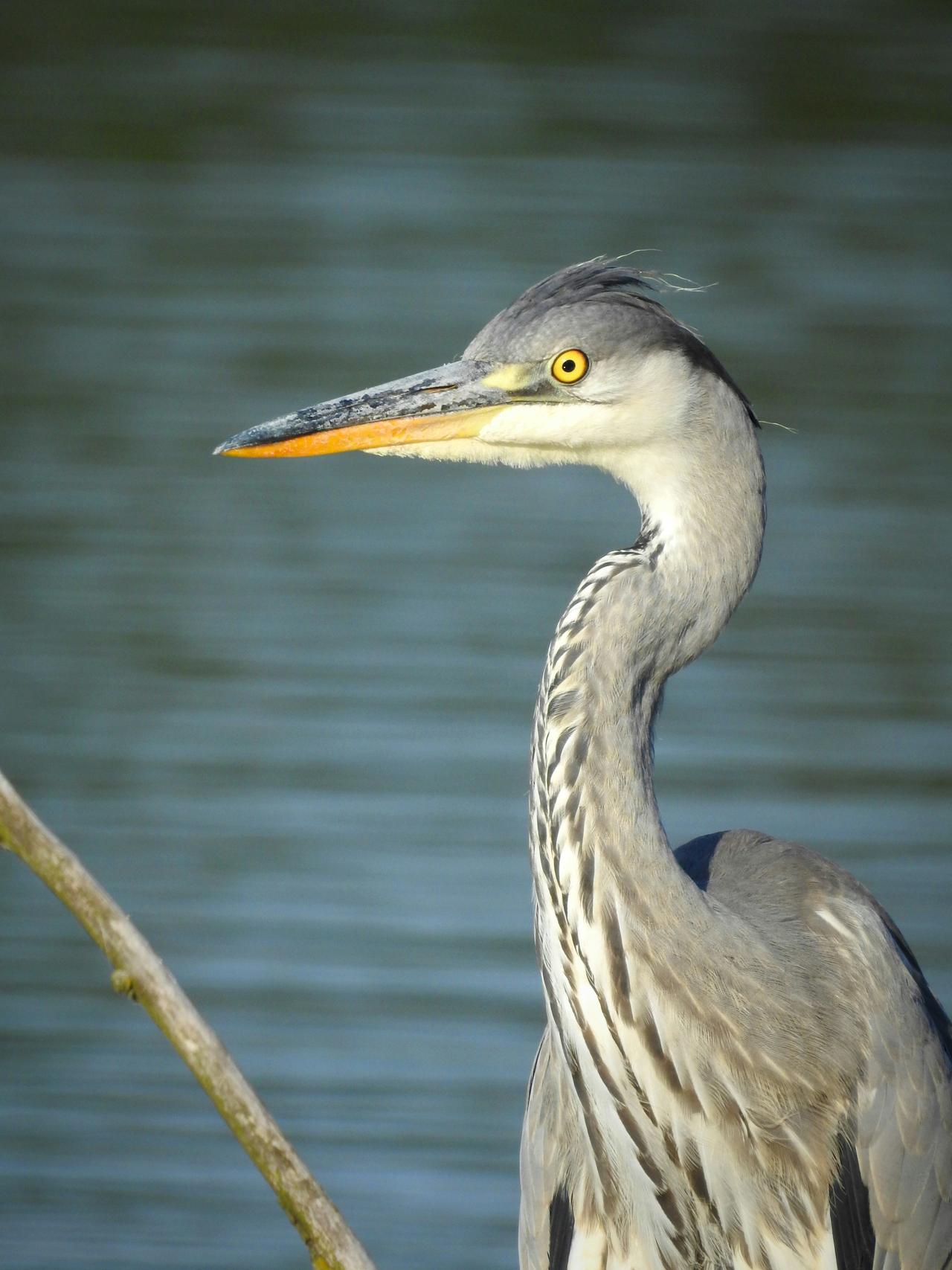
Grey Heron (Ardea cinerea) is a large bird species belonging to the heron family (Ardeidae), characterized by a long neck, long legs, and a robust build. It is typically recognized by its gray upper plumage and its ability to retract its neck. This species feeds in shallow waters, using its long, thick bill to catch fish, frogs, and other aquatic organisms.
The Grey Heron is a large bird species that stands out due to its size. Its body length typically ranges from 84 to 102 centimetres, with a wingspan of 155 to 175 centimetres. Its plumage is generally gray, with a darker gray back and lighter underparts. The head is white, with black extensions on the sides. The underwing is dark gray. The neck is long and can be curved into an S-shape, a characteristic feature of the species. The bill is long, straight, and pointed. The legs are long and slender. During the breeding season, the bill of some individuals turns orange and ornamental feathers become more prominent.
The Grey Heron (Ardea cinerea) is a species distributed across the Old World, breeding throughout Europe, Asia and North Africa. Its range covers the Afro-Palaearctic region. Individuals in northern regions migrate to sub-Saharan Africa and South and Southeast Asia during winter, while some populations are resident or partially migratory. In Türkiye, the Grey Heron can be observed throughout the country during winter months and migration periods. It breeds in all regions except the Mediterranean coast, Southeastern Anatolia and most of Eastern Anatolia.
The Grey Heron has a broad ecological tolerance in terms of habitat. It inhabits a variety of environments including lakes, rivers, streams and wetlands. It is also found along coastlines, tidal flats and seashores. It prefers shallow wetland areas for feeding and nesting. It can build nests in reed beds, shrubs and even at ground level.
The Grey Heron generally exhibits solitary behavior in both movement and feeding. However, it may gather in groups where food resources are abundant or when suitable habitat is limited. Its flight is slow and heavy. The species has a wide wingspan and exhibits slow but powerful wingbeats during flight. It can be observed at elevations up to 1,000 metres above sea level. Migration and movement patterns vary by population. Individuals in northern regions are migratory and move southward during winter, while southern populations are more sedentary or show short-distance dispersal. Migration typically begins in autumn with a return in spring.
The Grey Heron has a broad diet. Fish make up the majority of its food, but it also feeds on frogs, crustaceans, molluscs, crabs, aquatic insects and other invertebrates. It can also consume vertebrates such as snakes, small rodents and small birds. Plant material may also be part of its diet.
Its feeding behavior is mostly passive; it typically stands motionless at the water’s edge waiting for prey to approach, then captures it with a swift strike. Active methods such as slow walking, occasional running, swimming, diving and leaping into water are also used. It usually feeds alone and individuals defend their feeding territories, but it can also feed in groups under favorable conditions.
Daily feeding times vary; in some areas feeding peaks occur in the morning and evening, while in others it occurs at night or during twilight. Feeding in tidal zones is influenced by changes in water level. The species may forage up to 38 kilometres away from its colony.
The breeding season of the Grey Heron varies by region. In the Palaearctic region, breeding typically occurs between January and May. In temperate zones, breeding coincides mainly with spring and summer. In tropical regions, breeding is often linked to rainy seasons and may occur at different times of the year.
The species usually breeds in colonies. Colonies can range from a few nests to hundreds or even thousands of pairs, and are often mixed with other bird species. Nests are platform-like structures made of sticks, typically located in tall trees. However, they may also be built on the ground, in reed beds, on cliffs or on artificial structures. Nests are often reused by the same pair in subsequent years.
Females typically lay 3 to 7 eggs. Incubation lasts approximately 23 to 28 days. After hatching, the chicks are fed by both parents. The fledging period lasts about 42 to 55 days.
The Grey Heron (Ardea cinerea) is classified as “Least Concern (LC)” on the IUCN Red List. The species is not threatened at a global scale, primarily due to its wide distribution.
Nevertheless, in some regions, habitat alteration, degradation of wetlands, pollution and hunting may pose local threats.
All About Birds. "Gray Heron Life History." Cornell Lab of Ornithology. Accessed April 2026. https://www.allaboutbirds.org/guide/Gray_Heron/lifehistory
International Union for Conservation of Nature. “Ardea cinerea.” *The IUCN Red List of Threatened Species.* Accessed April 2026. https://www.iucnredlist.org/species/22696993/154525233
Kadava, Lukáš. “a close up of a bird on a branch near a body of water.” Unsplash. Accessed April 2026. https://unsplash.com/photos/a-close-up-of-a-bird-on-a-branch-near-a-body-of-water-WVxgsYC_Czc
ORNİTO. “Ardea cinerea (Gri Balıkçıl).” *Ornito.org.* Accessed March 19, 2026. https://ornito.org/Bird/Detail/189
eBird. "Ardea cinerea (Grey Heron)." eBird, Cornell Lab of Ornithology. Accessed March 19, 2026. https://ebird.org/species/graher1?siteLanguage=try

Family | Ardeidae | ||||||||
|---|---|---|---|---|---|---|---|---|---|
Conservation Status | LC - Least Concern (IUCN) | ||||||||
Incubation Period | 23-28 days | ||||||||
Wingspan | 155-175 cm | ||||||||
Subfamily | 84-102 cm | ||||||||
Class | Aves | ||||||||
Realm | Animalia | ||||||||
Genus | Ardea cinerea | ||||||||
Order | Chordata | ||||||||
No Discussion Added Yet
Start discussion for "Grey Heron (Ardea cinerea)" article
Morphological Characteristics
Distribution and Habitat
Behavior and Ecology
Diet
Breeding
Conservation Status