


This article was automatically translated from the original Turkish version.
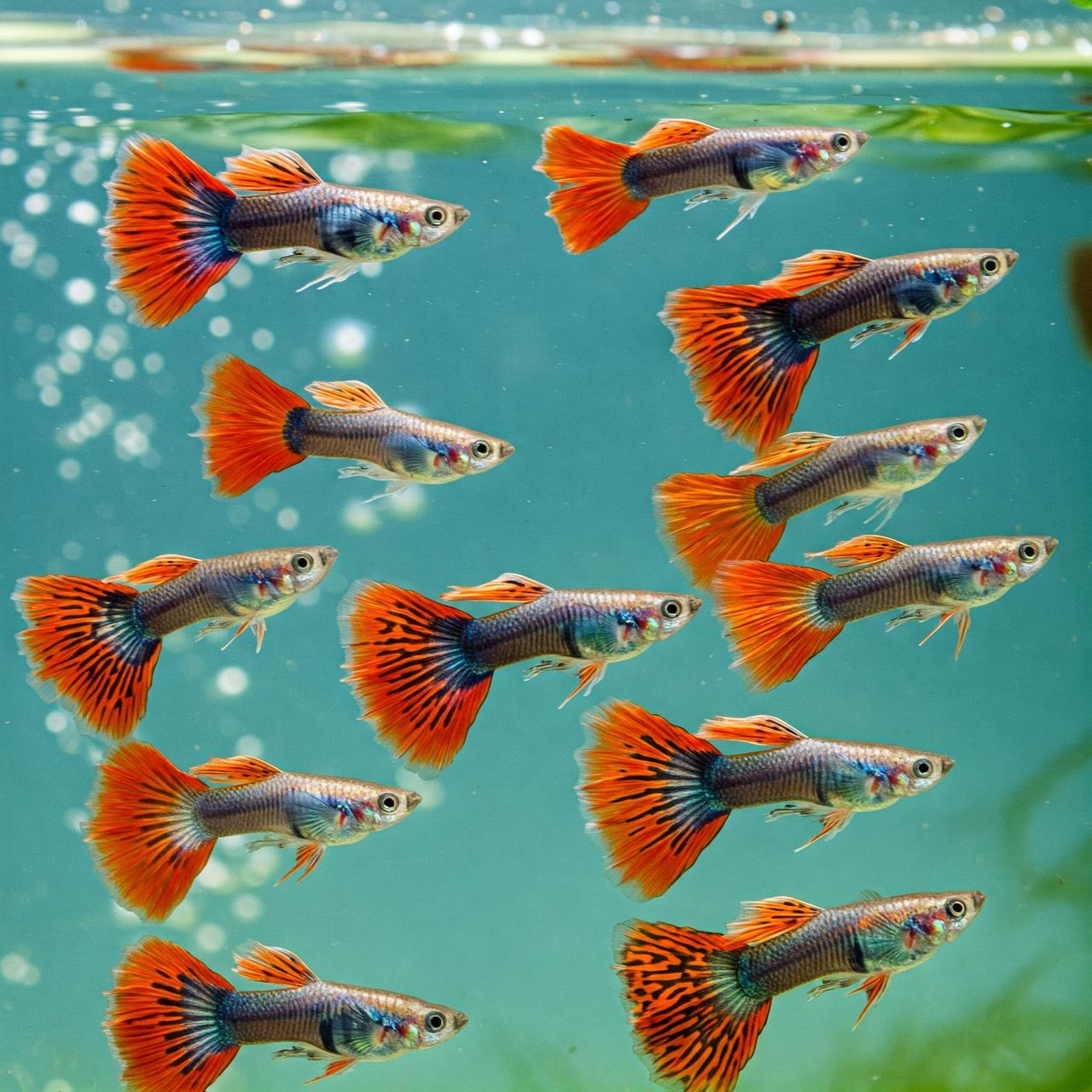
Guppy Fish
Type Name | Poecilia reticulata | ||||||||
|---|---|---|---|---|---|---|---|---|---|
Distribution(s) | Caribbean South America | ||||||||
Size(s) | Female: 4-6 cm Male: 2-3 cm | ||||||||
Lifespan | 2-3 years | ||||||||
Reproduction(s) | Ovoviviparous 20-40 offspring | ||||||||
Sexual Maturity | Female: 10-20 weeks Male: 7 weeks | ||||||||
Behavior | Lives in schools | ||||||||
Feeding | Omnivorous | ||||||||
Ecological Role | Vector control by consuming mosquito larvae | ||||||||
The guppy (Poecilia reticulata) is one of the most widespread and extensively studied freshwater species, originating from South America. Its use as a model organism in evolutionary biology and behavioral ecology renders it scientifically significant.
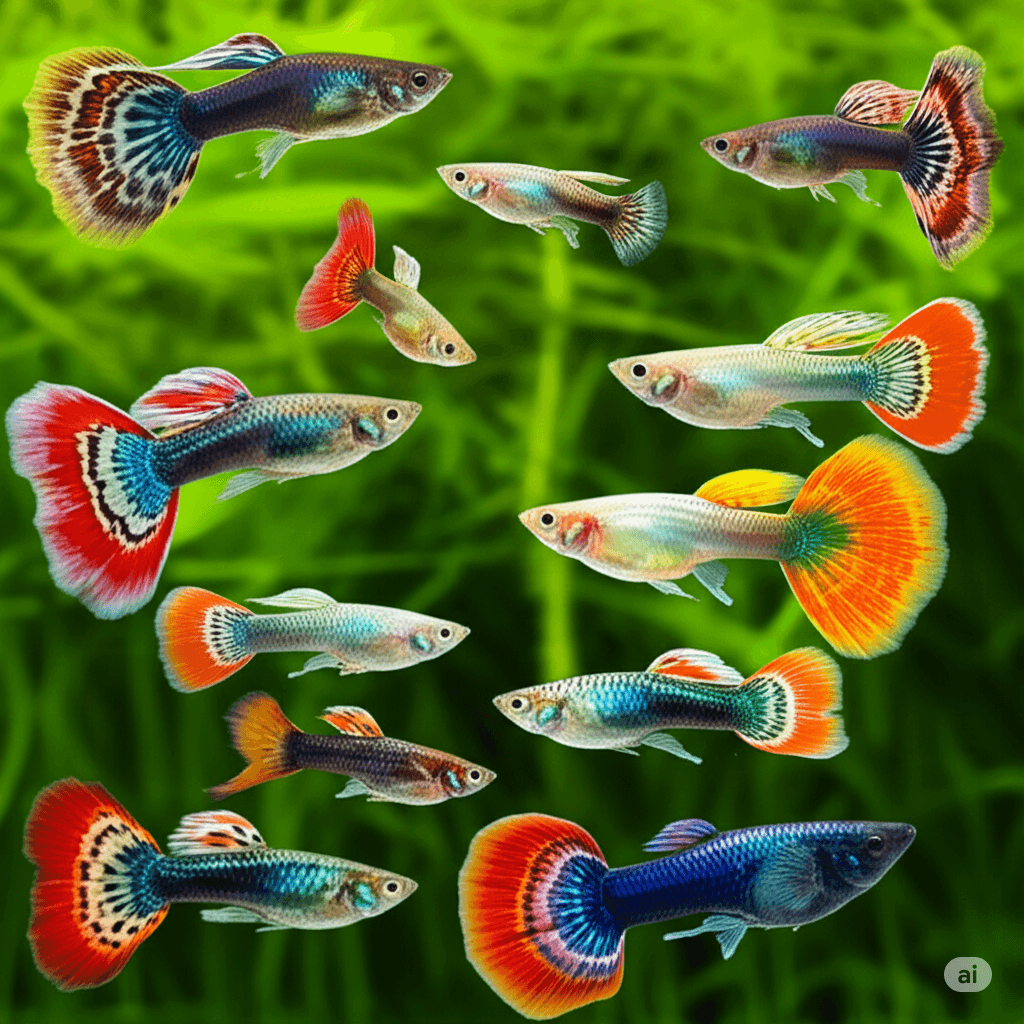
Male guppies(Generated by artificial intelligence)
Guppies exhibit sexual dimorphism【1】. Males are typically 2–3 cm in length and display vibrant colors and elongated caudal fins. Females are larger (4–6 cm) and have duller coloration. The male’s anal fin is modified into a structure called the gonopodium, which enables internal fertilization.
Guppies are ovoviviparous, meaning fertilized eggs develop inside the female’s body and are born as live young. Females can store sperm and produce multiple broods from a single mating. They may give birth to 20–40 fry every four weeks. Males reach reproductive maturity within seven weeks, while females do so between 10 and 20 weeks.
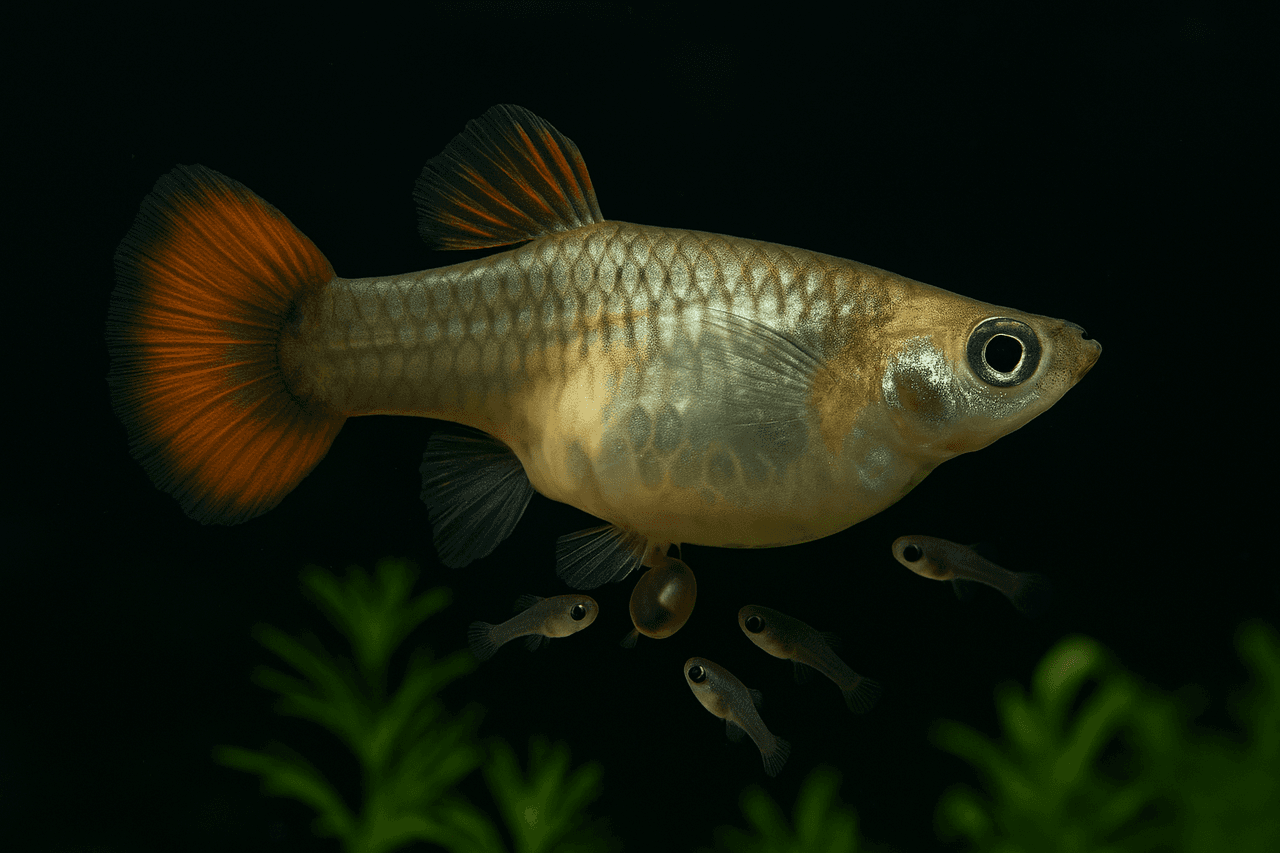
A pregnant guppy(Generated by artificial intelligence)
Guppies are social fish and typically live in schools. This behavior has evolved as a defense mechanism against predators【2】. Additionally, guppies have been observed to develop behavioral adaptations in response to environmental factors such as light intensity and predation pressure.
Due to their diet of mosquito larvae, guppies have been used in biological vector control. However, human-mediated introduction of this species into non-native ecosystems has disrupted ecological balances by exerting pressure on local species.
Guppies are widely used as model organisms in evolutionary biology research. Populations exposed to different levels of predation pressure show distinct life-history traits. For example, populations under high predation pressure mature earlier and produce more offspring.
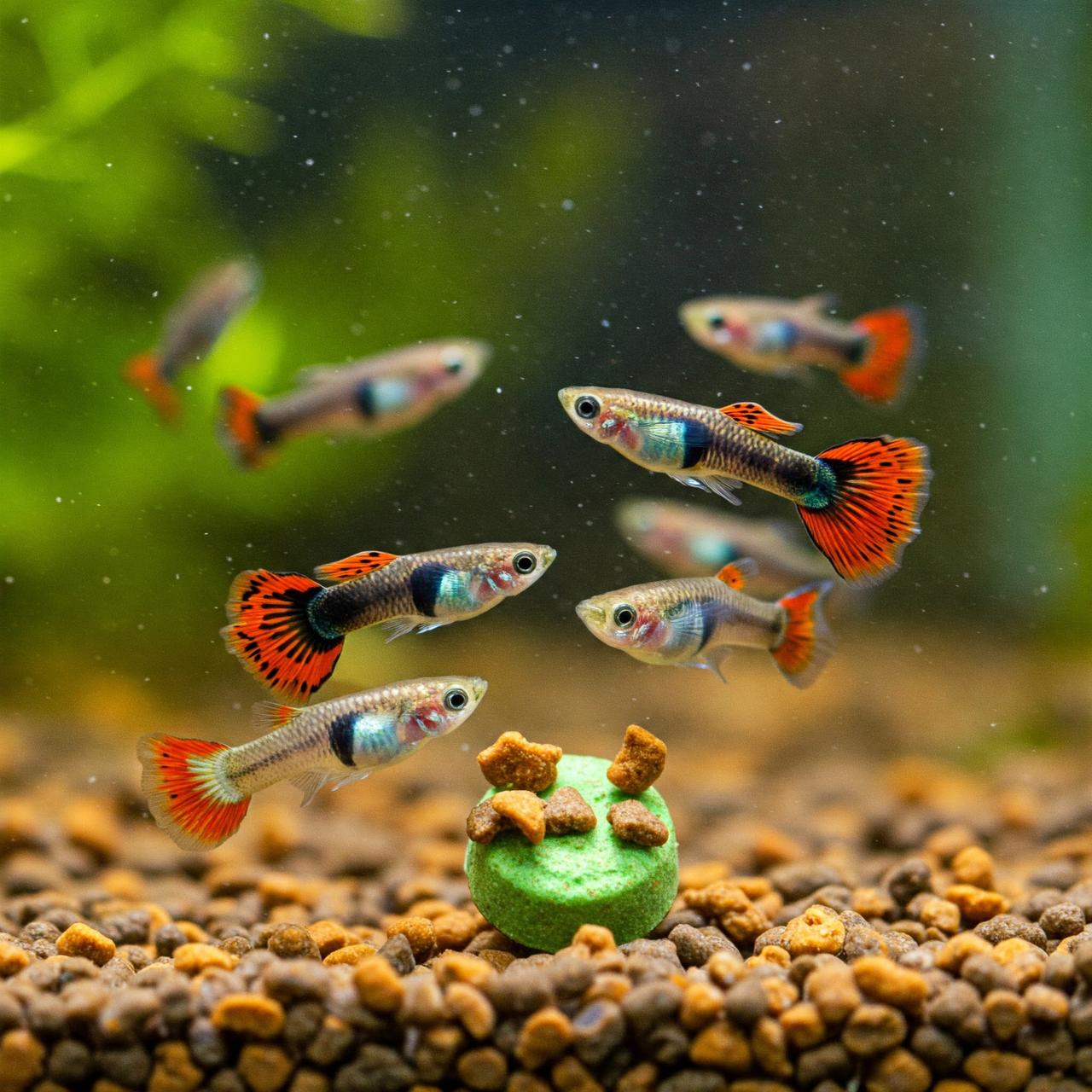
Young guppies(Generated with artificial intelligence support)
The guppy is an important species both for scientific research and aquarium hobbyists. Its morphological diversity, behavioral adaptations, and ecological roles make it an ideal model for study. However, its introduction by humans into non-native ecosystems can negatively impact ecological balances.
Deacon, Amy. (2023) "Poecilia Reticulata (Guppy)." CABI Compendium. https://www.cabidigitallibrary.org/doi/full/10.1079/cabicompendium.68208.
Khoo, G., Lim, T. M., Chan, W. K., & Phang, V. P. E. (1999). "Genetic Basis Of The Variegated Tail Pattern In The Guppy, Poecilia Reticulata." Zoological Science, 16(3), 431–437. https://bioone.org/journals/zoological-science/volume-16/issue-3/zsj.16.431/Genetic-Basis-of-the-Variegated-Tail-Pattern-in-the-Guppy/10.2108/zsj.16.431.full.
Reznick, D. N., Butler, M. J., Rodd, F. H., & Ross, P. (1996). "Life‐History Evolution In Guppies (Poecilia Reticulata) 6. Differential Mortality As A Mechanism For Natural Selection." Evolution, 50(4), 1651–1660. https://doi.org/10.1111/j.1558-5646.1996.tb03937.x.
Sasanami, M., Hustedt, J., Alexander, N., Horstick, O., Bowman, L., Hii, J., Echaubard, P., Braack, L., & Overgaard, H. J. (2021). "Does Anthropogenic Introduction Of Guppy Fish (Poecilia Reticulata) Impact Faunal Species Diversity And Abundance In Natural Aquatic Habitats? A Systematic Review Protocol." Environmental Evidence, 10(1). https://doi.org/10.1186/s13750-021-00248-6.
Soares, D., & Bierman, H. S. (2013). "Aerial Jumping In The Trinidadian Guppy (Poecilia Reticulata)." PLoS ONE, 8(4), e61617. https://doi.org/10.1371/journal.pone.0061617.
[1]
Cinsel dimorfizm, bir türde dişi ve erkek bireylerin dış görünüş, boyut, renk, şekil veya diğer fiziksel özellikler bakımından farklılık göstermesidir.
[2]
Diğer hayvanları, özellikle de diğer balıkları veya deniz canlılarını avlayarak beslenen balık türlerini ifade eder.

Guppy Fish
Type Name | Poecilia reticulata | ||||||||
|---|---|---|---|---|---|---|---|---|---|
Distribution(s) | Caribbean South America | ||||||||
Size(s) | Female: 4-6 cm Male: 2-3 cm | ||||||||
Lifespan | 2-3 years | ||||||||
Reproduction(s) | Ovoviviparous 20-40 offspring | ||||||||
Sexual Maturity | Female: 10-20 weeks Male: 7 weeks | ||||||||
Behavior | Lives in schools | ||||||||
Feeding | Omnivorous | ||||||||
Ecological Role | Vector control by consuming mosquito larvae | ||||||||
No Discussion Added Yet
Start discussion for "Guppy Fish (Poecilia reticulata)" article
Morphological Characteristics
Life Cycle and Reproduction
Behavioral Characteristics
Ecological Role and Distribution
Evolutionary Biology and Genetic Studies