

This article was automatically translated from the original Turkish version.
+1 More
Architect(s) | Moshe Safdie | ||||||||
|---|---|---|---|---|---|---|---|---|---|
Location | Montreal Canada | ||||||||
Style | Modular Design Brutalism | ||||||||
Heritage | National Heritage | ||||||||
Number of Floors | 12 Stories | ||||||||
Number of Units | 148 Dwellings | ||||||||
Opening | Expo 67 (World Fair) | ||||||||
Construction Year | 1967 | ||||||||
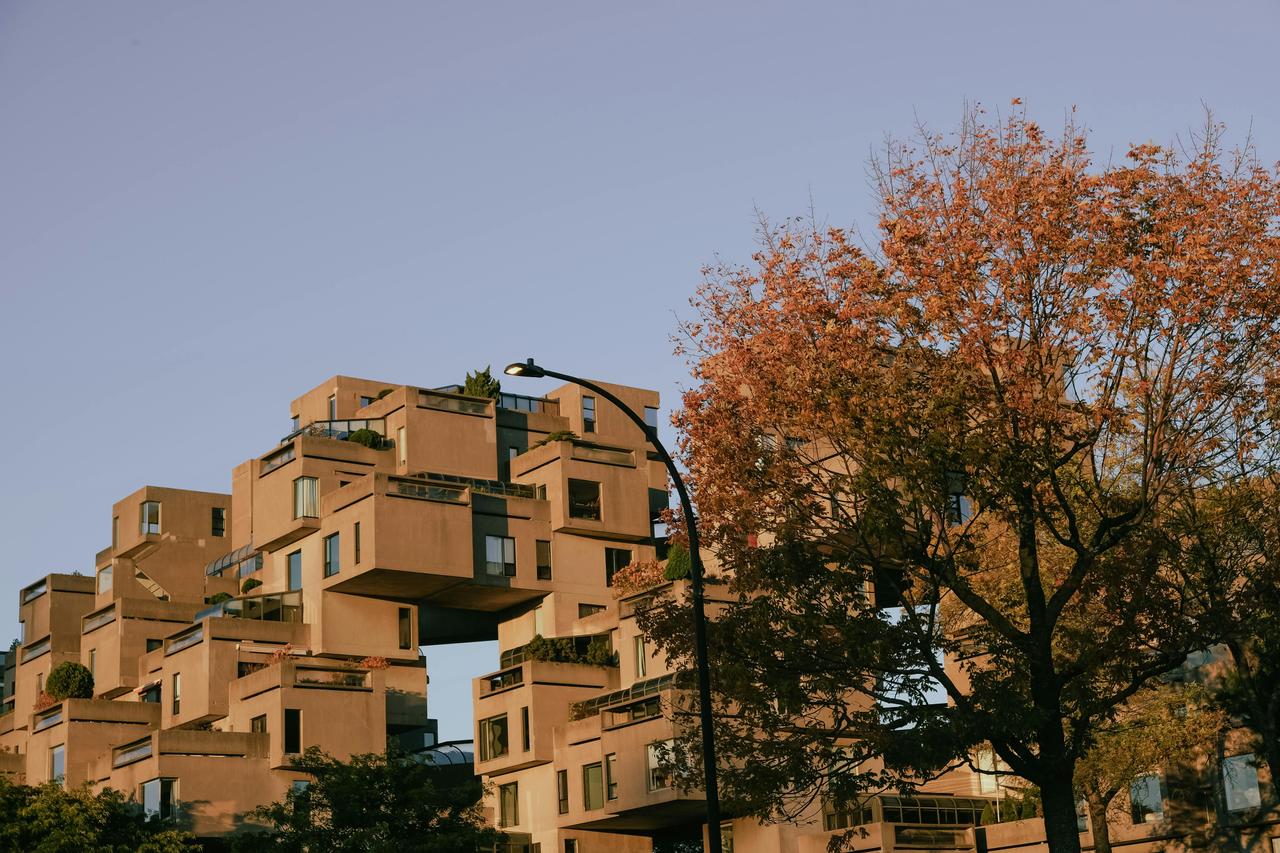
Habitat 67 is a modular housing complex designed and constructed in Montreal as part of Expo 67 by Moshe Safdie. The structure is formed by assembling prefabricated reinforced concrete units in a three-dimensional arrangement, aiming to combine high-density housing with individual residential qualities within a single system. Each dwelling is designed to provide open space, a terrace and natural light. The implemented project represents only a limited portion of a broader urban concept. In this respect, Habitat 67 occupies a unique position within discussions on modern residential architecture and industrialized building production.
Habitat 67 is located on the Cité du Havre peninsula along the banks of the Saint Lawrence River in Montreal, Canada. As part of the Expo 67 site, the structure extends in a north–south direction across a narrow plot surrounded by the harbor basin, transportation infrastructure and artificial shoreline modifications. This location provides the residential units with expansive views toward the river and harbor and enabled the development of an open, terrace-oriented layout that directly engages with the water.

Habitat 67 (Pexels)
Within the urban context, Habitat 67 constitutes a distinct group of buildings physically separated from Montreal’s traditional residential fabric, defined by its own internal spatial organization. Its position on the peninsula has limited its interaction with surrounding urban continuity; the settlement is shaped more by the residential units’ relationship with views, light and open space than by public life. The failure to implement the originally envisioned broader urban functions has constrained Habitat 67’s relationship with its surroundings and transformed the project into an independent architectural enclave.
The design process of Habitat 67 is based on a thesis project completed in 1961 by Canadian architect Moshe Safdie at McGill University. This work, developed as part of an exploration for a new residential model suited to high-density housing, was later adapted as a feasible proposal for Expo 67 in Montreal. The exposition’s central theme of “Habitat” provided the foundation for evaluating the project not merely as an exhibition structure but as an experimental model for housing production.
Initially, the project was planned as a larger-scale settlement incorporating housing, education, commercial and accommodation functions. It was envisioned to include approximately 1,200 residential units alongside additional public facilities. However, due to limited funding, the project was significantly scaled down and only a portion focused exclusively on housing was constructed. The completed Habitat 67, opened in 1967 as part of Expo 67, consisted of 148 residential units arranged within a 12-story structural framework.【1】
During this process, Habitat 67 emerged as a structure that represented only a fragment of the original holistic urban concept yet attracted international attention due to its original spatial and structural qualities. Although the realized form diverged from the initial comprehensive program, it was constructed as a permanent residential building within the temporary context of Expo 67.
The architectural design of Habitat 67 is based on a holistic approach to urban planning that integrates residential units through a modular logic. The structure was conceived to create an intermediate spatial order between individual dwellings and collective housing; its mass composition follows a terraced, stepped arrangement. This approach generates a three-dimensional residential layout while establishing the fundamental design framework that defines each unit’s relationship with open space, views and the environment.

Habitat 67 (Pixabay)
Habitat 67 employs a structural system based on the stacking of prefabricated concrete modules connected by high-strength steel cables. The modules typically feature walls five inches thick, though they are thickened up to twelve inches depending on their position. The structural system required a crane capable of lifting each module, which weighed between 70 and 90 tons, into place.【2】
The prefabricated modules were first cast with their floors, followed by their walls, with their upper sections produced separately. Concrete was compacted using vibration and cured with steam. During assembly, the modules were fixed together using connecting bolts and post-tensioning cables, integrating four-story clusters and circulation elements into the overall structure. This system necessitated precise coordination of all components to ensure the structural integrity of the entire Habitat 67 complex.
The dwellings in Habitat 67 are arranged across 12-story blocks using a modular system. The complex includes 15 different module types, each composed of combinations ranging from one to eight prefabricated cubes. Units are organized across one to four levels and offer living areas between 624 and 5,000 square feet. Each unit is equipped with views from three facades and landscaped terraces; private terrace areas range from 225 to 1,000 square feet.【3】
In addition to standard living areas such as living rooms, bedrooms, kitchens and bathrooms, units offer the option of adding a solarium. Six elevators support vertical circulation, and walkways at various levels are designed to facilitate access to the dwellings. Thanks to the modular design, the residences offer a unique spatial experience that integrates individual open spaces with shared living arrangements.

Habitat 67 (Flickr)
Habitat 67 is recognized as a pioneering example demonstrating the feasibility of modular and prefabricated building systems in modern residential architecture. Its design approach offers a way to balance high-density housing with individual quality of life within a single system. Furthermore, as an experimental housing model exhibited during Expo 67, the project has had significant theoretical and practical impacts on the architectural world. Habitat 67, which materialized the social and urban goals of modernist architecture, is internationally recognized as a reference for sustainable and high-density residential design in subsequent decades.
Arseneau, Mathias. "Fotoğraf." Pexels. Accessed February 4, 2026. https://www.pexels.com/tr-tr/fotograf/31379662/
ElBadri, Alaa. "Habitat 67." Academia.edu, pp. 1–32. Accessed February 4, 2026. https://www.academia.edu/5815365/Habitat_67?sm=b&rhid=37668463662
Finnsson, Ívar. "Habitat 67 Yaşam Alanı Montreal Görseli." Pixabay. Accessed February 4, 2026. https://pixabay.com/tr/photos/habitat-67-ya%c5%9fam-alan%c4%b1-montreal-2283537/
Fury, Maxwell. "Habitat 67 Montreal Apartman Görseli." Pixabay. Accessed February 4, 2026. https://pixabay.com/tr/photos/habitat-67-montreal-apartman-bina-3108642/
Hammond, Cynthia Imogen. "The (Human) Habitat: Humanism, Architecture, and Habitat 67/04." *Architecture and Identity*. (2008): 227–236. Accessed February 4, 2026. https://www.academia.edu/7697109/The_Human_Habitat_Humanism_Architecture_and_Habitat_67_04?sm=b&rhid=37668463662
Legault, Réjean. "The Making of Habitat 67: A Tense Pas de Deux between Moshe Safdie and August Komendant." *Journal of the Society for the Study of Architecture in Canada* 46, no. 1 (January 2021): 30–50. Accessed February 4, 2026. https://www.researchgate.net/publication/367841753_The_Making_of_Habitat_67_A_Tense_Pas_de_Deux_between_Moshe_Safdie_and_August_Komendant
Ly, Thanh. "Fotoğraf." Pexels. Accessed February 4, 2026. https://www.pexels.com/tr-tr/fotograf/bina-yapi-agaclar-mimari-9113612/
Mokry, Vladimir. "Habitat 67." Flickr. Accessed February 4, 2026. https://www.flickr.com/photos/vmokry/48083930087/
Safdie, Moshe. "Habitat '67 — Towards the Development of a Building System." *PCI Journal* 12, no. 1 (February 1967): 60–66. Accessed February 4, 2026. https://www.pci.org/PCI/Publications/PCI_Journal/Issues/1967/February/Habitat__67_-_Towards_the_Development_of_a_Building_System.aspx
Smith, Melissa. “Habitat 67: A Modernist Zeitgeist.” *Academia.edu*, pp. 1–17. Accessed February 4, 2026. https://www.academia.edu/82523733/Habitat_67_A_Modernist_Zeitgeist
Souza, Leonardo Prazeres Veloso de, and Ana Regina Mizrahy Cuperschmid. "HABITAT 67 — ENTRE A UTOPIA E A REALIDADE: O projeto enquanto patrimônio cultural arquitetônico." *II Seminário Prospecção em Bens Culturais.* (October 2025): 54–61. Accessed February 4, 2026. https://www.researchgate.net/publication/397627071_HABITAT_67_-ENTRE_A_UTOPIA_E_A_REALIDADE_O_projeto_enquanto_patrimonio_cultural_arquitetonico
[1]
Alaa ElBadri, “Habitat 67.”, Academia.edu, pp. 4–8, Last Access: 4 February 2026, https://www.academia.edu/5815365/Habitat_67?sm=b&rhid=37668463662
[2]
Réjean Legault, "The Making of Habitat 67: A Tense Pas de Deux between Moshe Safdie and August Komendant," Journal of the Society for the Study of Architecture in Canada 46, no. 1 (January 2021): 41, Last Access: 4 February 2026, https://www.researchgate.net/publication/367841753_The_Making_of_Habitat_67_A_Tense_Pas_de_Deux_between_Moshe_Safdie_and_August_Komendant
[3]
Alaa ElBadri, “Habitat 67.”, Academia.edu, p. 6, Last Access: 4 February 2026, https://www.academia.edu/5815365/Habitat_67?sm=b&rhid=37668463662

Architect(s) | Moshe Safdie | ||||||||
|---|---|---|---|---|---|---|---|---|---|
Location | Montreal Canada | ||||||||
Style | Modular Design Brutalism | ||||||||
Heritage | National Heritage | ||||||||
Number of Floors | 12 Stories | ||||||||
Number of Units | 148 Dwellings | ||||||||
Opening | Expo 67 (World Fair) | ||||||||
Construction Year | 1967 | ||||||||
Location and Urban Context
Historical Process
Architectural Design
Structural System
Residential Features
Place in Architectural History