This article was automatically translated from the original Turkish version.
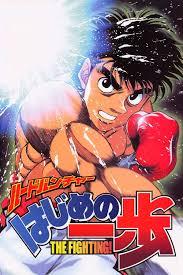
Hajime no Ippo is a sports manga series written and illustrated by Japanese boxer and manga artist George Morikawa. The series began serialization on 11 October 1989 under the publishing umbrella of Weekly Shōnen Magazine by Kodansha.
Physical print editions of the manga are published by Kodansha in tankōbon format. As of 2024, the series has surpassed 140 volumes and is among the longest-running manga productions in Japan.
The publication of the work has continued uninterrupted for over thirty years. During this period, the manga has been adapted into various anime television series, television films, original video animations (OVAs), and video games. In Western countries, the series has also been licensed under the title The Fighting! in some regions.
Hajime no Ippo is set in modern Japan, spanning a time period from the late 1980s to the present. The fictional center of the story is the Kamogawa Boxing Gym located in Tokyo. The narrative is built upon the hierarchical structure of the professional boxing world, training methodologies, and competition regulations.
The boxing universe in the series is grounded in real-world professional boxing organizations. Within this framework, institutions such as the Japan Boxing Commission (JBC), World Boxing Council (WBC), and World Boxing Association (WBA) play active roles. Characters compete in weight classes defined by these organizations—such as featherweight and lightweight—and climb the official rankings accordingly.
At the technical level, the fiction incorporates the physical and strategic elements of boxing. Character development is portrayed through realistic training routines such as road running, pad work, shadowboxing, and sparring. Additionally, the fictional universe includes detailed mechanical analyses of real boxing techniques such as the Peek-a-Boo style, the Dempsey Roll, and the Flicker Jab.
Hajime no Ippo follows the journey of Ippo Makunouchi, a shy high school student, as he enters the world of professional boxing and ascends its competitive ranks. The story begins when Ippo, who spends most of his time helping his mother’s fishmonger business and consequently suffers bullying in his social circle, meets the professional boxer Mamoru Takamura.
After being rescued by Takamura from an attack, Ippo is taken to the Kamogawa Boxing Gym. During initial trials, his innate punching power and durability are recognized. The central motivation of the character throughout the narrative is to discover what it truly means to be strong through boxing.
The plot progression, beginning with Ippo’s acquisition of a professional license, encompasses the following stages:
The narrative chronologically presents the protagonist’s training methodologies, professional rivalries, and strategic preparation phases preceding each match.
Hajime no Ippo lists the main characters of the series and the voice actors (seiyū) who portray them in anime adaptations:
Hajime no Ippo structures its narrative around the technical, psychological, and physical dimensions of boxing. Key themes and narrative techniques employed in the series include:
Accessed November 26, 2025. https://www.aa.com.tr/tr/kultur/ahlatta-acilan-kurslarla-geleneksel-tas-isciligi-yasatiliyor/3116279.
Accessed November 26, 2025. https://www.aa.com.tr/tr/kultur/ahlatta-acilan-kurslarla-geleneksel-tas-isciligi-yasatiliyor/3116279.
Accessed November 26, 2025. https://www.aa.com.tr/tr/kultur/ahlatta-acilan-kurslarla-geleneksel-tas-isciligi-yasatiliyor/3116279.
Accessed November 26, 2025. https://www.aa.com.tr/tr/kultur/ahlatta-acilan-kurslarla-geleneksel-tas-isciligi-yasatiliyor/3116279.
IMDb. "Hajime no Ippo (TV Series 2000–2002) - Episode List." Accessed April 27, 2026.
IMDb. "Hajime no Ippo (TV Series 2000–2002) - Parents Guide." Accessed April 27, 2026.
IMDb. "Hajime no Ippo (TV Series 2000–2002) - Plot Summary." Accessed April 27, 2026.
IMDb. "Hajime no Ippo (TV Series 2000–2002)." Accessed April 27, 2026.
IMDb. "Hajime no Ippo - All Anime (Series, Movies, OVAs & Specials)." User list. Accessed April 27, 2026.
IMDb. "Hajime no Ippo: New Challenger (TV Series 2009)." Accessed April 27, 2026.
IMDb. "Hajime no Ippo: Rising (TV Series 2013–2014)." Accessed April 27, 2026.
Jack X. "Hajime no Ippo - Trailer/AMV - The Boxing Program [HD]." YouTube video, 1:33. July 10, 2015.
https://www.imdb.com/list/ls527163530/
https://www.imdb.com/title/tt0481256/episodes/
https://www.imdb.com/title/tt0481256/plotsummary/
https://www.imdb.com/title/tt3514596/

No Discussion Added Yet
Start discussion for "Hajime no Ippo (Series)" article
Universe and Fiction
Plot
Main Characters and Voice Actors
Themes and Narrative Style